Search results for: photography buying guide softboxes what you need know
About 12 filtered results
by Mathew Malwitz · Posted
Who doesn’t want to capture fun and creative portraits of our four-legged friends? We know we love it. In fact, pet photography may just be the most popular form of photography there is. Think of all the smartphone snaps of yawns, big stretches, and funny moments we all take of our cats, dogs, chinchillas, and beyond.
Quick snaps aside, you know what really ups the quality of our pet portraits? Lighting. Just as with any form of portrait, lighting unlocks possibilities that can be impossible without it. But what lighting system should we use?

by Rebecca Melville · Posted
An on-camera flash is an indispensable accessory for many photographers. While it provides light to supplement dark conditions, an on-camera flash also allows you to achieve more balanced exposures in daylight conditions, permits freezing of fast-moving subjects, and can even be used to control other flash light sources. With so much to offer, an on-camera flash can become an integral part of your workflow, but where do you start? We are going to give you the on-camera flash rundown with everything you need to know to make the most of this

by Mathew Malwitz · Posted
Family portraits are a great way to capture a moment in your family’s history. You may find yourself wanting to capture family photos every few years or so, more often when the little ones are, well, little. Maybe you’re looking for a way to take matters into your own hands, or maybe you’ve been taking your own family photos for years and have found yourself being asked to take photos of friends, family members, or even paying clients.
Family portraits can be a lot of fun to shoot. Maybe you’ve been taking photos of your kids and want to

by Shawn C. Steiner · Posted
After you pick up your first speedlight, strobe, or LED panel, the best investment you can make is in some modifiers. These are tools that shape and alter the intensity of our light source. Modifiers come in all shapes and sizes based on the type of light you plan to use them on, which can make it difficult to pick one out if you are new to photography. Since each modifier comes with its own distinct look and ideal use, here is a

by Cory Rice · Posted
The equipment used by fashion photographers varies considerably, depending on what is being photographed and who is behind the camera. In general, the kit requirements for documenting a fashion show are more standardized than those for creating editorials. There are successful fashion photographers who can fit all of their gear in a single bag—and others who require an entire equipment truck. This article is aimed at photographers getting started with fashion productions. Photographers interested in capturing runway should read Theanos Nikitas

by Todd Vorenkamp · Posted
When wedding, portrait, and event photos are required outside of the studio, you often need to bring portable lighting kits. As we all know, houses of worship and event spaces are rarely lighting friendly to the wedding shooter and portrait photographer. While we all wish we had enough hired help to lug full-sized lights and heavy C-stands to our locations, portable light kits help photographers get the shots their clients demand without requiring pack

by Mary Latvis · Posted
Welcome to Filmmaking 101, where we offer some tips on how to go about creating your movie masterpiece. Read on to discover suggestions for your pre-production, production, and post-production phases.
Pre-Production
Scriptwriting
You have your idea for an arthouse masterpiece or an action-based blockbuster; now how do you translate that into a script―the backbone of your production? You can use MS Word, Google Docs, or another document program. But using dedicated screenwriting software provides the standard formatting, outline tools,

by Cory Rice · Posted
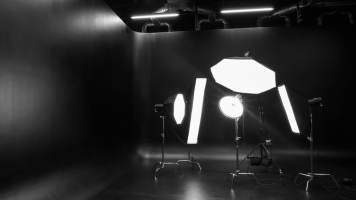
Subject and style may vary, but consistency is a quality shared by all successful photo studios. When working indoors, that begins with lighting. Strobes remain the bread and butter of many still photography studios. Unlike natural light, which can be finicky and unpredictable; on-camera flashes, which are not typically designed for studio use; or continuous lights, which can become costly as output increases; strobes are
by Cory Rice · Posted
One of the leading trends in digital cameras over the past few years has been the development of advanced video capabilities in mirrorless and DSLR cameras. Features that could once only be found in costly cinema cameras now come standard in still cameras targeted toward hybrid photo-video content creators. Accompanying the interest in cameras able to create high-quality stills and videos has come a demand for lights that can be used for both purposes.
While on-camera flashes and strobes have long been the standard for photographers, the short

by Todd Vorenkamp · Posted
Hey, the holidays are here! Is it the the 11th hour yet? Are you like me (and many others), who cannot figure out what photography-related gifts and stocking stuffers to get for all but your closest friends, family members, favorite shutterbugs, and romantic partners? Well, here are a few ideas—including many that will fit in your favorite person’s stocking—for those with the dreaded gift-giving block. These aren’t just my ideas, some of my colleagues at B&H told me what was on their last-minute wish lists, as well!
1. Keep Those Hands

by tom kirkman · Posted
A softbox is an enclosure designed to fit around an artificial light source, such as a flash tube or halogen lamp. Its reflective interior intensifies the light output and projects it through its only means of escape—the front diffusion screen. This creates a quality of light long appreciated by photographers and videographers, which resembles the softer light one might find streaming through a window. It also creates square or rectangular highlights in the reflective surfaces of your subjects. The "soft" name stuck because of the quality of

by Richard Scali · Posted
The word “photography” literally means “to draw with light” and is a simple way of expressing how essential light is to our craft. At times, however, natural light can be a scarce commodity and thus, it falls upon the photographer to create it. Fast-forwarding through the days of flash powder and disposable bulbs, we arrive at the modern day, an exciting time for “strobists,” when a plethora of compact options exists for creating and shaping light. Below, we’ll review some of the classic, essential, and innovative accessories for the