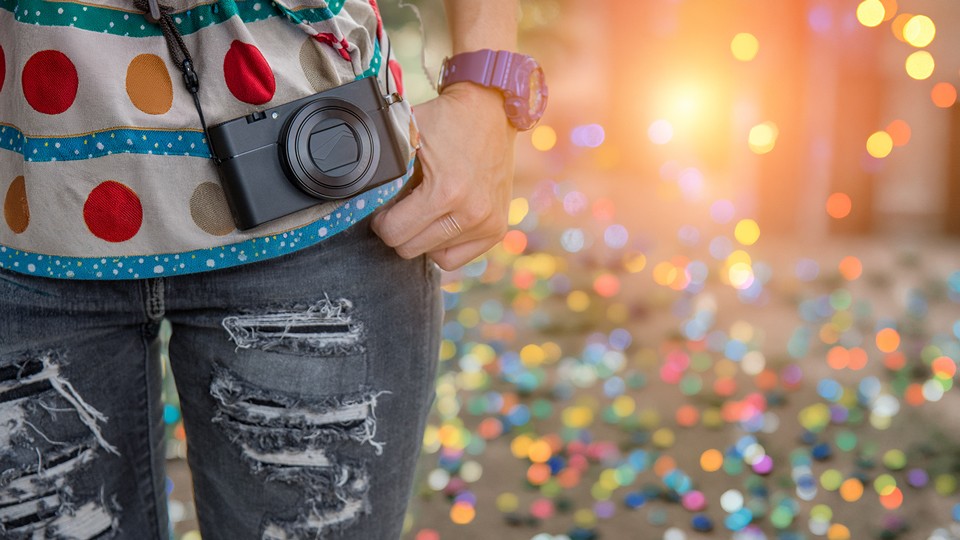
Whether you’re the designated photographer at a friend’s night out or a professional working an event, a compact, point-and-shoot camera can be a strategic choice for creating a distinctive look for your images. Depending on where you’re starting, the move to a compact camera can be either a step up from the smartphone or an embrace of a more limited feature set. In either case, the best event and party photography with a compact camera says one thing: you had to be there.

The number one advantage to using a compact camera is social. The discreet, diminutive form factor keeps party and eventgoers at ease when it’s out, keeping their walls down and the fun flowing. It feels less “official” and more like memory-making.
The small size and optical constraints tend to encourage physical closeness as well. The wide and normal length lenses featured in most compact cameras demand the photographer be a part of the action and not separate. No wallflower-sniping here! That proximity translates to a greater degree of presence in the resultant images, putting the viewer at the center of the party.
While there are constraints implied in the use of a compact camera, the upshot is that the constraints create cohesion in your images. For that reason, the choice of camera can have a more outsized effect than with a smartphone or interchangeable lens camera. It’s beneficial to choose a camera with the final look in mind, whether that be lo-fi, nostalgic, documentary, or paparazzi.
No matter what style you choose, event and party photography with a compact camera is going to include flash. This is a primary reason people upgrade from the smartphone, whose LED flash offers none of the direct brilliance so characteristic of the best party photography: bright foreground subjects, darkened background, sharp expressions, saturated colors, and a candid snapshot quality.

Since party and event photography is so portrait and gesture-driven, mastering flash can be the difference between muddy, useless images and ones that scream FOMO. Luckily, the technique behind effective flash for party and event photography is relatively straightforward.
Exposure for flash photography can be easily conceptualized as a composite of two exposures, flash and ambient. Flash exposure generally applies to the brightness of the subject, while ambient exposure applies to the background, room, and other adjacent objects.
Here’s a quick, down-and-dirty settings cheat sheet for how settings shake out for party flash with a compact camera:
- Shutter Speed: controls ambient light and motion blur.
- Aperture: affects flash exposure, depth of field, and ambient exposure.
- ISO: affects both flash and ambient exposure.
- Flash Exposure Compensation: adjusts flash brightness.
- Exposure Compensation: generally adjusts the camera’s metered ambient exposure, though behavior varies by camera and mode.
The distinction between flash exposure compensation and exposure compensation deserves an extra moment, as they’re often confused. Exposure compensation changes the camera’s metered exposure, which, in available light shooting, makes the whole image darker. However, when used with flash, its effect is more specific to the ambient part of the image. The flash exposure compensation setting, by contrast, changes the power of the flash output, which in turn affects the amount of light received by the subject.
In general, you can’t go wrong with setting the camera at ISO 800, f/2.8 aperture, and putting the camera in Program (P) mode. Your attention should be out of your camera and in the room, enjoying the ambiance as much as you’re scanning it for potential images. However, there are some distinctive flash effects that can add to the party character of the image beyond just direct flash.

Most popular is the dance floor, light-trails effect, achieved with a slow shutter speed and rear-curtain sync, if available. Rear curtain sync tells the camera to fire the flash when the shutter closes instead of when it opens. When combined with a slow shutter speed, this gives bodies, lights, and other objects a visible trail of movement before they’re frozen in light by the flash.
The other, perhaps less visually distinctive effects pertain to the relative brightness of the background. For some shooters, the goal is to cast the background in near-complete darkness, thereby eliminating distractive elements. To accomplish this, set the shutter speed as high as the flash sync allows, typically anywhere at or above 1/200s. Others may wish to preserve the ambient lighting as much as possible and reduce the obvious use of flash. There won’t be an exact shutter speed that corresponds to this effect, but the idea is to keep it as low as possible without introducing camera shake.
It’s important to remember that as critical as flash is to an event or party photograph, it has a direct and assertive social component. It changes moments, interrupts them, and announces itself to the subject that this is a moment to be preserved. Flash etiquette is real, even if it’s as basic as asking unwitting partygoers for permission before shooting and respecting their declines.
Another important, if overlooked, setting to consider when shooting party and event photography is white balance. The varying light sources at an event, including your flash, each have their own different color cast that will affect the final image. Clashing color casts can contribute to the “being there” of a party, but they can also muddle the photo.

Auto white balance is easy and generally effective, but with random variance. Flash white balance keeps color consistent in the flash zone but will warm ambient lights and backgrounds. Consider using daylight balance to strike a balance between flash and the ambient light.
Compact cameras have a long history of use in nightlife, fashion parties, gallery openings, backstage environments, music events, underground spaces, downtown social scenes, and social documentary work. They’re so effective in these contexts because their unintimidating profile combines access with informality. Compact, point-and-shoot cameras put people at ease for photos when the setting wants intimacy. They get close to the action, showing not just who was there but what it felt like to be there.
To learn more about all things photography, from point and shoots to larger, full sized mirrorless cameras, check out our other guides on the B&H Explora page.
