Digital Cameras
Explore digital cameras for every skill level, with expert guidance, key features, and options for any style


Canon EOS 5D Mark IV DSLR Camera (Body Only)
- 30.4MP Full-Frame CMOS Sensor
- DIGIC 6+ Image Processor
- 3.2" 1.62m-Dot Touchscreen LCD Monitor
- DCI 4K Video at 30 fps; 8.8MP Still Grab
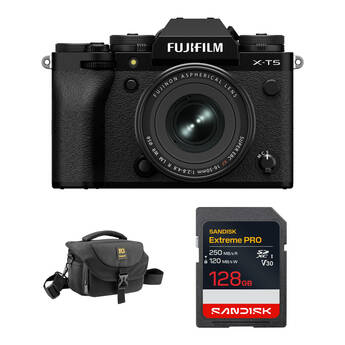
FUJIFILM X-T5 Mirrorless Camera with 16-50mm f/2.8-4.8 Lens and Basic Bundle (Black)
- Basic Accessories to Start Shooting
- Camera Bag and Memory Card
- XF 16-50mm f/2.8-4.8 R LM WR Lens
- 40MP APS-C X-Trans CMOS 5 HR BSI Sensor
Canon EOS R6 Mark II Mirrorless Camera with 24-105mm f/4 Lens
- 24.2MP Full-Frame CMOS Sensor
- 4K60 10-Bit Internal Video, C-Log 3
- External 6K ProRes RAW Recording
- Dual Pixel CMOS AF II
Sony a7R VI Mirrorless Camera with Basic Bundle
- Basic Accessories to Start Shooting
- Memory Card & Carry Bag
- 66.8MP FF Stacked Exmor RS BSI Sensor
- 30 fps Shooting with AF/AE & Pre-Capture
OM SYSTEM PEN Mirrorless Camera with 14-42mm III and 40-150mm R Lenses (Silver)
- 20.4MP Micro Four Thirds Live MOS Sensor
- TruePic IX Image Processor
- 5-Axis In-Body Image Stabilization
- Up to 30 fps RAW & JPEG Burst Shooting
Nikon Z50 II Mirrorless Camera with 18-140mm f/3.5-6.3 Lens and Basic Bundle
- Basic Accessories to Start Shooting
- Bag & Memory Card
- NIKKOR Z DX 18-140mm f/3.5-6.3 VR Lens
- 20.9MP DX-Format CMOS Sensor
Panasonic LUMIX S1 II Mirrorless Camera
- 24.1MP Partially Stacked CMOS Sensor
- 5.1K 60p Open Gate Recording
- High-Resolution Mode for 96MP Images
- 8.0-Stop 5-Axis I.S. Technology
Nikon Z8 Mirrorless Camera with 24-120mm f/4 Lens and Basic Bundle
- Basic Accessories to Start Shooting
- Bag and Memory Card
- NIKKOR Z 24-120mm f/4 S Lens
- 45.7MP FX-Format Stacked CMOS Sensor
Canon EOS R100 Mirrorless Camera with 18-45mm and 75-300mm Lenses
- 24.2MP APS-C CMOS Sensor
- DIGIC 8 Image Processor
- 4K 24p Video with Crop, Full HD 60p
- Dual Pixel CMOS AF with 143 AF Zones
Canon EOS R8 Mirrorless Camera with RF 24-50mm f/4.5-6.3 IS STM Lens
- 24.2MP Full-Frame CMOS Sensor
- 4K60p 10-Bit Internal Video, C-Log 3
- Dual Pixel CMOS AF II
- 2.36m-Dot Electronic Viewfinder
FUJIFILM X-T50 Mirrorless Camera with 15-45mm f/3.5-5.6 Lens and Basic Bundle (Charcoal Silver)
- Basic Accessories to Start Shooting
- Bag and Memory card
- XC 15-45mm f/3.5-5.6 OIS PZ Lens
- 40.2MP APS-C X-Trans CMOS 5 HR Sensor
OM SYSTEM OM-1 Mark II Mirrorless Camera (Body Only)
- 20MP Stacked BSI Live MOS MFT Sensor
- DCI/UHD 4K 60p 12-Bit Video Recording
- 10 fps Shooting, 120 fps with E. Shutter
- Cross Quad Pixel Phase-Detection AF
Nikon Z6 III Mirrorless Camera with FTZ II Mount Adapter and Basic Bundle
- Basic Accessories to Start Shooting
- Bag and Memory Card
- FTZ II Mount Adapter
- 24.5MP Partially-Stacked CMOS Sensor
Ricoh THETA X 360° Camera
- Image Stabilization, Real-Time Stitching
- 2.25" Touchscreen for Preview & Control
- 360° 5760x2880 5.7K30 Video
- Swappable Batteries & MicroSDXC Cards
Canon EOS R50 V Mirrorless Camera with 14-30mm f/4-6.3 Lens
- For Content Creators and Vloggers
- 24.2MP APS-C CMOS Sensor
- DIGIC X Image Processor
- UHD 4K60p Cropped, 4K30 6K Oversampled
FUJIFILM X-T30 III Mirrorless Camera (Charcoal Silver)
- 26.1MP APS-C X-Trans CMOS 4 Sensor
- X-Processor 5 Image Processor
- 6.2K/30p, 4K/60p & FHD/240p Video
- Configurable Film Simulation Dial
Nikon D7500 DSLR Camera with 18-140mm Lens
- 20.9MP DX-Format CMOS Sensor
- EXPEED 5 Image Processor
- 3.2" 922k-Dot Tilting Touchscreen LCD
- 4K UHD Video Recording at 30 fps
Sony a7 III Mirrorless Camera with 28-70mm f/3.5-5.6 Lens and Basic Bundle
- Basic Accessories to Start Shooting
- Bag and Memory Card
- FE 28-70mm f/3.5-5.6 OSS Lens
- 24MP Full-Frame Exmor R BSI CMOS Sensor
Ricoh GR IV Monochrome Digital Camera
- B&W-Only Recording; No Color Array
- Built-In Red Contrast Filter
- 25.7MP APS-C BSI CMOS Sensor
- New 28mm f/2.8 Lens (Full-Frame Equiv.)
Yashica Funtastic Key Chain Camera (Classic Hello Kitty)
- Tiny Y2K-Inspired Digital Camera
- 1MP 1/4" CMOS Sensor
- 35mm Equivalent f/2.8 Lens
- 1440 x 1080 30 fps AVI Video Recording
Kodak PIXPRO FZ55 Digital Camera with Complete Starter Bundle (Blue)
- 16MP 1/2.3" CMOS Sensor
- 5x Optical Zoom Lens
- 2.7" LCD Screen
- Digital Image Stabilization
FUJIFILM instax WIDE EVO Hybrid Instant Film Camera with Film Starter Pack (10 Exposures)
- Hybrid Digital/Instant Film Camera
- Accepts instax WIDE Instant Film
- 16MP Sensor, Fixed 16mm f/2.4 Lens
- 10 Lens Effects and 10 Film Effects
Sony a6400 Mirrorless Camera with 16-50mm f/3.5-5.6 II Lens and Basic Bundle
- Basic Accessories to Start Shooting
- Bag, Battery & Memory Card
- E PZ 16-50mm f/3.5-5.6 OSS II Lens
- 24.2MP APS-C Exmor CMOS Sensor
Nikon Z8 Mirrorless Camera with Basic Bundle
- Basic Accessories to Start Shooting
- Bag and Memory Card
- 45.7MP FX-Format Stacked CMOS Sensor
- Lightweight Design, 30% Smaller than Z9
FUJIFILM X-T30 III Mirrorless Camera with 13-33mm f/3.5-6.3 Lens (Charcoal Silver)
- 26.1MP APS-C X-Trans CMOS 4 Sensor
- X-Processor 5 Image Processor
- 6.2K/30p, 4K/60p & FHD/240p Video
- Configurable Film Simulation Dial
Camp Snap 2 Screen-Free Digital Camera (Strawberry Splash)
- Take 500 Photos per Charge
- In-Camera LED Flash
- Extra-Slim Design
- 8MP Sensor
FUJIFILM X-S20 Mirrorless Camera
- 26.1MP APS-C X-Trans BSI CMOS 4 Sensor
- X-Processor 5 Image Processor
- 5-Axis In-Body Image Stabilization
- 6.2K at 30 fps, 4K at 60 fps
Nikon Z8 Mirrorless Camera with 180-600mm f/5.6-6.3 Lens
- 45.7MP FX-Format Stacked CMOS Sensor
- Lightweight Design, 30% Smaller than Z9
- 8.3K 60p N-RAW, 4.1K 60p ProRes RAW
- 8K30p and 4K120p Video, 10-Bit Internal
Digital Camera Buying Guide
B&H Photo has been a staple in the photography and videography businesses since it was founded in 1973. Though we service more industries today, cameras remain the lifeblood of our business. We sell a wide variety of digital cameras from all the top brands like Canon, Nikon, Sony, Panasonic, Fujifilm, Pentax, Leica, Samsung, and more. Digital camera types include Digital SLR cameras (DSLR), Mirrorless System cameras, Point-and-Shoot cameras, Medium Format cameras, camera bundles and more. Read below to find out which camera type best suits your needs.
Types of Digital Cameras
DSLR (digital single-lens reflex) cameras largely replaced film-based SLRs during the 2000s. DSLRs are the most advanced and versatile cameras available to consumers today. They give you the most control over how your pictures are taken, and are thus meant for more serious amateur photographers and professionals. DSLRs allow you complete control over exposure settings, including aperture priority, shutter priority, and various program modes. Their fast autofocus produces great shots when shooting fast-moving subjects or scenes. They also utilize an interchangeable lens system, enabling photographers to use the most appropriate lens for whatever they are shooting. Finally, DSLRs have large sensors, which generally produce higher-quality images. Learn More About DSLRs.
Mirrorless system cameras are very similar to DSLR cameras in that they use interchangeable lenses, have large sensors, and allow the photographer to use the camera in full manual, automatic, or semi-automatic modes. The main difference is the size. Mirrorless cameras are closer to the size of compact point-and-shoot cameras because they do not have the optical viewfinder that DSLRs have. Optical viewfinders use a system of mirrors that accurately show the scene about to be photographed. Mirrorless cameras forgo those for electronic viewfinders or LCD screens, which preview the scene about to be photographed. This makes them quieter, smaller, and lighter, which is ideal for more serious photographers who value discretion and portability, from wedding and theater photographers to travel photographers. Learn More About Mirrorless Cameras.
Point-and-shoot cameras (sometimes called compact cameras) are most suited for entry-level hobbyists who value their smaller size and ease of use. The mode most often used on point-and-shoots is ‘automatic,’ which is great for beginners, and will generally produce a good photo. Those who want to take it a step further can use other scene modes such as landscape, portrait, or sports, depending on the shooting situation. Most point-and-shoots today feature at least a 3x zoom and 16.6 MP, making them better than most new smartphone cameras, and great for enlarging and printing photos. For amateur photographers who want something small that can fit into a purse or pocket, a point-and-shoot is probably the best option. Learn More About Point and Shoot
Medium format cameras are reserved for serious professionals. Their large sensors allow for larger individual pixels, and for more light to enter the camera. They also allow for a much greater dynamic range, which means larger tonal value, and greater color accuracy. The end results are stunning “real world” photos which capture scenes close to how your eyes and brain process them. If your goal is to take a photograph and enlarge it considerably, then medium format cameras are your best option. Be aware, though, that they often come with a steep price.