Ask Our Experts800-606-6969
Hello, Log InAccount & Orders
Video Chat with a Pro Audio Expert - Live
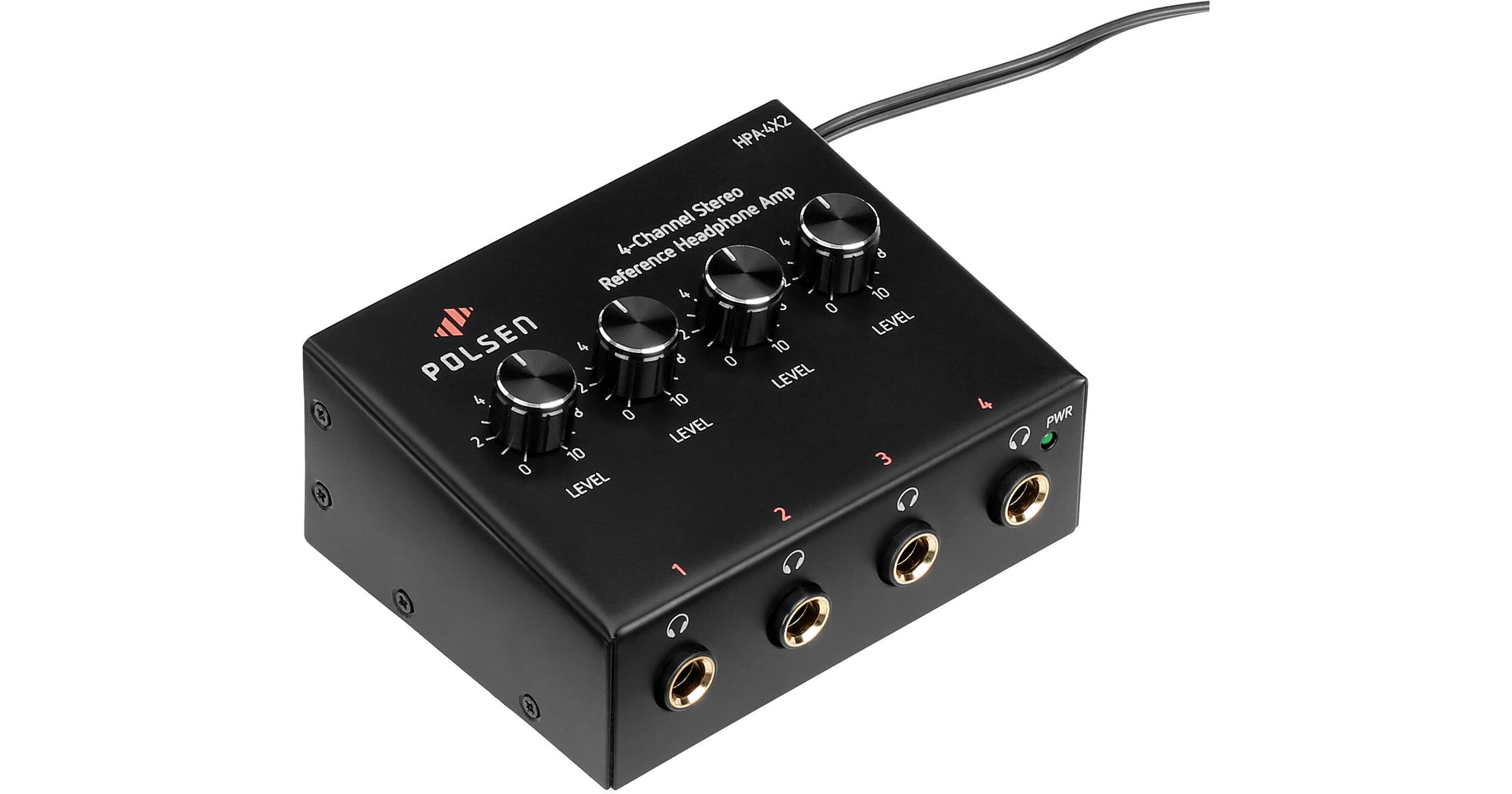
Key Features
- For Pro and Project Studio Applications
- Durable and Compact Design
- 1x 1/4" TRS Stereo Input
- Stereo RCA Inputs
The HPA-4X2 4-Channel Stereo Reference Headphone Amplifier from Polsen features a durable and compact design and can be used for a variety of professional and project applications including studio recording and stage monitoring, or any application that requires multiple headphone connections. Features include a wide frequency response of 20 Hz to 20 kHz with low distortion at high volumes and no signal loss when all 4 headphone outputs are used simultaneously. Each of its four channels allow for independent volume control. Thanks to its Link feature, you can daisy-chain multiple HPA-4X2s together to cater to your needed headphone count.
More DetailsIn Stock
Protect Your Gear
Add a protection plan from $8.99
See Options
See any errors on this page?
question
Please explain the mono switch. What I'm looking for his a device that will mix the stereo channels into mono and deliver the mono signal to both headphones channels. Can this unit do that?
Yes. An input to either input jack will sum to mono on both L&R outputs (with the switch in mono ).
Date published: 2020-12-04
question
Can I connect this to the headphones out of my Allen & Heath ZED-10FX mixer?
Hello: Yes you can. 1. Connect direct from your headphone jack on the Zed Fx to the 1/4inch on back of your Polsen. 2. Use a left right RCA from monitor out puts to your Polsen. Either way will give you good results. #1. is the easiest way. Hope this was helpful.
Date published: 2018-08-25
Is it have enought impedance output for 300 Omhs ...
Is it have enought impedance output for 300 Omhs headphones?
To drive higher impedance headphones(such as 300 ohm phones) a amplifier usually needs to produce a higher voltage swing. This is not a case of having "enough impedance for 300 ohm headphones", but of having enough voltage. Having "enough" depends on the sensitivity of the 300 ohm headphones and the voltage output capability of the amplifier, and how loud you prefer to listen. This amplifier can produce a RMS voltage swing of no more than 4.2 volts. That may be enough if you have sensitive headphones (more than 100dB/volt) and listen at safe levels. However, if your phones have low sensitivity(less than 96 dB/volt)and you want to listen at hearing-damaging heavy metal levels, then this amp won't be powerful enough.
Date published: 2024-03-28
question
Will the mono switch help detect if one of the stereo channels is out of phase? In other words, if the left channel is 180 degrees out of phase from the right, this can be difficult to detect with headphones, but if the channels are summed to mono, the cancellation should be audible in each ear. Is this the case with this mono switch?
Since I am not aware of the circuitry they use in this box to output mono from a stereo source, it is hard to predict. However, the result will depend on what audio spectra are included in each of the (2 stereo) channels. With stereo, the left and right channel usually do not contain the same signals hence spectra, unless it is the same recorded test signal in each channel! So, what you would hear in headphones will depend on a lot of factors. If you have a way to provide an equal-power lower freq test signal to both channel inputs, then it might become obvious. Sorry, not a simple answer.
Date published: 2018-08-25
question
What exactly does Output Impedance Minimum 10 ?, per channel mean? I'm trying to find out the actual impendance output of this amp and I don't know what they mean by minimum ? Can anyone clear this up for me? Thanks.
The provided specifications for this headphone amplifier are poor. The "minimum 10 ohm" spec implies that the amplifier is capable of being used with headphones with an impedance as low as 10 ohms, not that its actual output impedance is 10 ohms. Since the manufacturer does not specify actual output impedance, probably the only way to determine it is to actually measure it directly. Also, the "output level = 22dB" is totally meaningless. A figure of 22db represents a level change, not an absolute power or voltage level. A spec. of 22dBu or 22dBV defines a signal level, but "22dB" alone does not.
Date published: 2026-02-05