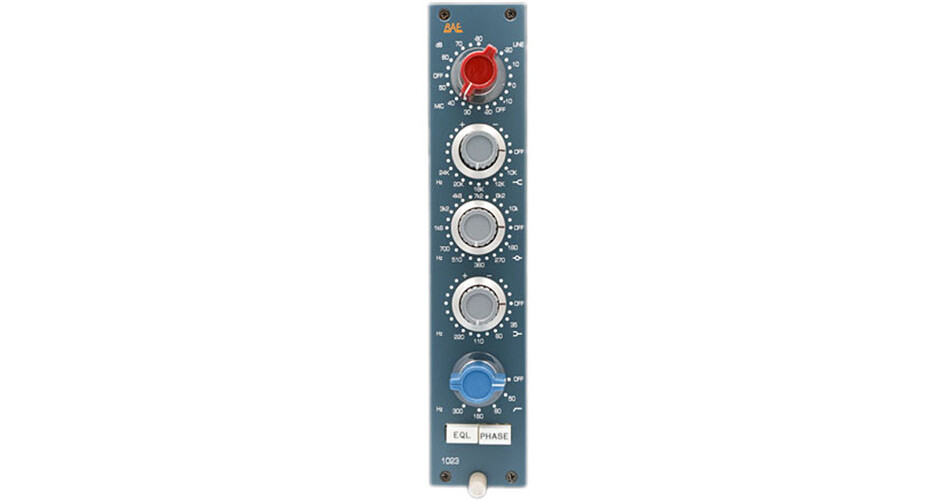
Hand-wired with Carnhill (St. Ives) transformers, the BAE 1023L is a 500-series mic preamp and EQ. It offers the same mic, line, DI input/output section of the BAE 1073. However, it complements the preamp with an EQ sporting significantly more frequency positions than the aforementioned unit.
For instance, while the 1073 provides a healthy six choices of center frequencies for the mid-sweep, the 1023 allows you to center around 160, 270, 360, 510, and 700 Hz—as well as 1.6, 3.2, 4.8, 7.2, 8.2 and 10 kHz—for a total of 11 positions; this gives the unit more functionality and versatility in emphasizing or taming midrange elements. Similar range of motion is provided in the high shelf, where you’ll find five center frequencies (10, 12, 16, 20, 24 kHz) instead of one fixed position. The EQ knobs, with the exception of the high-pass filter, are all concentric, with the outer knob wheeling between frequencies, and the inner knob dictating the level of boost or attenuation. The 1023L’s center frequencies have been stepped in such a way that you can play the midrange in opposition to the high and low shelves at interacting points—a trick many engineers love to employ to boost the aspect of a signal without bringing up unnecessary mud or harshness.
Input and output controls are provided, and at the top left of the unit, you’ll find push-buttons which enable various features. For instance, here you can select between line input and DI output (unselected defaults to microphone input), choose to engage 48V phantom power, select between 300 or 1200 Ohms (the differing impedances, among other things, changing the sonic quality of the signal), flip the phase, and engage/bypass the EQ.
With all these settings, the unit can work equally well on miked vocals, drum kits, and stringed instruments, as well as DI’ed guitars, basses, or keyboards, which can be routed into the 1023L through a front-mounted 1/4" instrument input. Also, if you pick up two of these units and switch them into line mode, you can then run your mixes through them, gain-staging and EQ’ing your 2-buss with the classic sound of a certain famous 1970s-era British console. This is a trick many engineers like to employ to give their ITB sound a little more analog flavor all around.