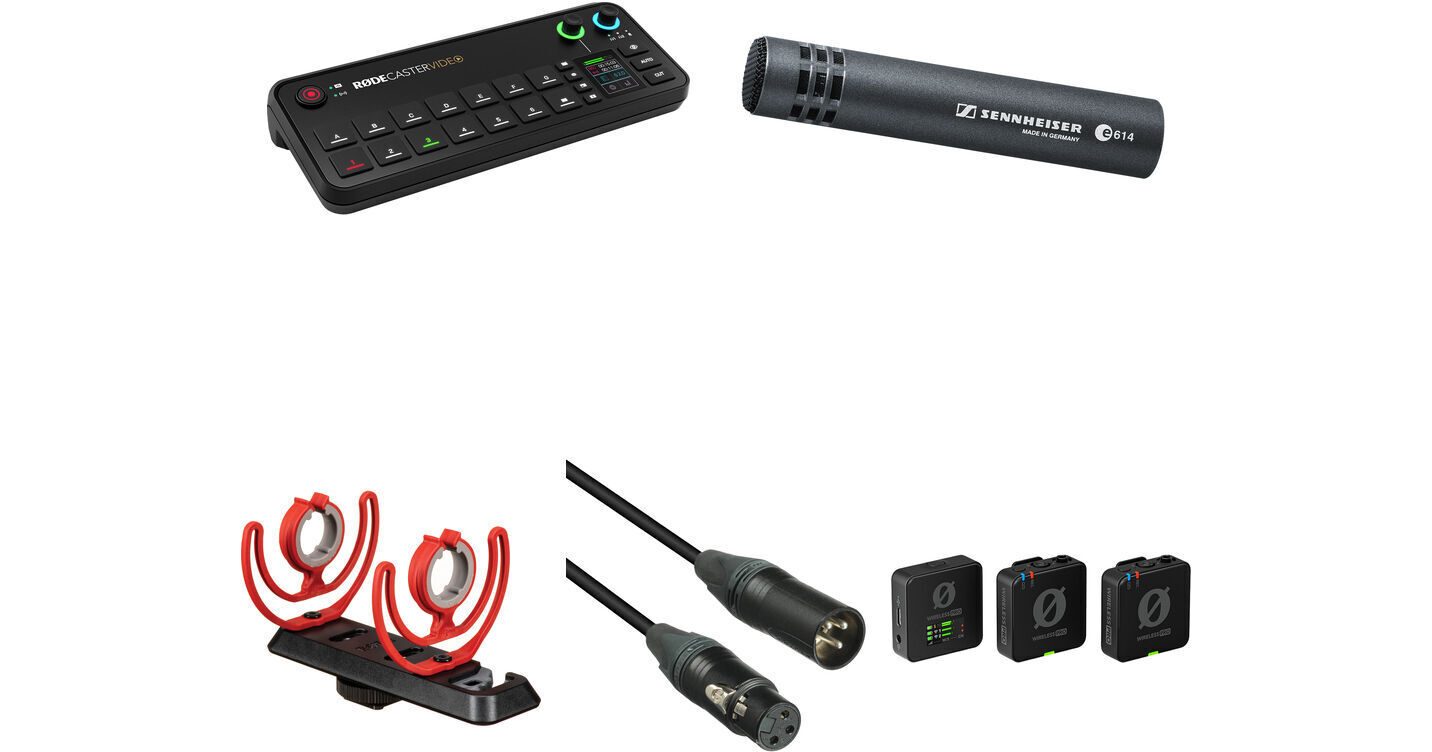


- The RODECaster Video features nine mix-effect layers that can simultaneously display in both preview and program views. Two downstream keyers toggle overlays and logo, two chroma-keyers toggle different backgrounds, and two media players can play simultaneous MP4 video, PNG/JPG photos, or WAV audio from an inserted microSD card.
- Multiview allows you to visualize both the program and preview, all the live inputs with scene and media thumbnails, the audio mixer and channel status, recording/network/storage status as well as runtime, date, and time information. Non-destructive setup means the process can be done live or configured as a saved scene without interrupting the flow of your production.
- Switch between six 1080p60 video sources—four HDMI and two USB-C—and create up to seven complex scenes with multiple layers of video, media, and graphics. Save these scenes and recall them with the touch of a button.
- Configure the two HDMI outputs to connect displays and view preview, program, and multiview feeds. Use the program feed to see what is being streamed/recorded and the preview feed to view inputs, scenes, graphics, or media sources before they go live.
- Two studio-grade combo XLR-1/4" jacks on the console are equipped with low-noise, high-gain Revolution Preamps to ensure pristine audio capture from XLR microphones and instruments.
- Use digital USB-C ports to connect RODE USB microphones, the RODECaster Pro II, or Duo Audio Production Studios. Other USB-C ports support 2-in/2-out multichannel outputs, mix-minus, and MFi protocols.
- Internal wireless receivers can connect RODE series IV wireless microphones to the console, like the Wireless GO II and Wireless PRO.
- Aphex VoxLab audio processing equips the RODECaster Video with EQ, compressor, noise gate, high-pass filter, de-esser, Aural Exciter, Big Bottom, and Compellor effects per channel. Integrated preamps provide up to 75 dB input gain and -131.5 dBV equivalent input noise.
- Mix and process audio onboard using the touchscreen and rotary encoder or the software mixer in RODE Central.
- The RODECaster Video prioritizes scene-based switching with an intuitive control layout. This gives users quicker access to the tools they need to create dynamic content without needing to access complicated settings. The front panel of the device includes a wide variety of controls specific to certain features.
- Automatic chroma keying makes replacing backgrounds with media or live video inputs a breeze. Apply transparency to use the input in scenes or with various backgrounds. Choose between blue and green screen with advanced controls.
- Seven media buttons load video clips, images, and sounds onto a microSD card for use in your production. Two internal video players allow you to transition from one to another in your scene compositions.
- Seven graphic buttons load images with transparency. Dynamically trigger graphics to transition over an input or scene.
The e 614 from Sennheiser is a supercardioid electret condenser microphone designed for general recording and sound-reinforcement applications. The e 614 features high SPL handling and fast transient response making it ideal for drums, percussion, bass, guitar, brass and other instruments rich in transient response. The supercardioid polar pattern is effective in minimizing noise and ambiance at the off-axis sections of the microphone capsule. The wide, flat frequency response of 40 Hz to 20 kHz lends itself for use on vocals as well as instruments.
The SM3-R Camera Shoe Shockmount from RØDE is a suspension shockmount with a camera shoe adapter for mounting various RØDE microphones onto a camera using a standard hot/cold shoe mount. It is built with dual Rycote Lyre mounts to provide maximum isolation from any handling vibrations.
Featuring four possible mounting points to suit the complete range of compatible RØDE on-camera microphones, the shock mount also has an integrated cable management clip. It is compatible with the following microphones: M5, NT5, NT55, NTG1, NTG2, NTG3, NTG4, and NTG4+.
The black Kopul Premium Performance 3000 Series XLR Male to XLR Female Microphone Cable (20') is designed to be an extremely quiet and flexible cable that is ideal for the most demanding live sound and performance applications. The cable is engineered to be durable and provide protection against EMI, RFI, and static noise. While the cable's color-coding affords the ability to quickly differentiate between multiple connections onstage, it provides a pleasant aesthetic quality at the same time.
Premium Performance 3000 Series cables are made from 24-AWG OFC copper wire that's wrapped with PE insulation and a conductive PVC inner shield. A cotton-yarn inner layer helps reduce electrostatic and microphonic noise. The 95% dual-spiral shielding makes the cable resistant to EMI and RFI noise. The Neutrik XX silver connectors provide a high level of connectivity, and all the solder connections are shrink-wrapped for protection.
- Each of the compact transmitters clips quickly and easily to talent and features a built-in microphone with a forgiving omnidirectional pickup pattern that makes it easy to place on talent and get great sound.
- For a more discreet look, two lavalier mics are included; these plug securely into the locking 3.5mm jacks on the transmitters—which can be clipped to belts or hidden in pockets.
- Intelligent GainAssist technology automatically sets input levels for you, saving you time and worry on set.
- Each transmitter features 32GB of internal storage, allowing you to record up to 40 hours of uncompressed back-up recordings while simultaneously transmitting to the receiver.
- The transmitters feature 32-bit float recording to maximize the dynamic range, prevent digital clipping, and ensure noise-free normalizing, even on very quiet recordings.
- Advanced timecode capabilities offer quick-and-easy audio/video sync in postproduction.
- A two-step high-pass filter can be set to 75 or 100 Hz to reduce unwanted low frequencies for clearer speech
- The lavaliers feature foam windscreens, and furry windscreens are provided for the lavs and transmitter mics for outdoor shooting.
- The compact and lightweight dual-channel receiver attaches to your camera or mobile device and allows you to record the incoming transmitters' signals to your device's audio tracks.
- Its bright, high-contrast display shows battery status for the receiver and transmitters, audio level, signal strength, and more.
- Rode's Series IV technology provides reliable, crystal-clear wireless transmission at a range up to 853' and features 128-bit encryption for security.
- The Wireless PRO is fully compatible with other Rode Series IV wireless devices, including the Wireless GO II, Wireless ME, RODECaster Duo, and RODECaster Pro II to ensure they work seamlessly together.
- A comprehensive cable set is included, allowing you to record to devices with 3.5mm, USB-C, and Lightning connectors.
- Monitor your audio in the field with the Wireless PRO’s high-power headphone output, complete with onboard level control, or connect a headset or narrator microphone such as a lavalier to capture a third audio track.
- Internal lithium-ion polymer batteries in the transmitters and receiver offer up to seven hours of battery life to handle long shoots.
- The included smart charging case will completely recharge both transmitters and the receiver two times.
- Easily recharge over lunch and dinner breaks—go from empty to a full charge in just 2.5 hours.
- USB Type-C ports provide for battery recharging, powering via external USB battery packs (available separately), and firmware updates.
- The case also allows for ultrafast data transfer, so you can quickly export recordings on the move.
- The transmitters can be set to automatically turn off after 15 minutes if they aren't recording or aren't paired to preserve battery life.
- Use the plug-in power detection option on the receiver to further extended battery life.
- Designed with stunning simplicity and efficiency in mind, the Rode Wireless PRO offers instantaneous functionality out of the box for your next news shoot, video project, or interview. Power up, let the receiver and transmitters automatically pair, then Go PRO.
- Precisely match your mic to your camera with flexible gain controls and tailored presets. Add an extra layer of protection with the safety channel.
- Check your audio levels at a glance with the bright LCD display and configure settings on the fly with dedicated controls for everything from gain adjustment to triggering recordings. Customize the system to your needs anywhere using your computer or smartphone with the RØDE Central app. The Wireless PRO gives you complete control over your setup, so you can be ready for any recording situation.
- Timecode is a media synchronization system that is designed to perfectly synchronize all your audio and video recordings. Not only does timecode save you time in the editing process, especially when working on shoots using multiple cameras and audio recorders, but it also becomes a single source of truth for referencing specific scenes, moments, or timestamps within your project.
- Timecode essentially works by labelling every clip with the exact time it starts. These timings are frame-accurate, which means clips can be perfectly aligned down to a fraction of a second, even if your devices started or stopped recording at different times.
- The Wireless PRO receiver acts as the 'Source' in a timecode setup, meaning that timecode is generated by the Wireless PRO and is received by other ‘Sync’ devices, such as cameras and audio recorders.
- The Wireless PRO outputs timecode information as an audio signal. If your camera accepts timecode, it will record this data into your video files directly, but if it doesn’t then you can still record this audio timecode signal into your camera’s mic or aux input just like you would a microphone—this audio is then later recognized as timecode in your editing software.
- The Wireless Pro receiver will automatically send timecode to the transmitters, so the recordings on your transmitters will have timecode baked into them and be perfectly synchronized, but you need to record the timecode onto your camera(s), so that your video files also have this sync information.