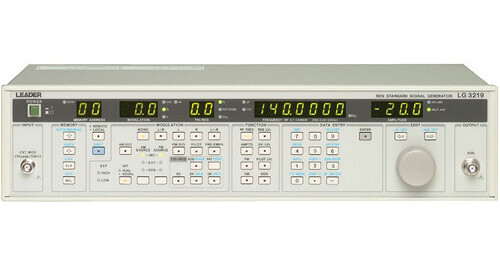
| Frequency |
|
| Range | 0.1 MHz to 140 MHz |
| Resolution | 100 Hz |
| Frequency Bands | Band 1: 0.1000 MHz to 35.0000 MHz
Band 2: 35.0001 MHz to 70.0000 MHz
Band 3: 70.0001 MHz to 140.0000 MHz |
| Accuracy | ±5×10⁻⁶ |
| Internal Reference Oscillator Temp. Stability | ±5×10⁻⁶ |
| Output Level |
|
| Range | -20 dBμV [emf] to 126 dBμV [emf] |
| Resolution | 0.1 dB |
| Accuracy | ±1.5 dB (output level ≥ 0 dBμV [emf])
±2.0 dB (output level < 0 dBμV [emf]) |
| Impedance | 50 Ω |
| VSWR | ≤ 1.3 (output level ≤ 101 dBμV) |
| Attenuator Contact | Solid-state |
| Spectral Purity |
|
| Spurious Output | Harmonics (2nd, 3rd): ≤ -30 dBc
Non-Harmonics: ≤ -50 dBc (bands 2 and 3)
≤ -40 dBc (band 1: 0.1 MHz ≤ fs ≤ 35 MHz)
≤ -30 dBc (band 1: fs ≥ 35.0001 MHz)
(at 10 kHz or more away from the carrier
fs: spurious output frequency) |
| Residual Modulation | FM Component: ≥ 76 dB (10.7 MHz ± 1 MHz, 76 MHz to 108 MHz)
≥ 73 dB (bands 1 to 3: 0.3 MHz to 140 MHz)
(S/N at 1 kHz modulation frequency,
75 kHz deviation. 50 Hz to 15 kHz
demodulation bandwidth, 50 μs de-emphasis.)
AM Component: ≥ 55 dB (band 1: 0.4 MHz to 1.7 MHz)
≥ 50 dB (bands 1 to 3: 0.15 MHz to 140 MHz)
(S/N at 1 kHz modulation frequency, 30 % depth.
(Beat components are excluded.) 50 Hz to
15 kHz demodulation bandwidth.) |
| Modulation |
|
| RC Oscillator | Frequency: 400 Hz, 1 kHz
Accuracy: ≤ ±3 % |
| External Modulation Input | Impedance: Approx. 10 kΩ
Voltage: Approx. 1 V [peak] |
| Amplitude Modulation (AM) |
|
| Optimal Range | Frequency ≥ 0.15 MHz |
| Depth | 0% to 80% |
| Displayed Depth | 0% to 100% |
| Resolution | 0.5% (0% to 100%) |
| Accuracy | ±(Setting × 0.1 + 1)%
(Band 1: 0.4 MHz to 1.7 MHz)
±(Setting × 0.1 + 2)%
(Bands 1 to 3: 0.15 MHz to 140 MHz)
(Depth at 1 kHz modulation frequency.
The maximum setting is 80%.) |
| Distortion | Band 1: 0.4 MHz to 1.7 MHz
≤ 0.5% (0% to 30% AM)
≤ 1.5% (30% to 60% AM)
≤ 3% (60% to 80% AM)
Bands 1 to 3: 0.15 MHz to 140 MHz
≤ 1.5% (0% to 30% AM)
≤ 3% (30% to 60% AM)
≤ 5% (60% to 80% AM)
(1 kHz modulation frequency by the RC
oscillator, 50 Hz to 15 kHz demodulation
bandwidth, beat components are
excluded) |
| Incidental FM | ≤ 150 Hz (band 1: 0.4 MHz to 1.7 MHz)
≤ 300 Hz (bands 1 to 3: 0.15 MHz to 140 MHz)
(at 1 kHz modulation frequency, 30 % depth) |
| Ext. Modulation Freq. Response | ±1 dB (1 kHz reference)
20 Hz to 10 kHz
(Maximum modulation frequency ≤ 2 % of
carrier frequency for 30 % AM) |
| Frequency Modulation (FM) |
|
| Optimal Range | Frequency ≥ 0.3 MHz |
| Frequency Deviation Range | 0.0 kHz to 100 kHz
(Band 1's maximum FM deviation ≤ 25 %
of the carrier frequency) |
| Resolution | 0.5 kHz |
| Accuracy | ±(Setting × 0.1 + 0.5) kHz
(10.7 MHz ± 1 MHz, 76 MHz to 108 MHz)
±(Setting × 0.1 + 1) kHz
(Bands 1 to 3: 0.3 MHz to 140 MHz) |
| Distortion | ≤ 0.05 % (10.7 MHz ± 1 MHz, 76 MHz to 108 MHz)
≤ 0.1 % (bands 1 to 3: 0.3 MHz to 140 MHz)
(1 kHz modulation frequency, 75 kHz
deviation, 50 Hz to 15 kHz demodulation
bandwidth, 50 μs de-emphasis) |
| MPX Stereo Signal Separation | ≥ 55 dB
(76 MHz to 108 MHz frequency, 1 kHz
modulation frequency, 100% depth, 67.5
kHz deviation) |
| Incidental AM | ≤ 0.5% (10.7 MHz ± 1 MHz, 76 MHz to
108 MHz) (1 kHz modulation frequency,
75 kHz deviation) |
| Ext. Modulation Freq. Response | MONO Mode: ≤ ±1 dB (20 Hz to 100 kHz, 1 kHz reference)
Not MONO Mode: ≤ ±1 dB (20 Hz to 15 kHz, 1 kHz reference) |
| Pre-Emphasis | 25 μs, 50 μs, 75 μs, off (amplitude characteristics
based on the off setting) |
| FM Stereo |
|
| Optimal Range | Frequency ≥ 0.3 MHz |
| Main & Sub Channel Signals | L=R Modulation Mode: INT, EXT signal; stereo modulation
based on one signal
L Modulation Mode: INT, EXT signal; stereo modulation
based on one signal
R Modulation Mode: INT, EXT signal; stereo modulation
based on one signal
L = -R Modulation Mode: INT, EXT signal; stereo modulation
based on one signal
MONO Modulation Mode: INT, EXT signal; monaural modulation |
| Depth | Range: 0% to 127%
Resolution: 1%
Accuracy: ±(Setting × 0.1 + 1)%
(10.7 MHz ± 1 MHz, 76 MHz to 108 MHz)
±(Setting × 0.1 + 1.5)%
(Bands 1 to 3: 0.3 MHz to 140 MHz) |
| Pilot Signal | Frequency: 19 kHz
Accuracy: ±1 Hz
Level Ratio Range: 0.0% to 15.0%
Level Ratio Resolution: 0.1%
Level Ratio Accuracy: ±(Setting × 0.1 + 1)%
(10.7 MHz ± 1 MHz, 76 MHz to 108 MHz) |
| Stereo Separation | ≥ 55 dB (400 Hz to 1 kHz modulation frequency)
(at 10.7 MHz ±1 MHz, 76 MHz to 108 MHz) |
| 38 kHz Subcarrier Leakage | ≤ -50 dB |
| Distortion | ≤ 0.05% (10.7 MHz ± 1 MHz, 76 MHz to
108 MHz) (1 kHz modulation frequency,
100 % depth, 50 Hz to 15 kHz demodulation
bandwidth, 50 μs de-emphasis) |
| Pre-Emphasis | 25 μs, 50 μs, 75 μs, off (amplitude characteristics
based on the off setting) |
| Simultaneous AM & FM |
|
| FM Mono, AM | (1) FM mono (EXT) - AM (INT) |
| Simultaneous Modulation | (2) FM mono (INT) - AM (EXT)
(3) FM mono (EXT) - AM (EXT)
(4) FM mono (INT) - AM (INT) |
| FM Stereo, AM | (1) FM stereo (EXT) - AM (INT) |
| Simultaneous Modulation | (2) FM stereo (INT) - AM (EXT)
(3) FM stereo (EXT) - AM (EXT)
(4) FM stereo (INT) - AM (INT) |
| Preset Function |
|
| Description | Stores and recalls these settings: frequency,
output level, modulation mode
(AM/FM, external/internal, depth, on/off),
external control output. (Maximum number
of presets: 100) |
| DDS Signal |
|
| Oscillation System | 12-bit direct digital synthesizer |
| Frequency Range | 20 Hz to 20 kHz |
| Resolution | 1 Hz |
| Frequency Accuracy | ±0.1% |
| Flatness | Same as the external modulation characteristics |
| Weather Band Output |
|
| Frequency Range | 162.0000 MHz to 163.0000 MHz |
| Resolution | 100 Hz |
| Frequency Accuracy | ±5×10⁻⁶ |
| Optimal Modulation Mode | FM monaural |
| External Interface |
|
| SCA Input | Input Level: 0.56 V [P-P] (0.2 V [rms]) (corresponds to
a level ratio of 10%)
Frequency Range: 20 kHz to 99 kHz, ±1 dB (57 kHz reference)
Input Impedance: Approx. 10 kΩ |
| Comp Output | Modulation signal's monitor output connector
Output Voltage: Approx. 5 V [P-P] (into 600 Ω, 100 kHz FM
mono)
Output Impedance: Approx. 600 Ω |
| Pilot Output | Output for modulation modes other than
MONO
Output Voltage: Approx. 1V [rms]
Output Impedance: Approx. 1 kΩ |
| GP-IB | Source handshaking: SH1 (Full capability)
Acceptor handshaking: AH1 (Full capability)
Talker: T7 (Basic talker, untalk on MLA,
talk-only)
Listener: L3 (Basic listener, unlisten on
MTA, listen-only)
Service request: SR0 (No capability)
Remote/Local: RL1 (Full capability)
Parallel polling: PP0 (No capability)
Device clear: DC1 (Full capability)
Device trigger: DT0 (No capability)
Controller: C0 (No capability) |
| RS-232C | Baud Rate: 38400 bps
Character Length: 8 bits
Parity: EVEN
Flow Control: Xon, Xoff
Stop Bits: 1 bit |
| External Control Interface | Description:
(1) Remote sequential recall
(2) Remote modify
(3) Remote direct recall
(4) Control output
(5) Relay drive output
Output voltage: Approx. 5V
Output current: Approx. 50mA |
| RDS Signal |
|
| Level Range | 0.0% to 10% (75 kHz FM deviation is
taken to be 100%) |
| Level Resolution | 0.1% |
| Accuracy | ±(Setting × 0.1 + 0.5)% |
| Spurious Output | ≤ -50 dB (at 53 kHz, 10% output)
≤ -40 dB (at 61 kHz, 10% output) |
| Subcarrier | Frequency Accuracy: 57 kHz ± 6 Hz
Phase: 0° or 90° (with respect to the pilot signal)
Phase Accuracy: ±10°
Leakage: ≤ -50 dB |
| Internal Data Mode | Subcarrier, null data, internal data |
| Patterns | 16 patterns maximum |
| Pattern Length | 2048 groups maximum
* The LG 3219 does not contain RDS pattern data. |
| TRI (or ARI) Signal |
|
| SK Signal | Level Range: 0.0% to 10% (75 kHz FM deviation is
taken to be 100%.)
Level Resolution: 0.1%
Accuracy: ±(Setting × 0.1 + 0.5)%
Frequency Accuracy: 57 kHz ± 6 Hz
Phase: 0° (with respect to the pilot signal)
Phase Accuracy: ±10° |
| DK Signal | Frequency Accuracy: 125 Hz (57 kHz / 456) ± 1%
AM Depth: 0% to 40%
AM Resolution: 1%
AM Accuracy: ±5%
AM Distortion: ≤ 1% (SK = 5.3%, AM = 30%) |
| BK Signal | Frequency Accuracy:
Code A: 23.75 Hz (57 kHz / 2 400) ± 1%
Code B: 28.27 Hz (57 kHz / 2 016) ± 1%
Code C: 34.93 Hz (57 kHz / 1 632) ± 1%
Code D: 39.58 Hz (57 kHz / 1 440) ± 1%
Code E: 45.67 Hz (57 kHz / 1 248) ± 1%
Code F: 53.98 Hz (57 kHz / 1 056) ± 1% |
| AM Depth | 0% to 80% |
| AM Resolution | 1% |
| AM Accuracy | ±5 % |
| AM Distortion | ≤ 2% (SK = 5.3%, AM = 60%) |
| Power Requirements |
|
| Voltage Range | 90 to 250110V AC |
| Frequency | 50/60 Hz |
| Power Consumption | ≤ 60VA |
| Temperature and Humidity Range |
|
| Operating Temperature | 0° C to 40° C, 20% to 90% (relative humidity) |
| Overvoltage Category |
|
| Overvoltage Category | CAT II |
| Dimensions & Weight |
|
| Dimensions | 3.9 x 16.8 x 11.8" (99 x 426 x 300mm)
(Without knobs or buttons) |
| Weight | 19.8 lb (9.0 kg) |