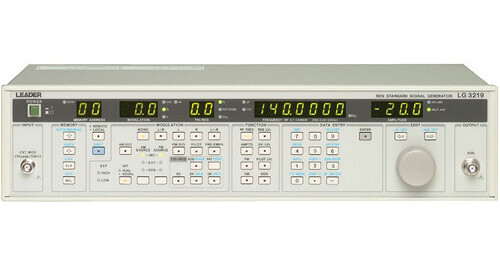
- Generates CW, AM, FM, AM/FM Signals
- 100 kHz to 140 MHz Range
- CW & FM Signals in 162-163 MHz Range
- RF Signals Phase-Locked to Crystal
The cost-effective, highly stable signal generator is also equipped with RBDS (Radio Broadcast Data System), RDS (Radio Data Systems) and TRI (Traffic Radio Information – also known as ARI) modulators. RDS is a digital data transmission system for FM radio broadcasts used in many European countries. TRI is used to provide traffic information in Europe, and RBDS is used in the U.S. During FM stereo modulation, these signals can be multiplexed into composite stereo modulation signals.
The LG 3219 produces synthesized, accurate radio frequency signals that are phase-locked at all times to an internal reference crystal oscillator. Fundamental oscillation is used to generate many frequencies (70-140 MHz and 162-163 MHz), and others are derived from these using either the heterodyne method (100 kHz - 35 MHz) or the 1/2-frequency division method (35-70 MHz). Frequency resolution is 100 Hz.
The generator can apply frequency modulation and amplitude modulation simultaneously, in order to combine internal modulation signals with one external modulation signal.
The output level can be set to a value from -20 dBμV (emf) to 126 dBμV (emf) in 0.1 dB steps. With the exception of the use of a relay to switch to 106 dBμV (emf), a solid-state attenuator is used to switch the output levels in order to extend the generator's service life.
The ΔF function can be used to get a direct reading of how much the frequency is offset from the reference frequency. The frequency can be changed in preset steps. Likewise, the ΔdB function can be used to get a direct reading of how much the output level is offset from the reference level. Like the frequency, the output level can be changed in preset steps.
A preset function allows the user to store 100 sets of frequency, output level, modulation mode, and external-control output-signal settings. Front-panel settings are retained when the power is turned off, and restored when the unit is turned back on. Remote control is possible via RS-232C, GP-IB, and external control interfaces.