| Networking | MAC address (IEEE 802.3)
IPv4 (RFC 791) upgradeable to IPv6 (RFC 1883)
Address Resolution Protocol (ARP)
Domain Name System (DNS) A record (RFC 1706) and SRV record (RFC 2782)
Dynamic Host Configuration Protocol (DHCP) client (RFC 2131)
Point-to-Point Protocol over Ethernet (PPoE) client (RFC 2516)
Internet Control Message Protocol (ICMP) (RFC 792)
TCP (RFC 793)
User Datagram Protocol (UDP) (RFC 768)
Real Time Protocol (RTP) (RFC 1889) (RFC 1890)
Real Time Control Protocol (RTCP) (RFC 1889)
VLAN tagging (IEEE 802.1p)
Simple Network Time Protocol (SNTP) (RFC 2030)
SIP channels support for both UDP and TCP transport |
| Voice Gateway | SIPv2 (RFC 3261, 3262, 3263, and 3264)
SIP proxy redundancy: Dynamic through use of DNS SRV A records
Reregistration with primary SIP proxy server
SIP support in network address translation (NAT) networks (including Serial Tunnel [STUN])
Highly secure (encrypted) calling using Secure RTP (SRTP)
Codec name assignment
G.711 (A-law and μ-law)
G.726 (32 kbps)
G.729 A
Dynamic payload
Adjustable audio frames per packet
Dual-tone multifrequency (DTMF): In-band and out-of-band (RFC 2833) (SIP information) |
| Voice Features | Independent configurable dial plans with interdigit timers and IP dialing (1 per port)
Call progress tone generation
Jitter buffer: Adaptive
Frame loss concealment
Full-duplex audio
Echo cancellation (G.165 and G.168)
Voice activity detection (VAD)
Silence suppression
Comfort noise generation (CNG)
Attenuation and gain adjustments
Flash hook timer
Message waiting indicator (MWI) tones
Visual messaging waiting indicator (VMWI) using frequency shift keying (FSK)
Polarity control
Hook flash event signaling
Caller ID generation (name and number): Bellcore, DTMF, and European Telecommunications Standards Institute (ETSI)
Streaming audio server: Up to 10 sessions
Music on hold
Call waiting, call waiting and caller ID
Caller ID with name and number
Caller ID blocking
Selective and anonymous call rejection
Call forwarding: No answer, busy, and all
Do not disturb
Call transfer, call return, and call back on busy
Three-way conference calling with local mixing
Per-call authentication and associated routing
Call blocking with toll restriction
Distinctive ringing: Calling and called number
Off-hook warning tone
Advanced inbound and outbound call routing
Hotline and warmline calling
Long silence (configurable time setting) silence threshold
Disconnect tone (for example, reorder tone)
Configurable ring frequency
Ring validation time setting
Tip and ring voltage adjustment setting
Ring indication delay setting |
| Fax Capability | Fax tone detection pass-through
Fax pass-through using G.711
Real-time fax over IP using T.38 fax relay (T.38 support is dependent on fax machine and network and transport resilience) |
| Security | Password-protected system reset to factory default
Password-protected administrator and user access authority
Provisioning, configuration, and authentication
HTTPS with factory-installed client certificate
HTTP digest: Encrypted authentication using MD5 (RFC 1321)
Up to 256-bit Advanced Encryption Standard (AES) encryption
SIP Transport Layer Security (TLS) |
| Administration | Web browser administration and configuration using integral web server
Telephone keypad configuration with interactive voice prompts
Automated provisioning and upgrade using HTTPS, HTTP, and Trivial File Transfer Protocol (TFTP)
TR-069
Asynchronous notification of upgrade availability using Notify
Nonintrusive, in-service upgrades
Report generation and event logging
Statistics in Bye message
Debug server records and syslog: Per-line configurable web browser
Ping and traceroute diagnostics
Configuration management: Backup and restore
Support for Bonjour |
| Subscriber Line Interface Circuit | Ring voltage: 40-90 Vpk configurable
Ring frequency: 20-25 Hz
Ring waveform: trapezoidal
Maximum ringer load: 5 ringer equivalence numbers (RENs)
On-hook voltage (tip and ring): -46 to -56V
Off-hook current: 18-25 mA
Terminating impedance: 600 ohm resistive or 270 ohm + 750 ohm
150 nF complex impedance
Frequency response: 300-3400 Hz
Return loss (600 ohm, 300-3400 Hz): up to 20 dB
Insertion loss (1 Vrms at 1 kHz): 3-4 dB
Total harmonic distortion (THD) (350 mV peak at 300 Hz): up to 3%
Idle channel noise: 72 dB (typical)
Longitudinal balance: 55 dB (typical)
Off-hook threshold (line seizure): Rdc < 1000 ohm
On-hook threshold (line release): Rdc >10000 ohm
Rdc DC supervisory range: Rdc > 450 ohm |
| Connectors | 1 x WAN 100BASE-T RJ-45 Ethernet Port (IEEE 802.3)
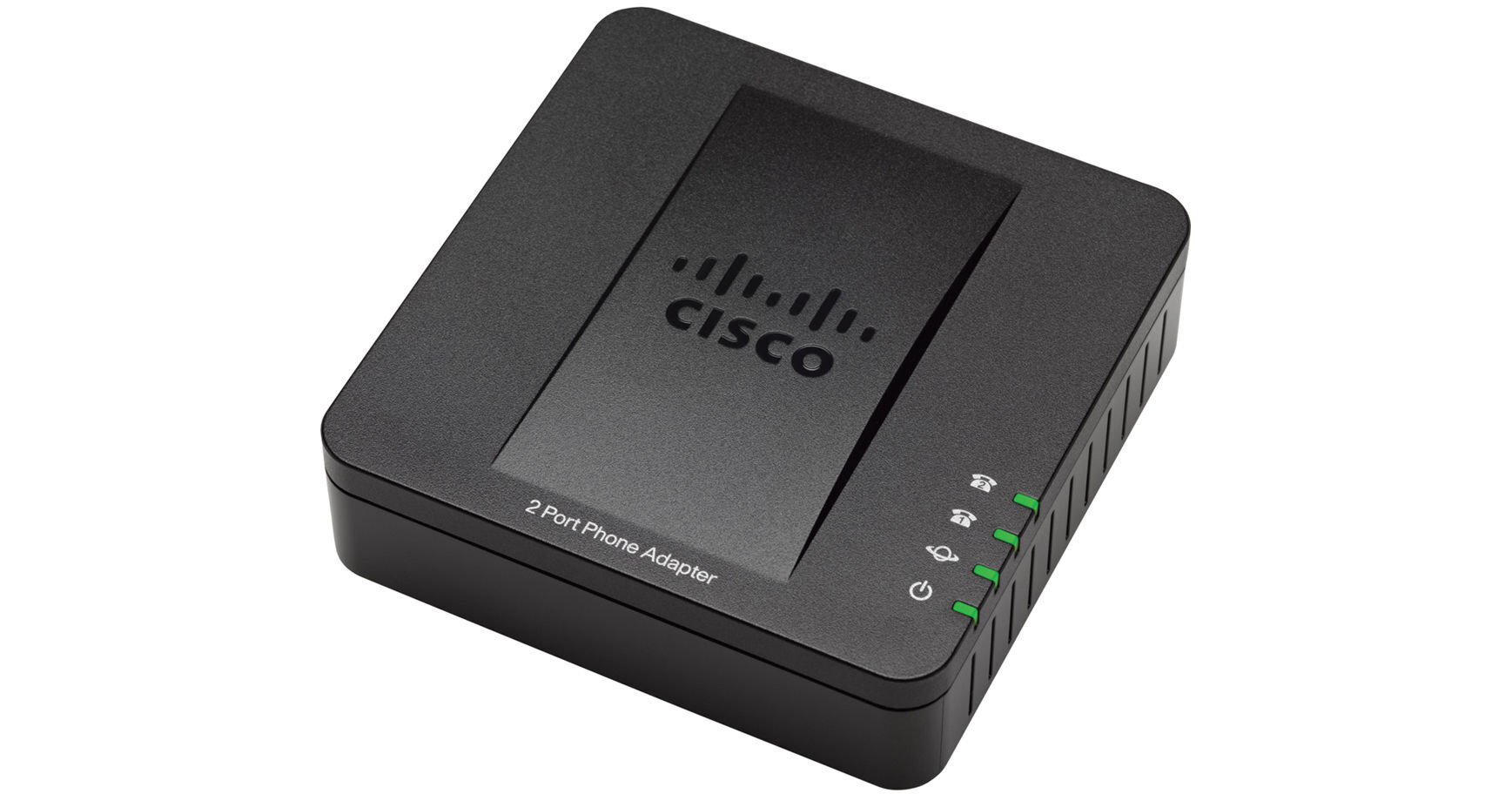
2 x RJ-11 FXS phone ports for analog circuit telephone device (tip and ring) |
| Buttons | Reset |
| Indicators | Phone 1, phone 2, Internet, and power (LEDs) |
| Power Requirements | DC input voltage: 5V DC at 2.0A maximum
Switching type (100-240V) automatic
Power adapter: 100-240V and 50-60 Hz (26-34 VA) AC input, with 1.8m cord |
| Power Consumption | 5W |
| Environmental Requirements | Operating temperature: 32 to 113° F (0 to 45° C)
Storage temperature: -77 to 158° F (-25 to 70° C)
Operating humidity: 10 to 90% noncondensing
Storage humidity: 10 to 90% noncondensing |
| Agency Certifications | FCC (Part 15 Class B), CE, ICES-003, A-Tick certification, RoHS, UL |
| Dimensions | 3.98 x 3.98 x 1.10" (101 x 101 x 28 mm) |
| Weight | 5.4 oz (153 g) |