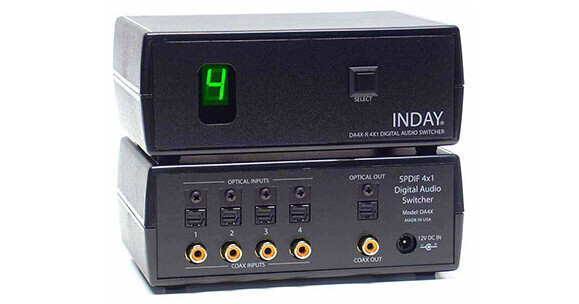
Flawed TOSLINK inputs
By Dennis
Rated 3 out of 5
Date: 2023-01-03
The switch generally supports 44.1/48/88.2/96/176.4/192 kHz in bit-perfect fashion, but the TOSLINK inputs are not stable with 192 kHz and even struggle with the 48 kHz signal from my TV sometimes, resulting in static like pops.
Those pops went away with a ViewHD TOSLINK to coax converter, feeding the Inday switch with a coax cable instead - obviously that shouldn't be necessary, especially at this price point.
I got this switch to transition away from TOSLINK - many devices don't have the greatest TOSLINK transmitters and receivers, making 192 kHz support quite the gamble, so I suppose this unit is in good company.
More expensive, pro audio devices like those from MUTEC show how robust TOSLINK can be, but even my older, much cheaper J-Tech JTDSM0402 handles 192 kHz very well, while a second unit bought later doesn't. However, J-Tech only claims to support up to 96 kHz anyway, while Inday proclaims support for 192 kHz unconditionally.
On many devices with TOSLINK ports the cable can wiggle a lot and cause connection issues at high sample rates, but the ports on the Inday have the opposite problem with some cables, like Kabeldirekt ones, which fit so tightly that a concerning amount of force is needed to get them out again.
The coax inputs work well, even with 192 kHz. A few of the cables I have don't plug in very firmly, which means hefty, rigid cables like those from BlueJeans come easily unplugged when pulling the device towards you, as one does when trying to access the ports.
The two outputs are active at the same time and appear to support 192 kHz reliably, which is great. I'm basically viewing this as a coax switch with TOSLINK and coax outputs now, I don't trust the TOSLINK inputs.
That aside, I would prefer being able to directly select the TOSLINK inputs (as inputs 5-8, or 2/4/6/8, say) since many devices send an active S/PDIF signal with silence when not in use, preventing the auto switching from working as intended.
The device is somewhat big for a switch like this, but very light (all plastic housing), so it cannot counteract the forces of multiple cables pulling on it. This means you need to somehow hold it in place when you push the input selector button. While this button feels quite nice to actuate, a fair bit of force is needed to do so, causing the unit to slide around when unsupported.
The seven segment display is recessed, probably almost 1/4, which means it may be partially occluded when looking at the device at an angle. My unit is on the bottom shelf of an audio rack next to my desk chair, so I have to lean back or do mental gymnastics to identify the current input from the remaining visible segments, but with enough of an angle 1 and 4 just can't be told apart anymore (see photo). As the similarly priced Topping E30 next to it shows this can be overcome by different design choices.
On the plus side the display is big enough to be readable from a distance.
When ordering directly from the manufacturer there's a choice between a green and a blue display. I'd prefer a single, neutral choice (white) that's automatically available at retailers like B&H - the blue variant is not.
The switch is very responsive to IR signals, and I'm very glad it can be switched between three different sets of IR commands since the first two of those sets conflicted with my J-Tech JTDSM0402.
I was able to teach these IR commands to my Logitech Harmony 665 universal remote and it works very well this way, even from a distance, odd angles or aiming the remote at the wall opposite the switch - well done. I have not used the included remote since, so the above comments mostly applaud the receiver.
Thanks to the manual I was able to control the unit with an OIKWAN USB to RS232 cable and a computer running Windows 10. Only the IR remote can turn the unit off, and any RS232 activity will turn it on again, but you cannot turn it off with RS232, or just the button on the device (or check with RS232 whether the unit is off).
Sadly even with RS232 you cannot get diagnostic information beyond the currently selected input. It would have been nice to be able to tell whether TOSLINK or S/PDIF is active, whether a stable signal is being received, how strong the signal is, what the sample rate is, whether S/PDIF transmission errors were detected, what S/PDIF metadata is being sent, etc., but it's quite possible that the controller chip doesn't even have that information since there's also no indicator on the unit that a valid signal has been detected.
I'm using the switch to feed a reclocker, so I cannot comment on its sound quality when used directly.
The Inday switch is a unique product in the market, mixing TOSLINK and coax inputs and outputs while also being IR controllable (something MUTEC doesn't seem to bother with). It has a lot of room for improvement, but luckily it functions as the bit-perfect coax switch with TOSLINK output and IR remote that I needed, so I'm glad it exists.
SO FAR, SO GOOD
By Daniel
Rated 5 out of 5
Date: 2022-03-27
Just got it about 2 weeks ago, but first impression of the item is - as advertised. Easy to set up and works flawlessly. No sound leak-through between inputs.
If I could improve one thing, It would be the weight of the switcher..........I would love it if it were a bit heavier to prevent moving around, but I can live with that. :)