
During Apple’s “Peek Performance” event, Tim Cook and company unveiled a treasure trove of new devices, including the insanely powerful Mac Studio and Studio Display, an upgraded iPad Air with Apple’s M1 chip, and some updated iPhone models, as well. Here’s everything that was everything at today’s product-packed showcase.
Mac Studio with M1 Max/M1 Ultra Chip
Arguably, the biggest reveal at today’s event was the introduction of the all-new Mac Studio and accompanying Studio Display. Designed for creatives, the Mac Studio is the latest desktop system powered by Apple’s M1-class processors. You can choose between the M1 Max chip, which, when it debuted, was widely considered to be pretty OP, or you can opt for the new M1 Ultra, which Apple claims is even more powerful. Check out some of the benchmarks, provided by Apple.
Click here for our hands-on review!

Mac Studio featuring M1 Max CPU

-
Delivers 50 percent faster CPU performance than 16-core Mac Pro
-
Transcodes video 3.7x faster than 16-core
Mac Pro Mac Studio featuring M1 Ultra CPU

-
Up to 3.8x faster CPU performance than the fastest 27-inch iMac with 10-core processor
-
Delivers 90 percent faster CPU performance than 16-core Mac Pro
-
Delivers 60 percent faster CPU performance than 28-core Mac Pro
-
Transcodes video 5.6x faster than 28-core Mac Pro
Studio Display
Along with the Mac Studio, Apple also unveiled the Studio Display, a gorgeous monitor featuring an expansive 27-inch 5K Retina display, a 12MP Ultra Wide camera with Center Stage, and a high-fidelity, six-speaker sound system with spatial audio. In addition to its 14.7 million pixels, the Studio Display’s 5K Retina screen can achieve more than 600 nits of brightness and supports P3 wide color gamut and True Tone technology, making it ideal for creatives who rely on color accuracy.

If the Studio Display’s gorgeous glass is familiar to you, that’s because it’s the same nano-texture material first introduced on the Pro XDR display. In terms of connectivity, the Studio Display features three USB-C ports delivering speeds up to 10Gb/s and Thunderbolt port that should enable users to connect peripherals to their Mac via a single cable. The same cable can also deliver up to 96W of power to a Mac notebook, allowing Studio Display to fast-charge power-hungry devices such as the 14-inch MacBook Pro.
iPad Air with M1
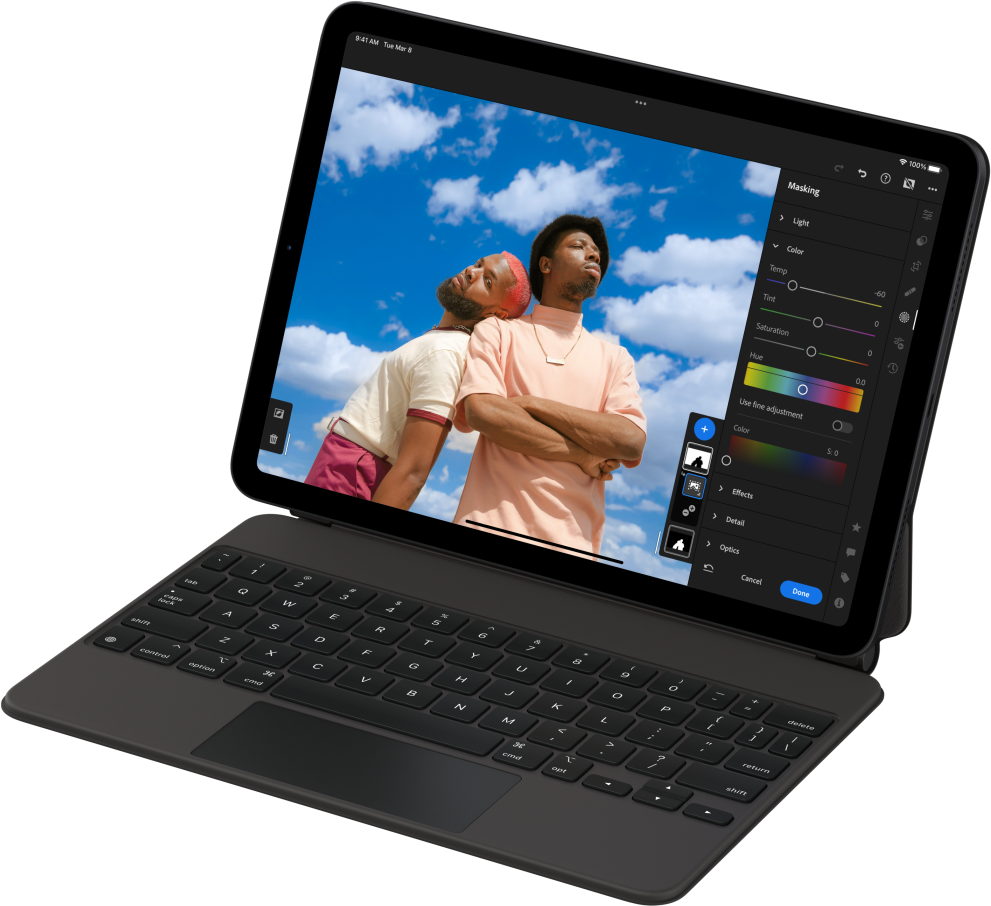
Apple’s other big news was the dramatically enhanced iPad Air. The upgraded iPad Air features Apple’s powerful M1 architecture, a new and greatly improved 12MP front camera system, and adds 5G wireless compatibility on cellular models—all told, making the new iPad Air the most powerful, capable, and versatile iPad Air ever. How powerful? According to Apple, efficiency and all-day battery life of the 8-core CPU delivers up to 60 percent faster performance. On top of that, the 8-core GPU delivers up to 2x faster graphics performance compared to the previous iPad Air model. Talking power and connectivity, the new iPad Air’s USB-C port is now 2x faster than the previous generation. These boosts in power and performance mean the iPad Air with M1 is now a viable entry point for creatives not wanting to go the full iPad Pro route.
Apple also announced the 2022 iPhone SE, which looks eerily similar to the 2020 iPhone SE on the outside, but features the more powerful A15 Bionic chip on the inside, along with all the performance boosts that come with it. The 2022 iPhone SE also boasts an upgraded camera system that supports pro features like Smart HDR 4, Photographic Styles, and Deep Fusion.

With so many new Apple devices announced, it’s hard to decide which we’re most excited about. Creative professionals will likely be drawn to the unprecedented power and capability of the Mac Studio and Studio Display, but don’t sleep on the M1-powered iPad Air. Its upgraded architecture makes it a viable tablet for users of every stripe.
What did you think about all the new Apple products? Let us know in the Comments section, below.