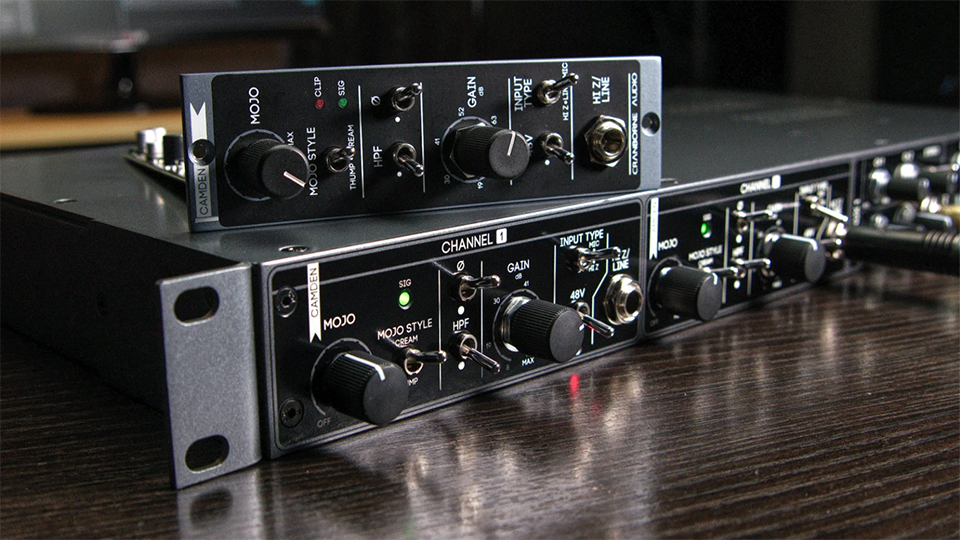
If you're new to the world of audio and are wondering what a mic preamp does and whether you need one for your home studio, you're in luck. We've put this guide together to answer all of your questions.
What Is a Mic Preamp?
The mic preamplifier, or preamp, is a device that increases the voltage of a mic’s outgoing signal so it can be strong enough to be processed by other audio equipment—it takes signal from mic level to line level (often boosting between 30-70 dB). It can also add a user-specified amount of gain to the signal which in turn increases the output volume.

Mic preamps, especially standalone analog preamps, can also add color, character, and/or warmth to your audio with the sonic characteristics determined by the type of technology and circuitry used to build the preamp.
Do I Need a Mic Preamp?
Technically, yes: all microphones need a preamp in order for the input signal to be strong enough to be heard, processed, and recorded. However, you don’t need to buy a fancy standalone outboard preamp to get your mic working properly, especially if you’re on a budget, just beginning your audio journey, or are working in a home studio.

The truth is that audio interfaces already come with built-in preamps. Everything from the popular entry-level Focusrite Scarlett series to the more expensive home-studio interfaces, such as the RME Babyface Pro, have solid preamps that can sufficiently power most types of microphones. So if you're a newcomer to the world of home studios, an external preamp is usually unnecessary.
Why Should I Buy a Preamp?
As mentioned, all you need to get started recording audio with a microphone or instrument is an audio interface. But if you’ve been making music for a while now, an external preamp might be a worthy investment.

While you’re always limited to the number of inputs on your input device, an external preamp will increase the number of mic inputs you can have running on your interface or mixer while recording—especially useful if you’re recording drums, full bands, choirs, and other larger outfits with an interface that has multiple inputs but only one or two mic pres. That, along with the power, polish, and prestige a great outboard preamp can give your recordings, your sound will attain a certain cache that’s more than worth the price of admission.
If you need that final push—the energy and eccentricity to get your recordings up to snuff with the most radio-ready sound out there—then a mic preamp should be something you start budgeting for today.
Before the Preamp, Buy a Good Microphone—or Two
Yes, microphones can be expensive, but so are preamps. And at the end of the day, having even a small arsenal of mics that can complement, highlight, or enhance the sound qualities of your vocalists will give you more creative flexibility than a single preamp.

Transparency is, of course, the number one priority when choosing a mic. And if you have the cash, it might be wise to just invest in a high-end mic, like the AKG C414 XLII. It's one of the most well-known and versatile condenser microphones on the market, and it's likely that you'll find it in virtually every professional recording studio.
A Preamp Won't Fix Bad Vocals or Poor Room Acoustics
If you're unhappy with the sound you're getting from your current recording setup, it simply might be that you're not recording quality vocals or your room acoustics and/or positioning of the vocalist in relation to the mic is degrading your recording. So, before investing in a pricey preamp, make sure your singer is good, insulated from sound well, and positioned at the correct distance from the mic. It might also be smart to tinker around with different gain levels to find the sweet spot for your vocalist. Any kind of clipping or distortion is usually a result of the gain level being set incorrectly.

What Mic Pre Should I Buy?
Mic preamps come in many sizes, shapes, and designs. Some are small boxes that can sit on your desktop and be a conduit between your interface and microphone, and others are rack mounted beasts that are used by the top studios in the world. Anyone who is looking for a serious mic pre should budget at least $1000, but those who are on a tighter budget have some great options as well. Here’s a small sample of some of our favorites on offer at B&H, but there are a bevy of options you can consider on our online storefront.
Budget Home Studio/Hobbyist Tier (<$500)
Usually single or dual input, these modules do little more than juice your signal to a hot enough level for recording while adding a bit of saucy harmonic distortion on the side, especially if it’s a tube based pre. These are perfect for solo outfits or for getting your expensive dynamic mic up to a level where you’ll start to hear the money.

- ART Tube MP Studio V3 Microphone Tube Preamplifier
- PreSonus TubePre v2 - Tube Preamplifier/DI Box
- Warm Audio WA12 MKII Single-Channel Preamplifier
Professional Home/Small Studio Tier (<$1000)
Leveling up a bit from the last tier, these preamps can have multiple channels or are single channel modules that have the sound and character that is well-regarded or even legendary in the industry.

- Warm Audio WA73-EQ Single-Channel Microphone Preamplifier and Equalizer
- Lion Audio Auteur Quad2 4-Channel Microphone Preamp
- Cranborne Audio Camden EC2 Microphone Preamp, Processor, and Headphone Amplifier
Mid-Sized Pro Outfit Tier (<$3500)
These preamps usually hold the same form factor the last tier but have significantly more impressive internal hardware that will make your mics and instruments bathe in saccharine harmonic distortion. Many pres at this tier can have up to eight inputs, but some single channel modules exist at this price—stuff that will make any engineer’s ears perk up.

- API AUDIO 3124V 4-Channel Microphone Preamp
- Focusrite ISA 828 MkII
- Avalon Design V5 Pure Class A Microphone Preamplifier
World Class Tier (<$∞)
If you must have the best the world has to offer, and you’re in the position where checking your bank account is entirely unnecessary, these preamps are the world class stuff used in the most prestigious recording studios.

What About Preamp Plugins?
If seeing some of the eye-popping prices of these devices scares you off, you’re still in luck—rather than spending all this money and research time on a preamp with the perfect sound characteristics, you can opt for a software preamp plugin if you’re not insistent on running an all-analog setup.
With the modern advancements of computation and digital audio technology, a lot of companies offer plugins that near-perfectly mimic the sound characteristics of best-selling, real-life preamps, making them relatively simple to use (due to no installation or physical routing) while allowing you to wield these powerful tone-shaping tools at a fraction of the cost. While you won’t get that analog “magic” that comes from the individual, discrete, and bespoke circuitry of physical audio gear, nor the physicality of interacting with a real-word machine, only the most puritanical of analog-obsessed audio engineers may notice a difference in the nature of the sound—and chances are, even they won’t be able to tell the difference.
Connecting the Preamp to Your Interface
This is pretty easy. Whereas your mic preamp accepts a mic-level signal, the output of your mic preamp will be a line-level signal. Most interfaces, such as the MOTU M2, are equipped with all-in-one XLR-1/4" combo input connectors that accept the line-level signal from your mic preamp. All you need to do is use an XLR or 1/4" cable between the two devices; the interface will automatically sense that it's a line connection rather than a mic connection.

For more information about the products listed above, including additional features, specs, and highlights, be sure to check out the detailed product pages. Or feel free to reach out to one of our audio experts online or at our Midtown store, and we'll do our best to answer all your comments and questions.
