Search results for: photography buying guide understanding auto exposure
About 7 filtered results
by Mathew Malwitz · Posted
Most photos consist of a balance between bright and dark tones, creating what we typically consider to be “proper exposure.” In proper exposure, there should be ample detail in all areas of the image, no matter how dark or how bright. At least, that’s what we should do when trying to capture a balanced exposure.
Balance, while important to most photographic situations, is not always best for a scene. There are

by Rebecca Melville · Posted
An on-camera flash is an indispensable accessory for many photographers. While it provides light to supplement dark conditions, an on-camera flash also allows you to achieve more balanced exposures in daylight conditions, permits freezing of fast-moving subjects, and can even be used to control other flash light sources. With so much to offer, an on-camera flash can become an integral part of your workflow, but where do you start? We are going to give you the on-camera flash rundown with everything you need to know to make the most of this

by Mathew Malwitz · Posted
What better place to spend a Saturday morning than the zoo. You can enjoy some time outside, all while seeing a variety of both local and exotic animals you'd otherwise never dream of encountering. Zoos also are great place to try your hand at photographing wildlife! In this guide, we're talking about taking our camera to the zoo to capture natural looking images of animals in their element! We'll be covering what you need as well as tips and tricks that'll help you capture stunning, natural looking images of animals.
Above photograph © Mathew

by Luke Rollins · Posted
Where other camera-makers might have the specs or the buzz, only one has the throne: Canon. Industry reports indicate the company has notched yet another year atop global sales of interchangeable lens cameras, extending that reign to 21. Yes, Canon's reign is now old enough to drink. And that's not to say their 2025 was booze-addled, but rather that there may be some unease in the

by Bjorn Petersen · Posted
While film photography tends to take a back seat to digital photography nowadays, many photography programs still teach film photography to help you gain a better understanding of how the basic photographic process works. Without computers and an LCD screen to fall back on, shooting with film helps to reinforce technique and make you learn, understand, and trust yourself while shooting.
Film
The most obvious thing someone needs to begin his or her education in film photography is
by John Harris · Posted
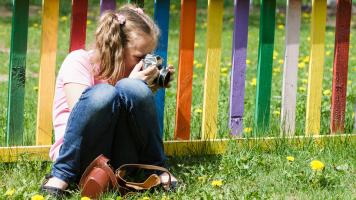
When you search “Cameras for Kids” on the B&H website, you get a small selection of cute cameras with princesses or cartoon characters on them. While these cameras are certainly functional and affordable and may be appealing to some toddlers, I feel that most kids age 5 or older are ready for a “real” digital camera. Have you seen a 2-year-old pick up an iPhone? It’s like they were born knowing how to buy an app. To wit, the other day I was

by Shawn C. Steiner · Posted
An on-camera flash, also known brand-wise as a “speedlight” or “speedlite,” is an indispensible accessory for many photographers; it provides additional light when conditions become too dark to handhold your camera comfortably, allows you to achieve more balanced exposures in daylight, permits freezing of fast-moving subjects, and can also be used to control or trigger other flash light sources. Additionally, a flash can be used as a highly effective creative tool to establish an aesthetic that elevates your imagery when lighting conditions