Search results for: photography tips solutions 10 digital photography tips for better pictures
About 26 filtered results
by John Harris · Posted
It would be foolish to claim that there is only one way to take a portrait, but there are some accepted norms and basic camera settings that you should understand if portraiture is to become your area of photographic interest. Remember though, as you walk down your creative path, that a portrait is more than a headshot, more than a beautiful photo of your subject; it is an opportunity to get to know someone, to have a visual conversation with a person, and to use your photographic skills to pass that understanding of the person on to the

by Steven Gladstone · Posted
Whether you’re a student or a seasoned veteran, selecting the right camera can make your head spin with questions. Does sensor size matter? What’s the difference between 4:2:0 and 4:2:2? Do I really need a camera that can record 8K? What about raw? We’ll explain the key components that help a camera produce cinematic images, and in doing so, hopefully help you make that all-important decision.
Evaluate Your Needs and Your Budget
Before considering certain cameras, you must know your needs and your budget. And be realistic. If you are a student

by Jill Waterman · Posted
Making pictures by night is a curious practice. While specialists of this subject embrace it as a deep-seated passion and have a never-ending quest for technical and creative advancement, those more familiar with daytime photography are often unaware that tried and true photography rules often need to be adapted or even overlooked at night. With this in mind, consider the following tips the next time you venture out in the darkness, to help you to adapt.
1. Take a Chance and Explore the Unknown
What’s my exposure time? This is the number one

by Todd Vorenkamp · Posted
1. Shoot every day Like any skill, the more you do it, the better you can get. The best camera you have is the one in your hand, so if you aren’t out with your full DSLR kit, don’t be afraid to take great photos with your cell phone camera or a point-and-shoot. Photography is photography, make pictures with a camera. Any camera.
2. Always have your camera near Pull up a chair and I can describe two amazing scenes that have been indelibly embedded in my mind. Unfortunately, for the first, my camera was broken (I was at sea, far from

by Todd Vorenkamp · Posted
Thirty? Really? Thirty questions for every photo? The title of this article might make you think there’s a burdensome checklist that must be completed every time you release the camera’s shutter.
There is not.
However, if you want to take your photography to new dimensions, this list of questions—some dealing with the physical act of the photograph and some dealing with the inner thoughts behind the image—might be just what you need to get your head, feet, or camera in the right place, to help make a good photograph great or a great photograph

by Allan Weitz · Posted
Am I the only one who thinks it’s funny that when a new smartphone debuts, the only thing people ask about is the camera? Is it a decent phone? Nobody cares. Does the caller sound like they’re calling from Mars? If they do it’s not the phone—contact your carrier. The only things people seem to care about are how many megapixels and how many lenses it has.
Unlike earlier-generation smartphones, which typically had a single semi-wide-angle camera lens with some form of digital zoom, today’s smartphones offer multiple lens options that enable you

by Jill Waterman · Posted
Each autumn, as the days get shorter and the weather cools, chlorophyll production slows in hardwood trees and bushes, causing leaves to lose the vibrant green of summer. As these conditions overtake the map, nature puts on a brilliant show of color in many parts of the United States. The changing of the leaves follows a rough pathway from north to south, starting in early September and often lasting into November in southern locales.
Above photograph: Colorado Gold, Maroon Bells Scenic Area © Bryan Carnathan
Fall foliage season is a big draw

by Allan Weitz · Posted
Over time I’ve been fortunate to have been able to shoot with almost every type of film and digital camera imaginable. The funny thing is, out of all of them, the camera that to this day amazes me the most is a pinhole camera I made out of a shoe box. Best part? I used it to photograph a magazine story and (thank goodness) the editors loved the results.
All Photographs © Allan Weitz 2020
Pinhole cameras are as basic as it gets. A darkened box with a pinhole on one side and a piece of photosensitive paper or film on the opposite side of the

by Allan Weitz · Posted
Image sharpness is an important part of the equation when purchasing a new lens. Who among us has purchased a lens without first inquiring about, among other things, how sharp the lens is? Anybody?
Don't get me wrong. Lens sharpness is an important piece of criteria when it comes to purchasing a new lens and that's because, just like you, I only want sharp lenses regardless of whether the lens is a pricier OEM lens or a lower-priced, third-party lens. If the lens isn't sharp, "Feh—I don't want it."
Photographs ã Allan Weitz 2020

by Allan Weitz · Posted
FAQ is a new ongoing series of B&H Explora posts regarding frequently asked photography-related questions. Topics we plan on covering include cameras, lenses, flash, accessories, and photo technologies. Many of the questions we’d like to answer will be based on feedback from our in-house experts at the B&H Chat lines and online sales. We’ll also choose topics based on listener feedback, so if there’s a topic you’d like us to address, let us know about it in the Comments field that follows this post.
Our first FAQ topic is image

by Allan Weitz · Posted
The practice of hand-coloring black-and-white photographs can be traced all the way back to the days of daguerreotypes, which predates Instagram creative filters by about 180-plus years. In a bid to add life to the putty-like tonality of many of the earliest print technologies, photographers would very carefully brush thin layers of color pigments mixed with gum arabic (or quicker-drying mixtures containing alcohol) onto the cheeks, hair, and outerwear of portrait sitters. With the advent of paper print processes and tintypes, the use of

by Jill Waterman · Posted
Ami Vitale has a remarkable affinity for life-changing events. A native of South Florida, Vitale was a self-described shy, gawky child who, like many young girls, possessed little confidence. The assessment of a grade school teacher, who told her she was not very good at English, stuck with her for years. “I just thought that I had no ability as a writer, or as a creative person,” she says. “I remember thinking I was going to become an engineer because I had almost perfect math scores on my SAT.”
Photographs © Ami Vitale
by Allan Weitz · Posted
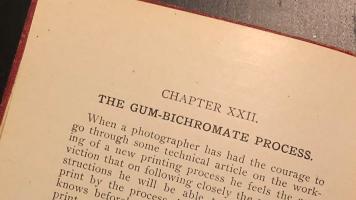
Some years ago, I stumbled upon a book called The Photographic Instruction Book, by Townsend T Stith © 1903. The book was filled with all sorts of advice on how to take successful photographs using the tools and technologies of the day. Surprisingly, many of the Mr. Stith’s suggestions, including advising against taking pictures from moving bicycles, hold true today.
I especially enjoyed reading the instructions for what we nowadays call “alternative processes,” including cyanotypes and gum bichromate prints, aka gum prints.

by Allan Weitz · Posted
Agfa Scala was a wonderful, ISO 200 black-and-white slide film that was produced about 25 years ago. Scala had an amazing tonal range with rich blacks and lovely highlight detail. If there was a downside to shooting Scala, it was that there was only one lab in the US that would process Scala—Duggal Color Labs, in New York City. Luckily, I worked down the street from Duggal so, for me, it wasn’t a hardship.
Then digital technology bulldozed the business and like many films, Scala became a thing of the past, and instead of shooting black-and

by Allan Weitz · Posted
As a working photographer, the center of the universe is your camera bag and its contents. Your cameras and lenses are the tools of your trade. As you may have noted, both are mentioned in plural because just as you wouldn’t jump out of an airplane without a backup parachute, you shouldn’t attempt to photograph an emotionally spiked, non-repeatable event armed with only one camera. The same applies to lenses, too. The many aspects that comprise shooting weddings—portraits, the ceremony, dimly lit environs, tight, crowded quarters and bright