
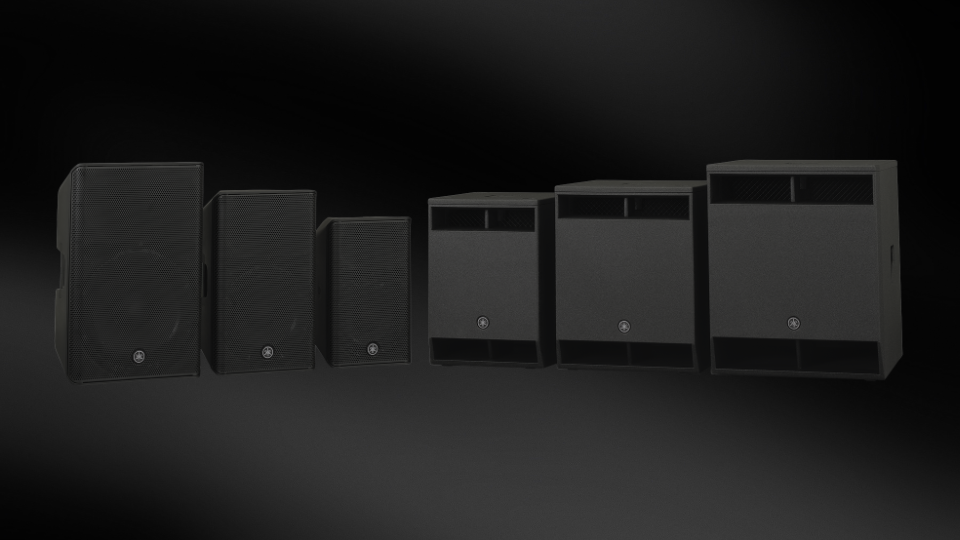
Yamaha has announced the release of the passive CXR/CXSmk3 loudspeaker and powered/active DXR/DXSmk3 subwoofers. They look to offer live venues and fixed installation firms new and improved features, easier installation, and better sound quality.
Every product in the new series offers bigger horn sizes, central ports that reduce wind noise and standing waves, symmetrical design for easier mirrored placement, and two-angle pole sockets (0˚ and 7˚) to choose from.
Because low-frequency sound has nebulous directionality, sub frequencies often bleed onto the stage, causing feedback and monitoring issues. With these new Yamaha subs, a pair of them can be used in cardioid mode—one facing the audience and one facing the stage—to cancel out the sound going to the stage while allowing the audience to enjoy floor-shaking rumble.
Additionally, the subs now use SpeakON cables for simpler cabling and have pole sockets compatible with ø35mm and M20, along with optional silent casters that can be installed at your discretion.
The DXRmk3 and DXSmk3 powered speakers offer a suite of features enabled by its on-board power system:
-
FIR-X tuning™ uses FIR filters in the built-in crossover to tune and improve phase and frequency response
-
DSP Mode can be turned on and set between a “FOH/Main” function when placed vertically or “Monitor” when placed horizontally as a wedge, used to control playback frequency bands, or to select the cutoff frequency and LPF/HPF coupling/uncoupling for flexible application.
-
Bluetooth connectivity allows you to play and control music from a smartphone, as well as use D-Remote to control and monitor the speakers from anywhere in your event space.
Both new lineups will come in three different cone sizes and specifications.
Here’s the rundown of the basics:
CXR Passive 2-way Speakers w/ Bass Reflex, Subwoofer w/ Bandpass:
| Name | Transducer Diameters | Power Rating | Impedance | Crossover | Max SPL |
| CXR15Mk3 |
15” Cone 3” Voice Coil |
600W RMS | 8 Ω | 1.8kHz | 126dB SPL |
| CXR12mk3 |
12” Cone 2.5” Voice Coil |
550W RMS | 8 Ω | 1.9kHz | 124dB SPL |
| CXR10mk3 |
10” Cone 2.5” Voice Coil |
550W RMS | 8 Ω | 2kHz | 123dB SPL |
| CXS18mk3 (sub) |
18” Cone 4” Voice Coil |
1000W RMS | 4 Ω | N/A | 129dB SPL |
| CXS15mk3 (sub) |
15” Cone 3” Voice Coil |
650W RMS | 4 Ω | N/A | 126dB SPL |
| CXS12mk3 (sub) |
12” Cone 3” Voice Coil |
650W RMS | 4 Ω | N/A | 125dB SPL |
DXR Active 2-way Bi-amped Powered Speakers w/ Bass Reflex, Powered Subwoofer w/ Bandpass:
| Name | Transducer Diameters | Power Rating | Crossover | Amplifier Class | Max SPL |
| DXR15mk3 |
15” Cone 3” Voice Coil |
1000W RMS (LF: 850W, HF: 150W) |
1.8kHz | Class-D | 134dB SPL |
| DXR12mk3 |
12” Cone 2.5” Voice Coil |
1000W RMS (LF: 850W, HF: 150W) |
1.8kHz | Class-D | 134dB SPL |
| DXR10mk3 |
10” Cone 2.5” Voice Coil |
1000W RMS (LF: 850W, HF: 150W) |
1.8kHz | Class-D | 132dB SPL |
| DXS18mk3 (sub) |
18” Cone 4” Voice Coil |
1250W RMS | N/A | Class-D | 134dB SPL |
| DXS15mk3 (sub) |
15” Cone 3” Voice Coil |
1250W RMS | N/A | Class-D | 133dB SPL |
| DXS12mk3 (sub) |
12” Cone 3” Voice Coil |
1250W RMS | N/A | Class-D | 132dB SPL |
These new series of Yamaha loudspeaker/sub combos are set for release mid-2026 and look to make installation and use easier than ever before. Venues and event spaces looking to upgrade, be on the lookout for the new Yamaha CX and DX systems!
