Search results for: video tips solutions high frame rate video shooting
About 29 filtered results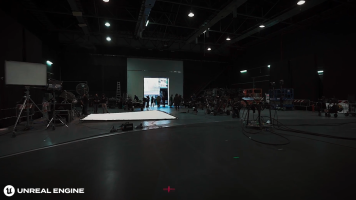
by Steven Gladstone · Posted
Your virtual production (VP) system isn't just playing back high-resolution video in the background. To work as believable 3D your system must be able to render in real-time and in high frame rate realistic 3D environments. To create and playback these environments you need creation software.
What Is Unreal Engine?
Simply put, it is an advanced real-time creation tool that powers your virtual production. It is based on 3D computer graphics gaming engine, and I remember playing Unreal as a multiplayer first-person shooter game, way back in the

by Luke Rollins · Posted
Video performance was a stealth strength of the a7R V, and in this next-generation a7R VI Mirrorless Camera, the improved performance moves the camera from “if you know you know” to video headliner. Sony’s latest acknowledges the new hybrid table-stakes for professionals and creators by delivering video quality worthy of the “R” imprimatur.

by Mathew Malwitz · Posted
What better place to spend a Saturday morning than the zoo. You can enjoy some time outside, all while seeing a variety of both local and exotic animals you'd otherwise never dream of encountering. Zoos also are great place to try your hand at photographing wildlife! In this guide, we're talking about taking our camera to the zoo to capture natural looking images of animals in their element! We'll be covering what you need as well as tips and tricks that'll help you capture stunning, natural looking images of animals.
Above photograph © Mathew

by Steven Gladstone · Posted
Whether you’re a student or a seasoned veteran, selecting the right camera can make your head spin with questions. Does sensor size matter? What’s the difference between 4:2:0 and 4:2:2? Do I really need a camera that can record 8K? What about raw? We’ll explain the key components that help a camera produce cinematic images, and in doing so, hopefully help you make that all-important decision.
Evaluate Your Needs and Your Budget
Before considering certain cameras, you must know your needs and your budget. And be realistic. If you are a student

by Zack Young · Posted
Any photographer worth their salt should be familiar with portrait photography, but they’re likely less familiar with high-volume photography, an offshoot of traditional portraiture that focuses on providing large quantities of professional-level headshots. The most common clients for this type of work include schools, sports teams, large corporations, government-run entities, and basically any other organization that needs a sizeable amount of quality headshots in a short amount of time. Because of the economies of scale, high-volume

by Zack Young · Posted
Enter the Sony BURANO 8K Digital Motion Picture Camera, Sony's newest jack-of-all-trades cinema camera that aims to combine the best features from the company's CineAlta, FX, and Alpha lines. Part of its versatility comes from the array of recording formats and resolutions it can capture, as well as a physical camera body that can accommodate a range of accessory options. So, what recording modes should you be using and how

by Zack Young · Posted
Whether you’re talking hue, saturation, exposure, or white balance, modern cameras can capture video in extremely flexible codecs and color spaces that give you a lot of headroom to tweak settings during post-production. But that freedom comes with a warning: if the highlights or the shadows are clipped, there’s no bringing back that information, as the camera simply didn’t capture it. That means you can have

by Stepan Andranikian · Posted
Following its electrifying debut in 2020, the Sony FX6 quickly established itself as a true powerhouse in the world of compact cinema cameras—thanks, in part, to its exceptional image quality, low-light dominance, and feature-packed design. Today, Sony's Cinema Line is more robust and well-rounded than ever, with the FX6 sitting firmly between the tried-and-true FX9 and the more recent FX3.

by Rebecca Melville · Posted
Even the most attentive creator can miss a mistake when reviewing footage on a tiny LCD screen, which is why an external camera screen (also known as an on camera monitor) is such a vital addition to any serious creator's gear pack. These screens come in many forms and are increasingly decked out with luxe features to make shooting more enjoyable. If you are in the market for an external camera screen, we have compiled some helpful information to keep in mind

by Steven Gladstone · Posted
Vlogging—video blogging—has become a powerful way to share your personal experiences with people around the world, and the Sony ZV-1 has established itself as one of the most powerful tools for vloggers who want sharp video and clean audio to reach their followers. Designed for the vlogger, the ZV-1 is tiny and lightweight, which makes it ideal for a vlogging camera, but within its small chassis lives a powerhouse of image capture for video

by Shawn C. Steiner · Posted
Time lapses feel a lot like photography during capture stages and a lot like video during the editing process. Creating them is a common progression for photographers looking to dip their toes into video and motion because you can start making high-quality time lapses with your current still photo equipment. If you are starting to tackle time-lapse projects, applying some video tricks can help smooth out your final product.
The Absolute Basics
I’m hoping that by the time you make it to this article you already have a basic understanding of how

Posted
In early July 2020, Canon announced a pair of EOS R-series cameras that should prove to be true game changers in the world of mirrorless cameras. The new cameras are the Canon EOS R5 and R6. Both are full-frame cameras—the R5 features a 45MP sensor, the R6 features a 20MP sensor—and have amazing stills and video. The following is everything else you need to know about these exciting new cameras.
Also, at the top of this page is a replay of our Live Q&A with Canon Technical Expert Rudy Winston. You'll find some questions have an
by Steven Gladstone · Posted
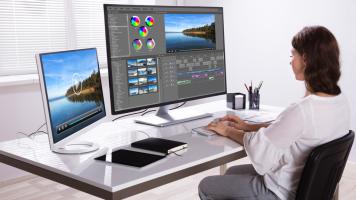
In/Out, Up/Down—it seems like everything takes everything today, and spits it all out. It wasn’t always the case. Now you can just let the technology do all the work, and the thinking too, but that is where you can run into trouble. Monitors are great for taking a wide range of image formats and even converting them for output. However, monitors are for evaluating your images, not for making the best video format conversions. So, although onboard monitors do a good job of displaying a useful image for your production, beyond that, you really

by Steven Gladstone · Posted
Once upon a time, compression was a dirty word, but the reality is that compression is occurring throughout the image taking process. Your lens compresses the image, unless you are shooting 1:1 macro. You could consider the Bayer filter on your sensor a form of compression, (referred to as Color Sampling Ratio) and, of course, there is the codec (compressor/decompressor), format, and bit-rate you choose. All this happens before your images even get to the recording media. So, compression is hidden throughout your image and, by itself,

by Shawn C. Steiner · Posted
There are plenty of ways to change the look of your film or video; it could be by changing the aperture, turning on a light, or even simply taking the camera off the tripod. If you really want to start experimenting, though, one of the most interesting (and fun!) ways of doing this is to start playing with the frame rates. Relatively speaking, it wasn’t all that long ago that inexpensive cameras started to shoot in Full HD at 24 fps, so we are exceptionally lucky today that options like the