Search results for: video tips why shoot video with a dslr mirrorless camera
About 23 filtered results
by Mathew Malwitz · Posted
Who doesn’t love a close-up shot of a flower or bumble bee? Some of the most beautiful aspects of nature are quite small and require special tools to capture them in a meaningful way. Whether it be of a cute little insect visiting our garden, or miniature figurines you paint and sell, we need a camera that can focus close and deliver good, quality results.
Before you panic, hear us out. We don’t need to get carried away with complicated lenses and accessories, and can just enjoy yourself with a simple compact,

by Mathew Malwitz · Posted
We’ve all tried to photograph something up close. This small-scale world fascinates us all, whether it be a stunning flower or a bumble bee crawling about, but our cameras can’t seem to focus as close as we want. So, what is a struggling photographer to do?
There are several ways to do close-up, or "macro" photography, but the

by Mathew Malwitz · Posted
Back in the good old days, during the infancy of autofocus, you had two options when it came to autofocus: On or Off. Now, with advancements in technology, many cameras, even simple point-and-shoot cameras, have a dizzying array of high-tech autofocus modes to choose from. Honestly, they can be intimidating to even to the most experienced shooters.
Before we dive in, be forewarned: almost every manufacturer has proprietary autofocus technology, nomenclature, and features. Even more confusing, the interface to access these modes can often

by Steven Gladstone · Posted
Whether you’re a student or a seasoned veteran, selecting the right camera can make your head spin with questions. Does sensor size matter? What’s the difference between 4:2:0 and 4:2:2? Do I really need a camera that can record 8K? What about raw? We’ll explain the key components that help a camera produce cinematic images, and in doing so, hopefully help you make that all-important decision.
Evaluate Your Needs and Your Budget
Before considering certain cameras, you must know your needs and your budget. And be realistic. If you are a student

by Mathew Malwitz · Posted
As you begin to research cameras, you’ll likely hear some technical jargon about sensors. While it’s easy to ignore some elements of any devices, there’s no way to work around sensors. But what is a sensor and what does it do? In this guide, we’re diving into the often confusing world of imaging sensors. By time we’re done, you’ll have a better understanding of the most significant component in our digital camera.
About Sensors
What Is an Imaging Sensor?
At the heart of our digital cameras sits an imaging sensor, which serves as the digital
by Shawn C. Steiner · Posted
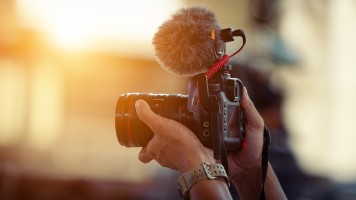
Audio is extremely important. Photographers haven’t really had to worry about this, but it is something that can make or break your videos. Watch some of your favorite movies and pay close attention to the sound—you will probably pick up some audio cues or effects that amplify the scene or action. If recorded poorly, audio can make something completely unwatchable. Have you ever opened a video online to crackling and noise and decided that it just wasn’t worth enduring? Clarity in audio is one of the most important things for keeping your

by Rachel Leathe · Posted
I can’t count the number of times a stranger has approached me while I’ve been setting up my drone to ask if they can watch the launch. I imagine this is how the world’s first television owners must have felt as the neighborhood kids crowded around the only television on their block to witness such groundbreaking technology.

by Rebecca Melville · Posted
Even the most attentive creator can miss a mistake when reviewing footage on a tiny LCD screen, which is why an external camera screen (also known as an on camera monitor) is such a vital addition to any serious creator's gear pack. These screens come in many forms and are increasingly decked out with luxe features to make shooting more enjoyable. If you are in the market for an external camera screen, we have compiled some helpful information to keep in mind

by John Harris · Posted
Sports photography is a true test for cameras. Perhaps more than any photo discipline, shooting sports photography leaves you little opportunity for a second chance and demands that your camera works at peak efficiency. I’ll save the classic caveat that you can shoot any subject with any camera for another article, and while I encourage all photographers to start with the camera they have, there should be little argument that cameras with a fast burst rate, good buffer depth, fast and accurate autofocus, a compatible lineup of telephoto lenses

by Shawn C. Steiner · Posted
Whether you want a professional look for your livestreams or simply to look better on your next video chat, one of the best options is to use a dedicated camera with excellent video specs—such as your Canon EOS DSLR, mirrorless, or PowerShot camera. To help facilitate the process Canon has introduced the EOS Webcam Utility for connecting the

by Jill Waterman · Posted
Ami Vitale has a remarkable affinity for life-changing events. A native of South Florida, Vitale was a self-described shy, gawky child who, like many young girls, possessed little confidence. The assessment of a grade school teacher, who told her she was not very good at English, stuck with her for years. “I just thought that I had no ability as a writer, or as a creative person,” she says. “I remember thinking I was going to become an engineer because I had almost perfect math scores on my SAT.”
Photographs © Ami Vitale

by Lawrence Cohen · Posted
Waterproof point-and-shoot cameras have changed the reason many people scuba dive. In the early days, ocean explorers like Jacques-Yves Cousteau used scuba and cameras to explore the deep for scientific research purposes. Now, sport and hobbyist divers want to capture images and video to share their underwater experiences. Simple digital cameras in basic housings allow all divers to capture underwater snapshots and movies. However, many divers want to take their imaging to new depths.
Using a DSLR or mirrorless camera with interchangeable

by Steven Gladstone · Posted
As filmmakers, we’ve all heard that it is important to get BTS video and on-set shots. On my last shoot, I handed a digital camera to a PA and said, “Take behind-the-scenes-stills.” This did not work out well, because I ended up with about 900 stills, of which 97% were useless. It wasn’t the PA’s fault—after all, this is a highly developed craft, and he had no idea what to photograph. I also had no idea what to tell him, so between his making coffee runs, picking up and dropping off actors, and driving the cube truck, he did his best.
I know

by Bjorn Petersen · Posted
When choosing the perfect camera for travel photography, there are myriad options available, depending on the way you like to shoot, how compact you want your camera to be, and how versatile your camera system needs to be. Ranging from ultra-compact point-and-shoots to sleek interchangeable-lens options, here are 12 portable cameras perfect for your upcoming travels.
1. Leica Q2
I’m an advocate of traveling with a single lens, and the Leica Q2

by David Adler · Posted
As someone prone to discussing video gear with just about anyone willing to engage in related conversation, one topic that is frequently brought up to me is the price and purpose of professional video gear and the seeming price disparity, in contrast to consumer or prosumer gear. In this installment of pro gear discussions, I will delve into what separates professional cinema lenses from their prosumer and consumer ilk.
Questions that I used to get while I worked in equipment rentals would commonly include, “Why do these cinema lenses cost so