Lighting Triggers & Remotes


2
Pieces
PocketWizard PlusX 2 Pack
- Compatible with FCC Compliant Items Only
- 2x PlusX Transceivers
- 1x 3.5mm Miniphone-to-Miniphone Cables
- 1x Locking 3.5mm Miniphone-to-PC Cables
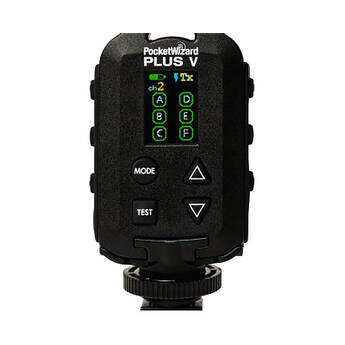
PocketWizard Plus Ve Transceiver
- New Compact Design with Removable Foot
- E Release Firmware Protocol
- Auto-Sensing from Tx and Rx Modes
- 32 E Flash Channels & 6 Zones
PocketWizard PlusXe Transceiver (2-Pack)
- E Release Firmware Installed
- Enhanced Range and Reliability
- Combination Transmitter and Receiver
- Full PocketWizard E Series Compatibility
PocketWizard PlusX Transceiver
- Compatible with FCC Compliant Items Only
- Combination Transmitter and Receiver
- 10 Channels with Backlit Channel Dial
- Auto-Sensing Transceiver
PocketWizard PlusXe Transceiver
- E Release Firmware Installed
- Enhanced Range and Reliability
- Combination Transmitter and Receiver
- Full PocketWizard E Series Compatibility
PocketWizard PowerST4 Receiver for Elinchrom RX
- Compatible with FCC Compliant Items Only
- Adjust Settings From Camera Position
- Auto or Manual ISO & Aperture Control
- Up to 20 ControlTL Channels Possible
PocketWizard Plus Ve Transceiver (2-Pack)
- New Compact Design with Removable Foot
- E Release Firmware Protocol
- Auto-Sensing from Tx and Rx Modes
- 32 E Flash Channels & 6 Zones
Exploring Flash Triggers and Radio Transmitters
Although many cameras, flash lights, and studio lights have wireless flash triggers and radio transmitters and receivers, these units have limited range, and are dependent on line-of-sight communication. In such instances, camera-mounted remote flash triggers offer increased flexibility, greater range, and an ability to trigger more than one set of lights simultaneously.
Understanding Infrared Transmitters
Low-cost infrared systems are effective for medium-range indoor and outdoor work. Transmitters slide into camera hot shoes and transmit signals to infrared receivers attached to flash or studio lights. Many lights have built-in infrared receivers, although separate infrared receivers may be more reliable. Most types support through-the-lens (TTL) light metering, while others have the ability to manually control flash output. If some lights aren't in direct line of sight, you can use optical slaves to trigger these lights.
Features of Wireless Flash Triggers
Wireless triggers operate on the same frequencies as other Wi-Fi systems and have multiple channels to ensure trouble-free communication. Each consists of a transmitter attached to the camera and one or more radio receivers attached to lights. Most use the 2.4 GHz radio frequency and have a TTL metering range of approximately 300 feet. Line of sight isn't important because wireless signals penetrate walls and structures, although signal attenuation does limit effective range. Transmitters using lower frequencies such as 900 MHz, 433 MHz, and 340 MHz have the potential for greater range.
Accessories for Wireless Radio Transmitters
In most instances, the camera's hot shoe controls the transmitters. However, you need to connect slave units to the remote flashes or strobe lights using appropriate radio slave cables. Additionally, if you're remotely triggering both the cameras and flash units, you may need camera cables. Other useful slave accessories include charging kits, hot shoe adapters, and flash zone controllers.
Measuring Incident Light with Light Meters
Managing the correct exposure is important. Although TTL metering works well with flash and strobe lighting, it's less effective as the distance between the cameras and sets increases, especially if you're working outdoors. In such instances, handheld light meters are more effective. While some read incident and reflected light, others also analyze flash intensity. Some models even control the power of strobe and flash lights to obtain the correct exposure.
Choose the best equipment for triggering and controlling your lighting at B&H Photo and Video.