Nikon SLR Camera Lenses

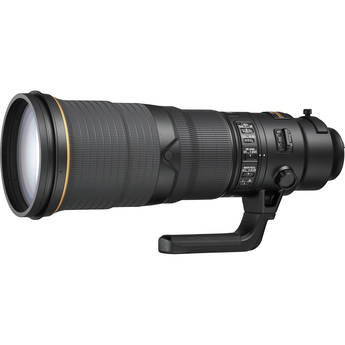
Nikon AF-S NIKKOR 500mm f/4E FL ED VR Lens
- F-Mount Lens/FX Format
- Aperture Range: f/4 to f/22
- Two Fluorite and Three ED Elements
- Nano Crystal & Super Integrated Coatings

Nikon AF-S NIKKOR 180-400mm f/4E TC1.4 FL ED VR Lens
- F-Mount Lens/FX Format
- Aperture Range: f/4 to f/32
- Built-In 1.4x Teleconverter
- One Fluorite and Eight ED Elements
Nikon AF-S NIKKOR 800mm f/5.6E FL ED VR Lens
- F-Mount Lens/FX Format
- Aperture Range: f/5.6 to f/32
- Two Fluorite and Two ED Elements
- Nano Crystal & Super Integrated Coatings
Choosing Nikon SLR Camera Lenses
When you choose Nikon SLR camera lenses for your Nikon DSLR cameras, you ensure seamless compatibility and quality performance. Critical features such as autofocus, vibration reduction, and aperture control are carefully calibrated to match your camera's characteristics.
What Are Nikon F-Mount Lenses?
Nikon introduced the F bayonet mount in 1959, and was one of the few manufacturers to retain the same mount with the introduction of autofocus capabilities. So, any F-mount lens will fit the current range of Nikon cameras, although features such as autofocus and electronic aperture control may only work in manual mode. Most lenses are forward compatible, meaning you can use them on newer cameras. Many current lenses are fully compatible with older cameras, too, although it's wise to check compatibility before purchase.
Nikon Full-Frame Lenses
Full-frame Nikon FX lenses work on any Nikon SLR camera, regardless of whether it's film, has a cropped sensor, or is a full-frame sensor. With adapters, they also fit the Nikon Z and older Nikon 1 digital mirrorless cameras. For historical reasons, full-frame lenses don't have FX as part of the lens name. Some lenses have Nikon's vibration reduction (VR) system that reduces the effects of camera shake. An ED designation means that the lens incorporates extra-low dispersion glass, which increases sharpness and minimizes chromatic aberrations. Another term related to glass quality is FL, which stands for the use of fluorite glass. Most lenses have autofocus capabilities, indicated by AF in the lens name.
Nikon DX Lenses
Lenses by Nikon with DX as part of their designation are for the company's range of cropped sensor cameras. While they physically fit full-frame cameras, their image circle is too small for complete sensor coverage. Many Nikon full-frame cameras recognize DX lenses and automatically crop photos to suit. These lenses are smaller and lighter than their full-frame cousins. Because DX cameras have a 1.5 crop, the focal length of Nikon lenses used on DX cameras is multiplied by 1.5 to obtain the sufficient focal length. Apart from this difference, Nikon uses the same nomenclature to identify lens features, such as vibration reduction and optical quality.
Nikon Gold Ring Lenses
Nikon uses a gold-colored ring mounted near the front of a lens to indicate that the lens is a ""gold ring lens"" intended for professional use. These lenses offer wider apertures that improve low-light performance and allow the use of faster shutter speeds. Also, they have low dispersion glass elements, aspherical elements, and special nano lens coatings (N) that together improve sharpness and optical performance.
Find the right Nikon camera lenses for your Nikon DSLR camera system at B&H Photo and Video.