Video Chat with a Pro Audio Expert - Live

Neumann BCM-104 Large Diaphragm Condenser Broadcast Microphone

BH #NEBCM104 • MFR #BCM 104
Print
Neumann BCM-104 Large Diaphragm Condenser Broadcast Microphone
Key Features
  • Radio, Streaming, and Podcasting
  • Dynamic Mic Capsule
  • Hypercardioid Polar Pattern
  • Integrated Elastic Suspension
The BCM-104 Large Diaphragm Condenser Broadcast Microphone from Neumann features a large-diaphragm, cardioid condenser capsule. It has a frequency response that is flat up to 3 kHz and then gradually boosted in the higher frequencies. If required, internal switches can be used to compensate for the proximity effect and to reduce the sensitivity by 14 dB.
More Details
In Stock
No Store Display
Free 2-Day Shipping
Protect Your Gear
Add a protection plan from $162.99
Ask an Expert
800-606-6969

Neumann BCM-104 Overview

The BCM-104 Large Diaphragm Condenser Broadcast Microphone from Neumann features a large-diaphragm, cardioid condenser capsule. It has a frequency response that is flat up to 3 kHz and then gradually boosted in the higher frequencies. If required, internal switches can be used to compensate for the proximity effect and to reduce the sensitivity by 14 dB.
This microphone is part of the B&H Virtual Mic Locker, an online tool to help our valued customers determine the sonic differences between popular microphones for podcasting and voice over work. Each microphone was recorded using a Grace Design M103 preamp into a Presonus Quantum 2626 interface.
Functional Design
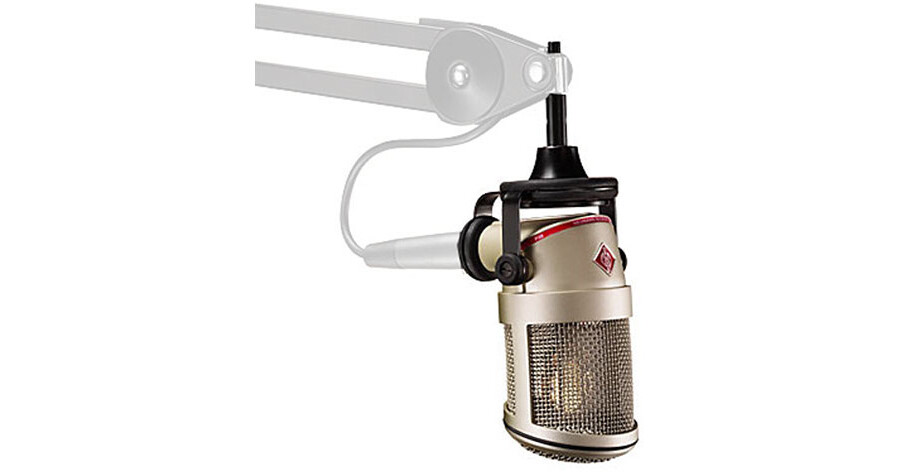
The microphone headgrille twists off for quick cleaning. In front of the capsule, mounted on a frame holder, a fine gauze serves as a built-in popscreen. The microphone has an elastic mount against structure-borne noise, that is compatible with standard broadcast-segment microphone arms.
K 04 Large-Diaphragm Capsule
The microphone headgrille houses the K 04 large-diaphragm capsule, which has a flat frequency response up to 3 kHz. Higher frequencies have an increased presence up to 2 dB. Since the above-mentioned microphone characteristics are obtained without the use of resonance effects, the microphone features excellent transient response and transmits all transient phenomena of music and speech without any coloration.
Removable Pop Screen
A pop screen not only prevents the occurrence of plosive pop noises in vocal recordings, but also efficiently prevents unwanted particles, from respiratory moisture, nicotine, to food remnants, from settling on the diaphragm. The pop screen can be removed for cleaning without the use of tools.
High-Pass and Pre-Attenuation Internal Switches
Instead of a transformer to couple the microphone output to the supply voltage, the BCM-104 has an electronic circuit which, like a transformer, provides for good common mode rejection. Interference induced in the balanced modulation line is thus suppressed effectively. With a very low self-noise of 7 dB(A), and an overload capability extending to 138 dB SPL, the BCM-104 has a dynamic range of 131 dB (A-weighted).

The BCM-104 amplifier has a linear operation down to 20 Hz. An active filter efficiently suppresses signals below this frequency. In order to compensate for the proximity effect, an electronic high-pass filter, activated by a switch, is built into the microphone. This filter reduces frequencies below 100 Hz by 12 dB/octave. A 14 dB pre-attenuation switch is provided in order to adjust the sensitivity, if necessary, to circuits designed for dynamic microphones. But this will increase the self-noise accordingly. Both switches are located inside the microphone housing, since they will normally be operated only once, when the broadcasting facility is set up.
Mounting and Elastic Suspension
The preferred mode of operation is to suspend the BCM-104 from a standard studio boom arm. A thread adapter to fit different connector threads is included. In order to provide protection from structure-borne noise, both the capsule and the microphone in its mount are elastically suspended.
UPC: 615104084834

Neumann BCM-104 Specs

Key Specs
Microphone Type
Large Diaphragm
Polar Pattern
Cardioid
Element Type
Condenser
Controls
No
Frequency Response
20 Hz to 20 kHz
Maximum SPL
138 dB (without Pad)
152 dB (without Pad)
Analog Output
1x XLR 3-Pin
Power Sources
Phantom Power
Microphone
Microphone Type
Large Diaphragm
Polar Pattern
Cardioid
Element Type
Condenser
Sound Field
Mono
Orientation
Side Address
Controls
No
Pad
-14 dB
Circuitry
Solid-State
Performance
Frequency Response
20 Hz to 20 kHz
Maximum SPL
138 dB (without Pad)
152 dB (without Pad)
Sensitivity
22 mV/Pa (at 1 kHz into 1 Kilohms)
Connectivity
Analog Output Connector
1x XLR 3-Pin
Power
Power Sources
Phantom Power
Operating Voltage
48 V
Physical
Color
Silver
Dimensions
ø: 2.5 x L: 3.35" / ø: 63.5 x L: 85 mm
Weight
1.1 lb / 500 g
Packaging Info
Package Weight
1.855 lb
Box Dimensions (LxWxH)
8.3 x 4.85 x 4.85"

Neumann BCM-104 Reviews

A VERY Good Broadcast Microphone

By Brian
Rated 5 out of 5
Date: 2026-04-10

This is a VERY well designed and thought out electret condenser mic, even for the Neumann line, and in this lineup is well priced for what it offers, compared to other Neumann mics. Specifically, The BCM 104 includes a built-in and very effective shock mount, switchable high pass filter and attenuator, and a (decent but not perfect) internal pop filter. Maintenance has been thought through and its grill is easily removed for cleaning - BUT BE CAREFUL NOT TO TOUCH THE CARTRIDGE!. In comparison to the Neumann TLM 103, it offers a somewhat similar sound but more (very useful) features, some of which are a significant extra expense (like the shock mount) on the TLM103. Its simply more capable and versatile than the TLM 103 or 102, yet is less well known - a "sleeper" mic. Compared to the venerable Electrovoce RE20 and popular Shure SM7B? I put them in the same category of quality/capability, but with distinctly different strengths, weaknesses and required EQ. As dynamics, the RE20 and SM7B are way tougher, still VERY versatile, do not require phantom power but need a LOT more preamp gain and different EQ for any given job. That said, all three mics take EQ very well and are a pleasure to use (for me). Is the BCM 104 worth the the more than 2x premium over the RE20 and SM7B? Depends - its always about the right tool for the job. The BCM104 is probably somewhat better for mixed broadcast/studio AND voiceover work, where the mic is NOT physically abused, and it CAN be used effectively on instruments as well, if you're careful about its handling. Also, its way smaller than the two other mics, so it intrudes less on voice talent. But the BCM is also more fragile internally - electrets usually are - and will likely not stand up to shock, moisture and heat quite as well as the dynamics DON'T manhandle the BCM 104 - the case is REALLY solid - but that terrific electret element is like a "bird in a cage". DON'T bang it up! The SM7B and RE20? They're pretty tough, go anywhere, do almost anything mics with a slightly more mellow sound and lower cost to replace if you make a mistake. Much more popular in broadcast and podcasing than the BCM104. But that "Neumann Sound" is alive and well in the BCM 104 is still pretty much king in voiceover, especially for clients who demand raw, unprocessed recordings. In the end, YOU need to decide if this is the right tool for YOUR work - and is worth the premium over other choices.

Nothing but the Best

By Gregory
Rated 5 out of 5
Date: 2020-09-29

Neumann makes great stuff all around and this microphone does not disappoint. Clear, crisp, and great sound pattern. Highly recommend for anything with vocals.
See any errors on this page?
Whatever You Need, We've Got It