Tokina

If you’re a storyteller who appreciates the rich, appealing natural look of classic films, Tokina’s new Vista-C Prime Lenses have you covered. This set of nine primes ranging from 18mm to 135mm combines a unique vintage look with the ease of a modern lens design, offering coverage for up to full-frame and large format sensors including VistaVision.
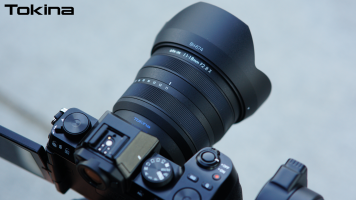
For years, Tokina has made some of the best wide-angle zoom lenses for Nikon, Canon, and Sony APS-C cameras. Now the brand is bringing this high-performance and quality lineage to the world of mirrorless with the new ultra-wide-angle zoom Tokina atx-m 11-18mm f/2.8 E lens for FUJIFILM X cameras with a 35mm equivalent focal length of 17-27mm.
Vintage lenses are taking over Hollywood! Two of the most visually impressive films from the past six months—Poor Things and Dune: Part Two—both utilized old rehoused glass in key scenes for super swirly bokeh and significant edge distortion. But what if you want that spherical distortion without the drawbacks of lenses built half a century ago? Tokina Cinema’s Vista-P line has you covered, offering a vintage look
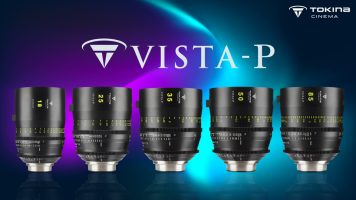
Tokina Cinema just announced the Vista-P Prime T1.5 collection, a new set of cinema lenses featuring five large-format primes with focal lengths of 18mm, 25mm, 35mm, 50mm, and 80mm. Intended to be an improvement over the coveted Vista Prime lineup, the new Vista-P Primes are designed to produce a uniquely vintage look, thanks to their low contrast and exceptionally stylistic bokeh.

As the holidays quickly approach, the pace of new product launches slows but it doesn’t stop. This week, we have a good lineup for video production to highlight. A couple of cine lens lineups are getting tweaked this week, with Tokina revealing a new character-filled version of its full-frame cinema primes, the Vista-P series, and Samyang/Rokinon adding a

Common sense says if you’re going to take sharp, dramatic photographs at a fast-action sporting event, make sure you have an autofocus lens that is at least 300mm or longer, and fast (f/2.8 or f/4) and, IMHO, preferably a zoom. As part of our coverage of Sports Week, I thought it might be fun to photograph the opening night of the 2021 racing season at the New London-Waterford Speedbowl using a lens that falls seriously short on all but one of those critical points of common sense.
Photographs © Allan Weitz 2021
The Tokina
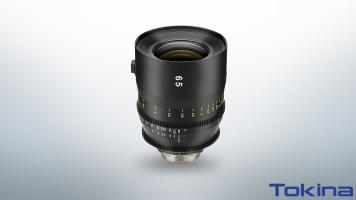
We here at B&H Photo are happy to share with you the news of the newest member of Tokina’s Cinema Vista line of full-frame lenses: the 65mm T1.5. Sharing the same features with other lenses in the lineup that make the Cinema Vistas an excellent choice for full-frame or VistaVision origination, the 65mm has the same robust build and quality, with a T1.5 maximum aperture and a 9-blade iris to deliver consistent exposure between lenses, thus avoiding relighting when swapping lenses, as well as maintaining the same pleasing bokeh.
The

Filtering ultra-wide-angle lenses, which are generally defined as lenses with diagonal angles of view of 90° or greater, can be challenging. And the greater the AoV, the more challenging filtering can become. The big problem has to do with vignetting, which in the case of filtering ultra-wide-angle lenses means seeing the edges of the filter in the corners of the frame.
In the case of full-frame cameras, this is seldom an issue with lenses in the 18mm to 21mm range (approximately 90° to 100° AoV) assuming you are using threaded, thin-mount

One of the most daunting aspects of stepping up to an interchangeable-lens camera is the startup cost of purchasing a camera body and a lens. Fortunately, camera companies and retailers, well aware of this financial deterrent, often team up on a solution: the “kit” lens. While technically kit lenses come in a wide variety of shapes, sizes, and price points, for the purposes of this article I am thinking of a specific lens many photographers have encountered at one point or another when buying a new camera: the “all-purpose” zoom that provides

0 Plays ·Posted
On this week’s episode of the B&H Photography Podcast, we welcome Kevin Rickert, who is a camera and lighting Senior Sales Trainer for B&H. Rickert teaches and updates the Pro Photo staff on all the features and specs of new cameras and often gets these cameras in his hands well before anyone else. Could there be a better guest for this episode, in which we discuss the many recent camera and lens announcements from the major manufacturers?
Much of the chatter in new

by Nate Luebbe ·Posted
Astrophotography is a nearly inevitable trajectory for any serious landscape photographer. It’s not surprising, really: spend enough evenings perched on a hillside documenting sunsets and you eventually get curious about what comes next. The world doesn’t disappear when the sky goes dark, and neither does the potential for striking photos. While, of course, the most basic equipment necessities are obvious (a stable tripod, for instance), choosing the correct lens

Looking to delve into the world of time-lapse and motion-control videos and panoramic photos? Read on for our hands-on review of the Syrp Genie Mini II and more. Designed to take advantage of new features introduced with the Genie II app, the Genie Mini II is a motion-control device compact enough to take along even on solo adventure treks.
This update on the original
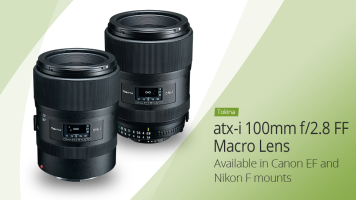
Tokina has announced the successor to its popular AT-X M100 PRO D Macro lens—the Tokina atx-i 100mm F2.8 FF MACRO. Slightly lighter (490 grams) and shorter (95.1mm) than its predecessor, Tokina’s newest 100mm macro lens is designed for portraits, landscapes, street shooting, commercial applications, and, of course, macro close-ups down to life-size (1:1).
Available in mounts for Canon EF and
Even with DSLRs declining in popularity and prominence, development of new lenses continues for these tried and true cameras. While production has slowed in the last few years, optics manufacturers are still working on putting out new glass to make the most of updated sensor designs and pushing the boundaries of how well a lens can perform, how compact and lightweight a lens can be, and filling in the gaps of desired focal lengths.
Pentax
Perhaps the most notable of DSLR stalwarts, Pentax continues to champion the history, reliability, and
Lens development for mirrorless cameras has been in full force throughout 2019, with more lenses from more manufacturers being released than ever before. With many new companies focusing on building new full-frame camera systems, along with the introduction of a few new lens-mount types, brands are chugging along at adding everything from the necessary staples to any well-rounded lens system to even beginning to add some more niche and exotic glass for those special circumstances. Here’s a look at some of the mirrorless lens highlights from