Search results for: photography buying guide rise mirrorless cameras
About 12 filtered results
by Mathew Malwitz · Posted
Choosing our first point-and-shoot camera can be a daunting task. There are so many cameras on the market, and at various price points. Do we need the most expensive model? Do we need the one with the longest zoom range? There’s a lot to consider, and a lot of options on the market, but which is right for us? Set tech specs aside and focus on the basics.
When choosing a compact camera, we must first consider what we’re photographing. That might sound obvious, but we can often be blinded by the size of a camera, a singular feature, or even the

by Luke Rollins · Posted
While 2025 continued many of the photo industry's developments (emphasis on hybrid developments, splashes of niche camera releases, sequels to established camera series), it also formalized the compact digicam trend that had emerged on social media in recent years, with several companies releasing (or re-releasing) point-and-shoot cameras. As the floor for image quality continues to rise, and with yesteryear's flagship features trickling down to today's mid-market offerings, manufacturers are distinguishing themselves through body design,

by Mathew Malwitz · Posted
This holiday season, we’re looking at fun and affordable lenses for your mirrorless systems. There will be both unique lenses and some overlap thanks to the vast number of third-party lenses hitting the market for all major brands. In this guide, we’re covering lenses for the Sony E mount. From ultra-wide-angle lenses suited for landscapes and architectural images to super telephoto ones for sports and wildlife, we’ll be covering a variety of focal lengths are variety of uses.
Lenses
7Artisans 10mm f/2.8 Mark II Fisheye Lens for Sony E
Outside

by Zack Young · Posted
Macro photography is one of the best ways to see the world in a new light. Give it a try and you might suddenly be pulling your camera out at the very mention of an insect, rare coin, or fuzzy speck of dust. But what are the best gifts to get the macro photography enthusiast in your life?
TTArtisan 40mm f/2.8 Macro Lens
The easiest place to start is also the simplest: an affordable, high-quality macro lens. If your giftee

by Rachel Leathe · Posted
What makes a camera good for landscape photography? In this article, we’ll dive into factors such as megapixel count, sensor size, usability, weather readiness, and design—helping you develop your own personal metric for finding the ideal camera. We’ll help you wade through all the technical mumbo jumbo to figure out what specs really matter, whether you want to capture stunning mountain ranges or shoot star-strewn night skies.
Megapixels
It doesn't get much more basic than megapixels. They're like the atoms of photography. But just how many

by Rebecca Melville · Posted
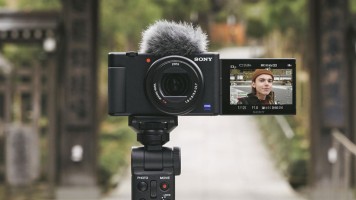
2023 has been another banner year for vloggers. Not only did we see new releases from familiar faces like GoPro and Sony, but big-name camera brands like Canon and FUJIFILM wheeled out their own vlog-specific and vlog-friendly cameras, making content creation more accessible than ever. With vlogging on the rise and showing no signs of stopping, you might be interested in getting a vlogging camera for yourself.
The vari-angle rear LCD touchscreen is a must-have for most content creation and vlogging. Vari-angle touchscreens can twist and
by Rebecca Melville · Posted
As vlogging continues its meteoric rise in popularity, more and more manufacturers are producing cameras specifically targeting vloggers. Of those manufacturers, none have produced more than Sony, whose extensive fleet of vlogging cameras continues to dominate the scene—led, of course, by fan-favorite and arguably greatest vlogging camera ever made, the Sony ZV-1.
In this article, we’re going to take a closer look at the ZV-1

by Todd Vorenkamp · Posted
Capturing amazingly sharp photos of birds in the wild is the goal of many birders. There are different ways to do this, but the most organic is using extremely long telephoto lenses for digital or film SLR cameras or mirrorless interchangeable lens cameras. Not only useful for photography, modern digital cameras also can record

by Bjorn Petersen · Posted
Just as mirrorless is now the dominant camera type, full frame is now the dominant sensor size. It wasn’t too long ago when full-frame cameras were seen strictly as tools for professional and high-end photo applications due to their expense and the associated feature sets that were part of the complete full-frame camera system. Over the last few years, however, full-frame options have begun to trickle down to the middle tier of interchangeable-lens camera development, with some instances placing entry-level full-frame cameras right alongside

by Bjorn Petersen · Posted
As cameras continue to evolve and impress, their newest features often play to the fast-paced multimedia world. For landscape photographers, the ability to minimize or eliminate the time it takes to print an image or display it online can have limited use, and tends to overshadow a range of core camera functions that appeal to our genre of photography. Landscape photography can arguably be one of the slowest-paced schools of image-making. As such, it does not have the same subset of requirements as many other categories of photography. Ranging

by Bjorn Petersen · Posted
When you look beyond the 24-70mm f/2.8, the 50mm f/1.4, and the 18-55mm f/3.5-5.6 lenses of the photography world, you can quickly discover there is a huge array of exciting, noteworthy, or in some cases, just weirdly enticing optics. And once you dig even deeper than the 12-24mm f/2.8, the 58mm f/1.4, or the 200mm f/2, you get to some of the most unique optics out there; a select group of lenses that instantly trigger a picture in your mind or are simply well known for how they operate, look, or even just the prestige they exude. Though some

by Josh Taylor · Posted
How does a rangefinder camera work? What were the landmarks in rangefinder camera design? How have they influenced photography over the years? What are their pluses and minuses compared to SLRs? What do they do best, and why?
In the late 19th Century, there were two dominant camera types:
1. View cameras that required you to compose the shot upside-down and in reverse on a ground glass, and focus by moving the lens back and forth until the subject looked sharp. You then inserted a plate or sheet film holder in the exact same image plane,