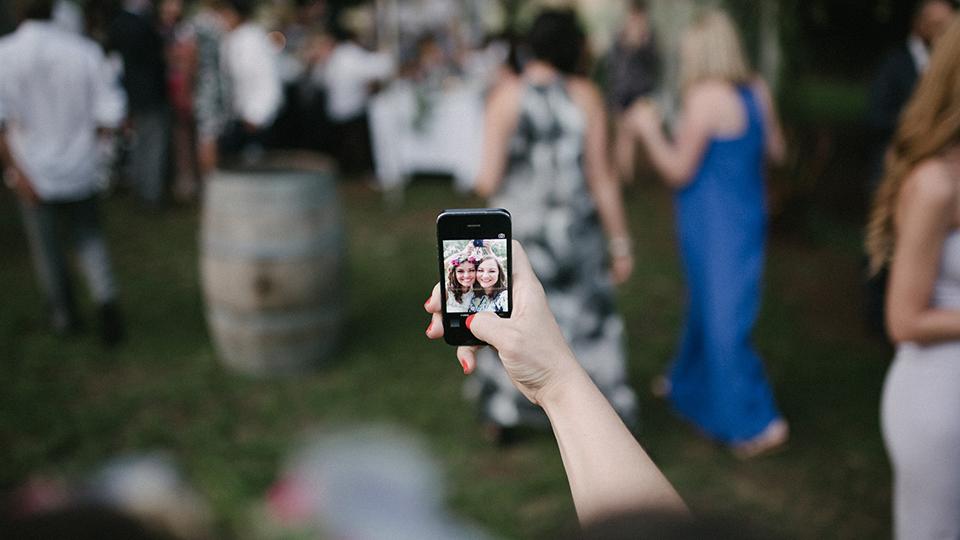
Everyone is a photographer these days, with iPhones or other devices constantly at the ready, and anxious to capture every photogenic moment or significant event—from daily selfies to pivotal moments in the lives of family and friends. Nothing is sacred amid this picture-taking frenzy, not even the complex orchestrations of a wedding day.
Above photograph: © Jai Long, Free the Bird Photography
So, what can a professional wedding photographer do to stem the tide of snap-happy wedding guests, oblivious to the fact that they are homing in on your territory? We asked seven pros for some strategies that offer them the best results.

“An unplugged wedding!” exclaims New York City-based wedding photographer Paige Denkin. “It’s a thing and I highly recommend it.” Denkin, who is preparing for her own wedding this fall, notes that this is a question her own wedding planner recently brought up.
“I’ve seen it handled two different ways,” Denkin says. “One was a very pretty message, written on a chalk board up at the front. It said, ‘Live in the moment, don’t worry about capturing the details. Someone is here to do that for you.’ In the other instance, it was mentioned by the officiant, who had a very clever, easy way of saying it.”
A business strategy Denkin has adopted to protect herself and her work methods is to include a clause in her wedding contracts to specify that no other professional flash photography is allowed.
“It’s usually the flash that bothers me, because any of those waves can set mine off. But I have yet to meet someone who is a total diva and has tried to get in my way,” says Denkin. “I have yet to have any moments of panic, but that’s because we try to prepare as much as possible in our contracts,” she adds. “There is absolutely nothing worse than having the uncle in the photo with the iPad.”
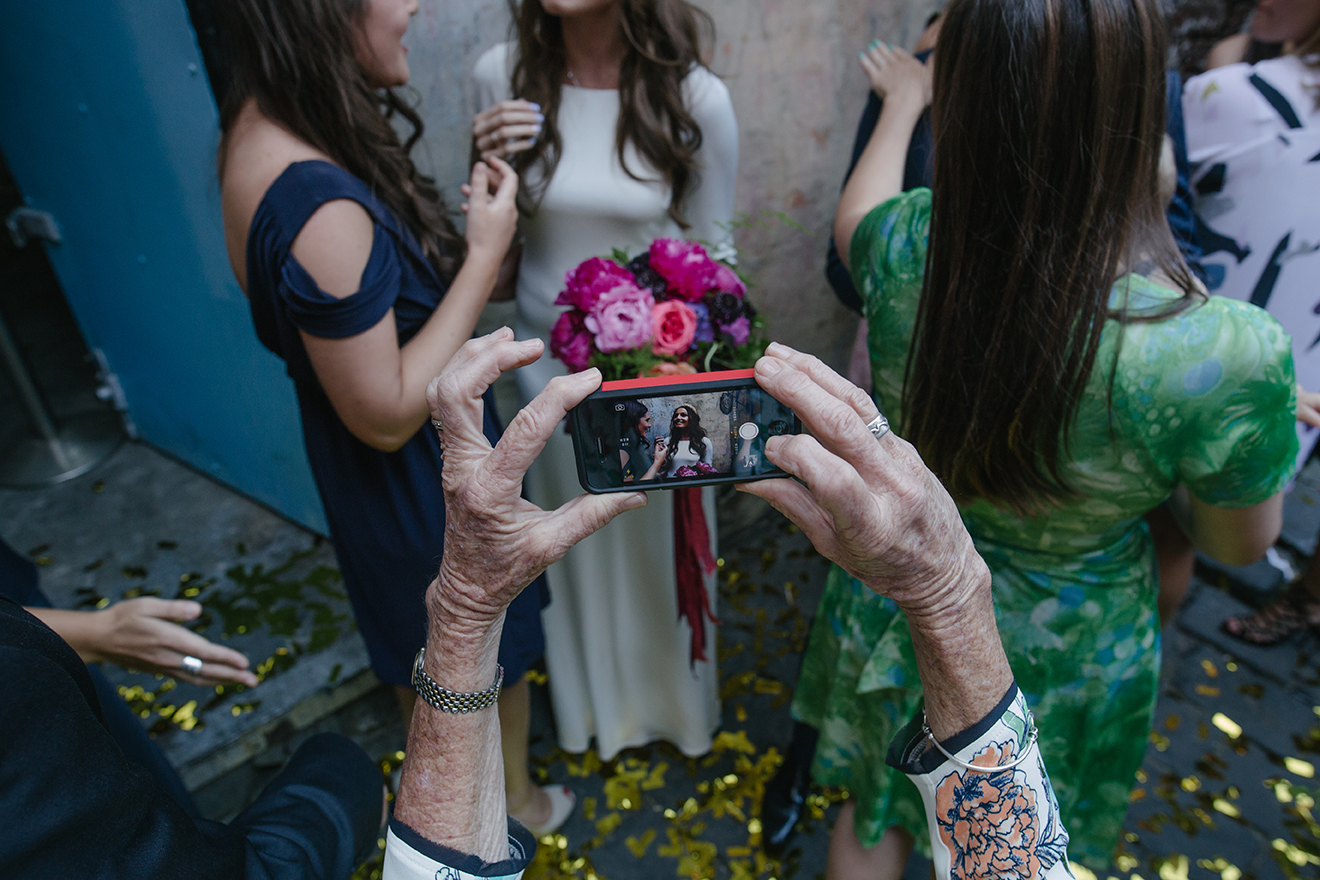
“Many photographers are not keen on the idea of other people with cameras at weddings, and for good reason—they can potentially interfere with your best photo or an important part of the day,” says Australian wedding photographer Jai Long.
However, Long takes a philosophical view over the concern about wedding guests taking pictures, saying, “Personally, I have no problem with friends and family bringing their cameras to the weddings I shoot. If the couple doesn’t mind having an uncle taking photos on the DSLR he just bought, then I don’t mind either. It is their wedding, and their friends and family, so I will work around everyone to make sure I get the best possible photos.
“Sometimes if the guest with a camera looks very ambitious, I will kindly ask them to respect my space, especially during the ceremony,” he points out. “You have to remember that you are a wedding vendor, not a guest or a friend. So you need to respect the decisions made by the couple and their friends and family.”

Brooklyn, New York-based wedding photographer Chellise Michael says, “The ceremony is my favorite time to photograph guests, because everyone is seated, smiling, and happy. Having a phone in front of a guest’s face shows they are not present. I tend to skip photographing them because I can't see any emotion to capture, so I move on to photograph the guests who are fully present. These are the photos that the couple will love to see most.”
She suggests that if the bride and groom have a family member or guest who is a known photographer and likely to bring a DSLR and an off-camera flash, the couple should have a chat with them way in advance of the wedding date, asking them to refrain from shooting so they can enjoy the wedding as a guest, and assuring them that a great team have been hired to photograph the event.
“When the couple looks out into the sea of everyone they love, all in the same room, they don't want to see your gaudy Hello Kitty iPhone case staring back at them. They want to see you in the crowd, beaming, smiling, and listening fully.”

Arizona-based destination wedding photographer Jamelle Kelly says, “We find it very common to have a simple note in the ceremony program that expresses the bride and groom’s wishes about taking photos. They use language such as, ‘We’ve taken special care to hire a professional photographer so that our family and guests may enjoy the ceremony.’ Sometimes this contradicts the trend of using wedding hashtags,” notes Kelly. In this instance, she suggests, “wedding planners usually have great advice about how to word guest-photo etiquette in their wedding programs.”
Kelly points to the ceremony as the one opportunity to approach guests about not getting in the way of photos, explaining, “While everyone is being seated, we can typically identify potential problems, such as the guest holding up a large iPad or someone already standing in the back, waiting to photograph the bride walking down the aisle.”
After telling individual guests that they are welcome to take photos, she reinforces that they must remain in their seats during the ceremony. “We also remind them that they can’t stick their phones in the aisle,” she says.
“Most guests respond quickly and recognize that we are the primary photographer for the event. It’s important to always be kind and respectful. As professionals, we are always dealing with unexpected hiccups during a wedding, and other guests may be one of them. We work the best we can and remain professional at all times.”

Donna Von Bruening says, “There seem to be two types of wedding guest photographers these days: iPhone/iPad photographers and those with prosumer cameras and lenses. They need to be handled in different ways. Prosumer camera guests tend to be aware that they can be intrusive.”
According to Von Bruening, these guests often speak to her about their intention to photograph. “A polite approach, such as asking them to wait until you get your images, usually does the trick,” she says.
On the contrary, “guests with iPhones tend to be completely oblivious and tend to only be focused on themselves and their moment. iPhones have ruined many, many images for my couples,” she adds. “I find them horribly intrusive and, sadly, they aren’t going away. I just grin and bear it.”

“I do my best to educate my couples about the disruptions that overly friendly guests can cause, but, at the end of the day, there’s not a ton we can do about it,” says Los Angeles-based wedding destination photographer Brian Leahy. “During certain portions of the day, I am very much in charge and have been known to politely shout, ‘For the next 30 minutes, this is the only camera that counts.’”
Leahy, whose general shooting style is fun, light, and fast-paced, is totally comfortable telling a disruptive guest that they can have a turn once he is finished. “I always say it with a smile, and often a joke that their little camera probably takes way better photos than mine anyways,” he explains. “Our clients hire us to get images no one else at that wedding can take, so it’s our job to be flexible and anticipate when a particular guest may be an issue,” Leahy adds.
He keeps an eye out for guests he feels could become disruptive with their photographs and then engages them in conversation, “all the while I subtly reinforce that I’m in charge for the day, and that they’re more than welcome to do as they please, as long as they’re not in the way of the photo and video teams.”
According to Leahy, if he finds a guest to be particularly disruptive, “I make few quick shots as if that person wasn’t there. I’ll also get different angles and viewpoints without them in the picture,” he says, finding it beneficial to have examples to show the couple if questions arise after the fact.
“I’ve already presented them with the best angles and shots, but I can also show a reference photo with Uncle Bob’s iPad about to block the photo of their first kiss.”

Washington, DC-based wedding photojournalist and former White House photographer Paul Morse, says, “We’re photographers, but we’re also diplomats. We’re put in a position of making things happen, and handling ourselves in a very delicate manner when the pressure is on, right in front of the client.”
Morse has weathered all manner of roadblocks. “In some churches, the priest will say, ‘Sorry you have to shoot from the balcony,’ but Aunt Jane can be in the front row with her digital SLR and shoot all the pictures she wants—and that’s OK,” he opines.
He also points out that when people see a camera, they don’t always know whether it’s the official photographer or not. In the case of a camera-toting Uncle Bob, “they’re going to look at Uncle Bob because they know him.”
One strategy Morse uses to make a positive impression is to provide the bride and groom with some images right away, “like the morning after the wedding, or even that evening. I’ll put together a sneak peek and email it or send it via text,” he says. “The response is incredible.”
Not only does this immediately validate your photography and your best efforts, “it also gets ahead of everyone’s iPhone pictures, where the lighting is off and the couple doesn’t look good at all. Almost immediately, the bride and groom get to put my picture up on social media instead of Uncle Bob’s,” he says.
“Ultimately, people want to share the pictures, so if you can share them right away and show them what the professional does, it makes a big impression. You can’t be the policeman—it doesn’t work,” Morse says in summation. “If you have competition, you’ve just got to draw your couple to you, for a moment at least.”
To learn more about the contributors to this article, click on their names below:
Jai Long and Free the Bird Photography
Jamelle Kelly
