Search results for: pro audio tips solutions live sound processing techniques
About 11 filtered results
by Freddy Gerngross · Posted
Like anything worth creating, solidifying the process of a project is key to success. Often, the ambitious work of aspiring music producers can get bogged down from a lack of organization. Projects can bloat into dozens of unnamed tracks processed with reckless abandon, and audio and MIDI clips get chopped and sliced into a charcuturie board of chaotic (un)organization.
For the fever-pitched producer in a flow state, this chaos can be managed during the session (to an extent). But what if they were to step away from the project and come back

by Freddy Gerngross · Posted
Since its founding in 1992, DPA Microphones has gained a prestigious reputation in the audio industry for their mics' exceptional quality, crystalline transparency, and rugged and reliable build quality. And while DPA's microphones have found their way onto the stage with Beyonce, onto the sets of Game of Thrones, and into the concert halls of the world's greatest orchestras, what's perhaps most impactful to our world is the contributions they've made to the scientific community: DPA's microphones have enabled advancements in medicine,

by Freddy Gerngross · Posted
Reverb gives sound verisimilitude. Think of it as the persistence of sound after it is produced—a phenomenon of multiple clashing and diverging sonic reflections whose characteristics are defined by the surfaces and materials they contact. It reveals the nature of a physical space in infinitesimal detail.
Reverb defines the tangible nature of space and our place within it—something that sighted and hearing humans often take for granted. You can infer a ton of knowledge about an environment simply by listening to what it sounds like.
The

by Freddy Gerngross · Posted
Mixing audio is not an exact science—there are many ways to achieve similar results, and what works for one project may not for another. In my ten-plus years of mixing, I’ve had the privilege and opportunity to learn both common and lesser-known techniques from some of the best engineers in the world, as well as the time and practice to discover my own tricks and techniques through experimentation and a few happy accidents. We don’t gatekeep at B&H—here are ten helpful techniques you can use to bring the best out of your mix.
1. Use

by Freddy Gerngross · Posted
Equalizers are the most powerful tool any audio engineer or musician has in their arsenal. Like many tools in the world of pro audio, while its concept and function are simple to understand, the different philosophies of a given EQ’s design and application can result in numerable sonic outcomes. Understanding how an EQ works is extremely helpful in deciding when and where to use a certain type and will work wonders for live setups, mixing, mastering, and perfecting tone.
In this tutorial guide, we’ll begin with the basics of equalization and

by Trevor Collins · Posted
These days it often seems like everyone has a podcast. With so much competition and so many options for podcasting-centric equipment, it can be daunting to dive in headfirst without knowing the ropes. That’s where B&H comes in, with another all-encompassing guide to set you up for success and help you get your content off the ground as painlessly as possible. Let’s begin.
Why Make a Podcast?
The first topic couldn’t be simpler: Why even start a podcast? The answer is simple−because it’s the best way to get your content to the masses.

by Gabby Bloch · Posted
Here at B&H, we’ve written countless articles on podcasting, including guides on editing, mixing, and mastering your podcast. But if you’re still having trouble getting the sound you want, we recommend simplifying your production process. Let’s discuss how to separate and streamline your production tasks to get a better final product with hopefully less effort.
Separate the Recording and Mixing Processes
Many people feel the
by Nicholas Messitte · Posted
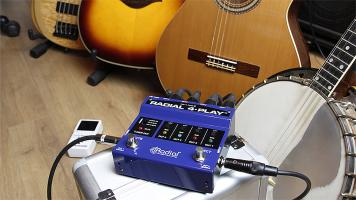
Ever had this problem? You record a demo in your DAW, plugging your acoustic guitar straight into your interface—no mic, just a DI. Then, when it comes to the actual mix, you think: can’t I somehow just use that acoustic DI track, so I don’t have to mic up my acoustic? As probably the laziest person at the B&H office, I can assure you it’s happened to me.
Though sometimes the problem is not even due to laziness: maybe you played gold in that one passage, and you can’t recreate it. Whatever the reason, you’re stuck with DI, and no idea how
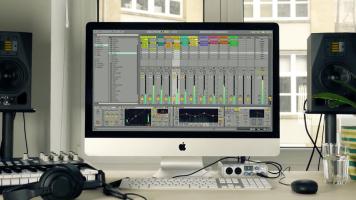
by Nicholas Messitte · Posted
Hi there! Do you have a rich, velvety voice that people compliment all the time? Do you have secret desires to cut out of your nine-to-five grind and get into the illustrious world of voice-overs? Of course you do! (You clicked the headline, didn’t you?)
Let me start off by telling you two things: To get sustainable voice-over work is harder than you’d think—lots of people want to do it, and networking, no matter the industry, is a deleterious task worthy of all your contempt. However, it’s never been easier to produce professional-grade

by Aaron Belinfanti · Posted
It is widely accepted in the world of pro audio that when it comes to mixing songs, making the lead vocal shine above everything else is paramount. Certainly, the other instruments in a song are important, and a solid musical arrangement is indeed desirable and appreciated; however, the singer often bears the responsibility of conveying the overall emotion and meaning behind a song.
Think about it. When we go to karaoke with our friends—often in an attempt to fool ourselves into believing that we are much better singers than we are—we love

by Allan Weitz · Posted
Sometimes, the phrases, acronyms and strings of numbers or number-letter combinations used to identify photographic hardware or techniques can be daunting to the uninitiated neophyte photographer.
We've prepared a list of the basic terms. Have we left any out that you think should be added? Please let us know!
0-9 | A | B | C | D | E | F | G | H | I |