Music Production

0 Views ·Posted
Can content creators, music producers, and photographers learn from each other? Sony Kando proves that they can. Matt talks to his fellow creators about the importance of having a community.
0:00 - Intro
0:24 - Ivey Kennedy, Kyle Meshna, & Anthony Gugliotta
2:12 - Sunrise & Early Morning Photoshoot
3:07 - Drue Schnelle
3:42 - Nancy Borowick & Golden Retrievers
5:36 - Sidney Diongzon & What's In The Box?
6:05 - Megan Brief
7:04 - Jared Vandermeer
7:28 - Dimitry Mak & Anthony Gugliotta
8:03 - Works in Progress
8:26 - Matt's

0 Views ·Posted
There's no doubt that the C-800G is a legendary mic for vocals, especially for pop, R&B, and rap. But did you know that it sounds great from a wide range of sources? Join Andrew as he shows off the capabilities of Sony's flagship microphone on guitars, bass, Fender Rhodes, piano, drum room, and yeah, some vocals.
0:00 - In This Video
0:23 - Full Band Demo
1:32 - What Makes The C-800G Unique?
2:25 - Isolated Vocals
2:59 - Polar Patterns
3:22 - Isolated Acoustic Guitar
3:57 - Isolated Electric Guitar
4:35 - Isolated Fender Rhodes Suitcase

0 Views ·Posted
Andrew takes us through ways to record both electric and acoustic upright bass at home. You'll hear how different DI boxes can subtly change the sound of the electric bass and how to mic a bass amp. For Upright bass, Andrew will share some considerations when using a DI box as well as a nifty trick to mic an upright with a Shure SM57. You'll also hear how both ribbon and condenser mics can make the upright bass sound full.
0:00 - What We're Covering Today
0:29 - How Electric Basses Work
1:03 - Using the Hi-Z/Intrument Input
2:03 - DI Boxes
0 Views ·Posted
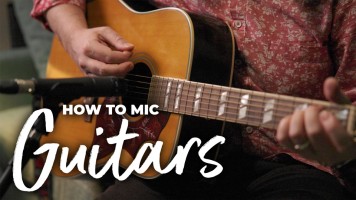
Take the guesswork out of at-home recording. Musician and B&H Social Media Video team member Andrew Swift walks you through the essential techniques for micing both acoustic and electric guitars live.
0:00 - Intro
1:03 - Recording acoustic guitar sound
12:20 - Recording with a dynamic mic
23:32 - Recording with a condenser mic
31:23 - Recording with both a large and small condenser mic
51:52 - Recording electric guitar sound
1:07:06 - Recording with a ribbon mic
1:15:21 - Recording with large condenser & ribbon mic
1:28:48 - Plugins
1

In the postmodern era of music production, most musicians, producers, and engineers rely on a computer running a robust Digital Audio Workstation (DAW) like Pro Tools or Ableton to be the studio centerpiece. But despite their power and convenience, sometimes creating in this environment can turn into a series of mouse clicks that eat away at the joy and magic of music production. There are times when ditching the DAW and going old school with a physical piece of hardware can unlock new potential, forcing you to develop alternative techniques

Recording drums is an esoteric practice; even with consistent techniques, it can be difficult to get consistent results, and with so many microphones on the market, it's tough to know what gear will bring out the most life from your performance. Luckily, you don't need expensive mics to achieve a brilliant recording (but it doesn't hurt)—if you're someone who wants to know more about recording drums and which mics are best suited for the job, this article is for you!
How Do I Record a Drum Kit? Basics Before Micing
While this article is a

0 Views ·Posted
Drum sounds are an integral part of a song's production. However, recording drums at home presents its own unique challenges. Andrew provides solutions, such as microphone choice and placement.
0:00 - Introduction
0:35 - Challenges of Recording Drums at Home
2:15 - Many Parts, One Instrument
2:45 - Drum Tuning and Head Choice
3:25 - 1 Mic, 2 Options
6:00 - 2 Mics (Glyn Johns)
8:08 - 4 Mics (Glyn Johns w/kick & snare)
10:29 - 4 Mics (Spaced Pair w/kick & snare)
12:30 - 4 Mics (Blumlein Pair w/kick & snare)
13:18 - Options for Using

0 Views ·Posted
Are you recording your music at home? Not sure how to approach recording an electric guitar? Andrew shares a few mic setups, showing you how microphone choice and placement affect your sound.
0:00 How Electric Guitars Work
1:00 Simple & Budget Setup
2:33 How Does Mic Position Affect The Sound?
3:40 How Dynamic Moving Coil Mics Work
4:41 Over-Driven Electric Guitar Sound
6:35 What Other Dynamic Mics Can You Use?
8:02 Using Ribbon Microphones
10:39 Two-Mic Setups
14:04 Condenser Mic Options
14:58 Adding a Room Mic
16:48 Outro

0 Views ·Posted
Home recording is more accessible, but how do you make your instruments sound good? Andrew shares how to get the most out of your experience recording music at home. In this episode, you’ll get a crash course on acoustic guitar recording at home, as well as mistakes to avoid. You’ll learn how to choose a microphone, where to place your mic, how to record acoustic guitars in an untreated room, and more. As always, Andrew will demo each mic position and share its pros and cons.
0:00 - In This Tutorial
1:00 - Basic Mic Placement
2:23 - How

Reverb gives sound verisimilitude. Think of it as the persistence of sound after it is produced—a phenomenon of multiple clashing and diverging sonic reflections whose characteristics are defined by the surfaces and materials they contact. It reveals the nature of a physical space in infinitesimal detail.
Reverb defines the tangible nature of space and our place within it—something that sighted and hearing humans often take for granted. You can infer a ton of knowledge about an environment simply by listening to what it sounds like.
The

Akai carries on the MPC’s mythos at NAMM 2026 with the announcement of the new flagship Akai Professional MPC XL, a computer-free music creation station that may very well set the benchmark for complete standalone music production machines.
Akai Professional MPC XL
Akai’s newest offering is a technical powerhouse: The MPC XL features a new 8-core processor with 16GB of RAM, boasting quadruple the power of previous MPCs.

Rupert Neve Designs carries on its legacy of creating unique and powerful outboard audio gear, unveiling their brand new OptoFET Dual-Stage/Dual-Band Compressor. The OptoFET is an aptly named piece of gear, featuring both an optical compression circuit (Opto) and a newly designed field effect transistor compression circuit (FET) in a single one-space rackmount device.
The OptoFET makes it quick and simple to take

0 Views ·Posted
DPA Microphones' 4099 is already a beloved instrument mic, so how does the CORE+ version improve on what was already impressive? Andrew and Gabe are joined by Marco Panascia at the Atomic Sound recording studio to put this supercardioid microphone to the test. As always, we will share the final track as well as the raw, unprocessed audio.
0:00 - Overview & Today's Recording Session
1:01 - Demo

0 Views ·Posted
DJ and Producer extraordinaire Laleyna Gomez (a.k.a. Amore Querida) demos the Akai Professional MPC Live III Standalone Music Production Workstation at the Engine Room. Bringing the old-school style of flow into a portable, modern unit, the MPC Live III is a full production studio that does not require a laptop. Laleyna shares how new features--such as the MPCe 3D-sensing pads--allow you to accomplish your

Equalizers are the most powerful tool any audio engineer or musician has in their arsenal. Like many tools in the world of pro audio, while its concept and function are simple to understand, the different philosophies of a given EQ’s design and application can result in numerable sonic outcomes. Understanding how an EQ works is extremely helpful in deciding when and where to use a certain type and will work wonders for live setups, mixing, mastering, and perfecting tone.
In this tutorial guide, we’ll begin with the basics of equalization and