
You've finalized your script, completed casting, and locked down your stage and/or locations for your first video production. If you haven't already, you (or your director of photography) need to select your camera. Here we present an overview and just a few examples of digital cinema and mirrorless cameras, camcorders, and cine-style lenses used for video capture. We've focused on several relatively affordable options for a camera body and lenses for the beginner filmmaker. Your choice of several tiers will be determined by your budget and shooting style:
- Purchasing a cinema-style camera and lenses.
- Investing in a more advanced cinema camera and renting lenses to suit each production.
- Using a mirrorless or DSLR camera and lenses – which you may already own for your still photography.
- Opting for a more affordable yet feature-heavy camcorder.
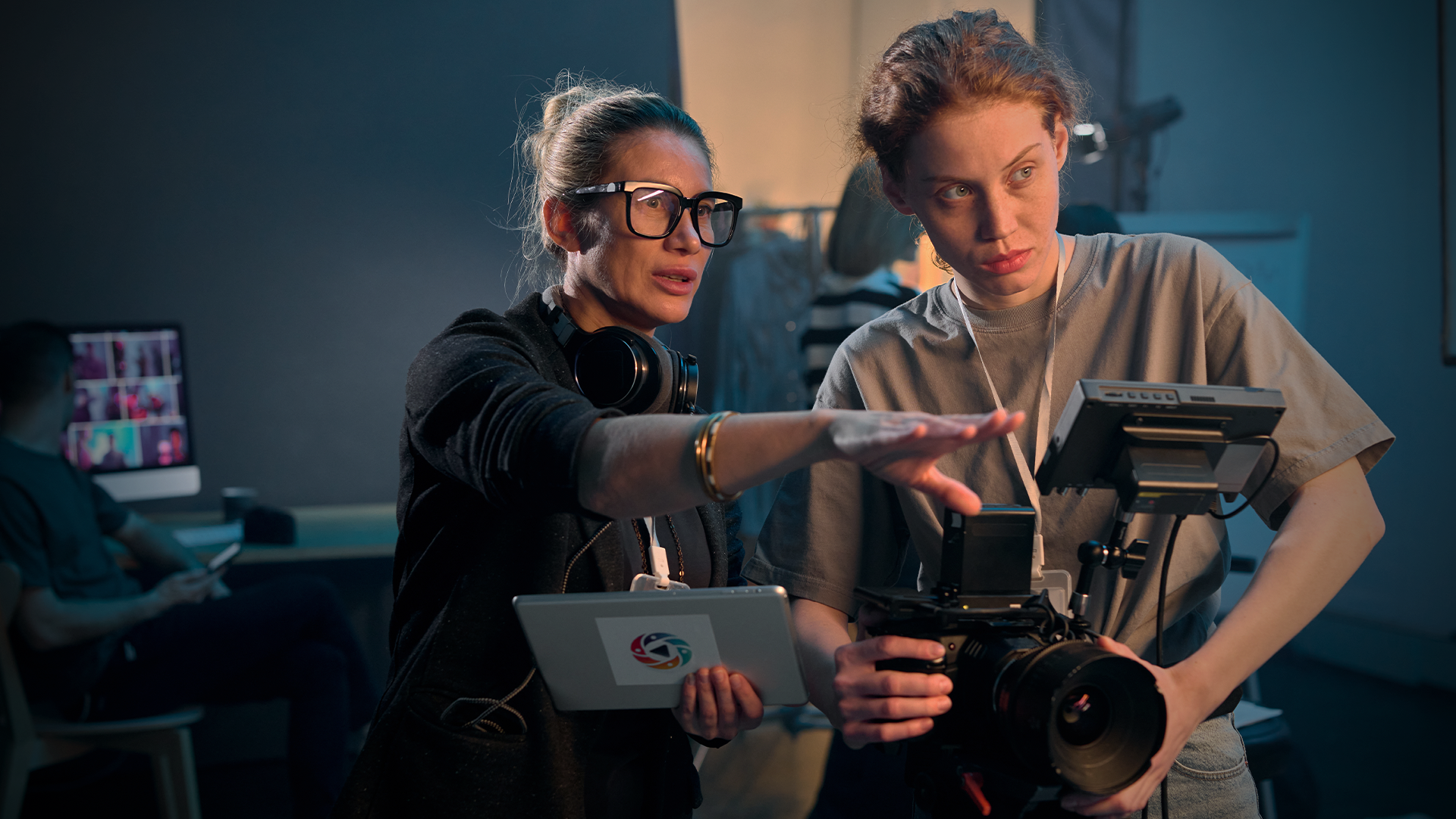
Cinema Cameras
Dedicated cinema cameras are the most geared towards filmmaking with features like:
- High-resolution, large image sensors, wide dynamic range
- Multiple resolution and frame rate options
- Selectable aspect ratios including anamorphic
- Various codecs and media recording options
- Ethernet and Wi-Fi support
- Timecode and/or genlock
- Assignable function buttons
Assignable LUTs (look-up tables) enable you to view or "bake in" a preferred look before post-production. SDI and HDMI outputs can be used for larger monitor displays and for wireless video transmission. Integrated ND (neutral density) and OLPF (optical low-pass filter) functions enable precise exposure and truer colors. Some cine cameras feature interchangeable lens mounts and provide several mounts for attaching accessories.
Sensor Size and Maximum Resolution
A note about your camera's sensor size and maximum video resolution – the larger the sensor and the higher the resolution, the greater the detail and more nuanced your imagery. But… consider your overall production and post-production workflow and the ultimate distribution of your production. Larger-sensor and higher-resolution cameras incur notably higher media and processing power requirements, increasing both your capture and post-production costs. See this article by my colleague Steve Gladstone for further details on camera sensors, video resolutions, and more.
Cine-Style Camera and Lenses
If you have the means, using a cinema or mirrorless camera rig with interchangeable, cine-style lenses is going to provide higher optical quality for your production than a fixed-lens camera like a camcorder or point-and-shoot model. The full frame SP3 Primes from storied lens maker Cooke feature the classic Cooke look in a compact, lightweight form that is optimized for mirrorless cameras. Designed to complement the sought-after Cooke Panchro primes, the SP3s feature on-axis sharpness, gentle focus roll-off at the frame edges, and a unique sense of dimensionality. Each SP3 prime comes with an interchangeable Sony E mount and includes your choice of a free Canon RF, Leica L, Leica M, or Nikon Z mount via Cooke's website.

The Blackmagic Design PYXIS 6K Cinema Box Camera packs a load of features into a compact form, offering a full-frame 6K sensor, 13-stop dynamic range, flexible formats/aspect ratios, Rec.709 LUTs, an activation key for DaVinci Resolve editing software, and the ability to record in Blackmagic RAW and space-saving H.264 proxy files.

Pairing the Leica L-mount PYXIS 6K with Cooke SP3 Prime lenses and L-mount adapters gives you an ultracompact, lightweight full-frame setup that is suitable for handheld, gimbal, or tripod-mounted capture. For a unique challenge and more affordable kit, consider choosing a single lens to provide a consistent look throughout your film with the shallow depth and immersive look of a full-frame lens. You'll then be able to expand your lens kit with additional focal lengths as your budget permits.
If using your existing, familiar still photo lenses appeals to you, check out the RED DIGITAL CINEMA KOMODO-X Z-Mount Production Pack with a Canon RF or Nikon Z lens mount. This pack supports up to 6K video capture and comprises the Super 35 6K global-shutter KOMODO-X camera and essential accessories like an input/output module, 7" Touch monitor (pictured above), XLR audio adapter, micro V-mount battery plate, and two memory cards. The KOMODO-X's global shutter catches motion in crisp detail, making it ideal for sports-oriented and other fast-paced subjects.

Some More Full Frame Lenses
Another cine-style prime series with interchangeable mounts is the fast Sirui VP-1 Vision T1.4 Primes, available singly or in a 3-Lens Kit with the 24mm, 35mm, and 50mm with native Sony E mounts and Canon RF, Leica L, and Nikon Z adapters. The VP-1 Vision lenses feature a waterproof, uniform design that is easy to use with matte boxes and lens accessories. The Canon RF-mount Simmod APSARA LUMIERE T1.4 Super Speed Primes come separately or in a 4-Lens Set, each featuring an organic look with controlled flares and a built-in focus mark light for working in dark environments.
Mirrorless Cameras
Developed as lighter, more compact alternatives to DSLR cameras for capturing still photos, mirrorless cameras have had ever more advanced video recording built in, resulting in a single-camera solution for working in several workflows. Mirrorless cameras are available with full-frame, APS-C/Super 35 or MFT (Micro Four Thirds) sensors, with MFT models being more compact and affordable.
For a sweet entry-level kit, consider the Blackmagic Design Pocket Cinema Camera 4K/HDMI Monitoring Kit. This MFT-mount camera provides a compact, lightweight UHK 4K option with a Micro Four Thirds sensor. The tilting display features a touchscreen interface, letting solo operators make quick adjustments to the camera settings. This kit comprises the camera, a 5" monitor, two batteries, a charger, and a DaVinci Resolve download code for editing your footage.

There's a huge variety of MFT-mount lenses available, including ones that are optimized for cine-style use with 0.8 MOD gears and easily readable focus marks. The Rokinon T1.5 High-Speed Cine DSX Lenses feature soft bokeh and a superfast T1.5 aperture for shallow depth of field looks. They can be purchased singly or in a handy 4-lens kit that covers 24-85mm. Check out the Sirui Night Walker T1.2 S35 Cine Lenses for more entry-level priced options including a 24mm, 35mm, and 55mm 3-lens set. The Night Walker primes offer an ultrafast T1.2 max aperture, consistent color, and minimal aberrations.

The Sony FX30 Digital Cinema Camera Kit with 18-50mm Lens uses an APS-C/Super 35 sensor to offer UHD 4K capture at rates up to 120 FPS, 16-bit raw output for select recorders, and 5-axis image stabilization, features usually only found in higher-end models. Pro features like S-Cinetone color and custom LUTs match Sony's advanced cameras, letting you use the FX30 as a 2nd camera if you decide to upgrade in the future. Its ultracompact form makes it perfect for handheld, gimbal, and drone capture. The lightweight Sigma 18-50mm zoom lens provides the equivalent of a 27-75mm 35mm-format lens, covering the most commonly used focal lengths.
Camcorders
Like your mom or dad says, don't worry about what the other kids are doing – camcorders are not just for 1980s tv show reboots! You may have a compelling script, amazing actors, and access to striking locations but a woefully meager budget. You could shoot your film on your smartphone but consider a camcorder for better optical elements, advanced image processing, easier control, improved monitoring, smooth zooming, and extended recording time.
The similarly priced Canon Vixia HF G70 4K Camcorder offers up to UHD 4K capture, a 3.5" flip-out display, optical image stabilization, 20x optical zoom, audio input, and automatic and manual focus.

The Canon also has an electronic viewfinder, integrated lens hood to block flares, USB-C output to your computer (video only), slow-and fast-motion, and dual SD card slots.

The Panasonic HC-X2100 UHD 4K Pro Camcorder offers a step up with several features that are usually only found in professional-level models. It has the UHD 4K capture and other shared features of the camcorders above but also offers built-in ND filters for quick exposure adjustments, pro-style XLR audio input with manual level adjustment, a longer 24x optical / 48x digital zoom, built-in LED light, and high bit-rate recording.

Whether you opt for a higher-end model or a more affordable one that lets you stretch your budget in other areas, we hope you get out there and complete your cine-style production. You can always explore the Premium Cinema Cameras available at B&H to get a feel for what you can aspire to for future projects. Learn more about these video cameras on their pages on the B&H site and check out the Explora page for the latest videography news, tips, and reviews.
