Search results for: video tips solutions how to use depth of field
About 43 filtered results
by Mathew Malwitz · Posted
Who doesn’t love a close-up shot of a flower or bumble bee? Some of the most beautiful aspects of nature are quite small and require special tools to capture them in a meaningful way. Whether it be of a cute little insect visiting our garden, or miniature figurines you paint and sell, we need a camera that can focus close and deliver good, quality results.
Before you panic, hear us out. We don’t need to get carried away with complicated lenses and accessories, and can just enjoy yourself with a simple compact,

by Todd Vorenkamp · Posted
There is nothing that can replace the extreme close-up view of a rare bird in the wild. Binoculars can get you close but, if you want to look the bird in the eye or confirm that identification for your life list, you need a spotting scope. Spotting scopes pack incredible magnification in a generally simple and lightweight package that is

by Steven Gladstone · Posted
Whether you’re a student or a seasoned veteran, selecting the right camera can make your head spin with questions. Does sensor size matter? What’s the difference between 4:2:0 and 4:2:2? Do I really need a camera that can record 8K? What about raw? We’ll explain the key components that help a camera produce cinematic images, and in doing so, hopefully help you make that all-important decision.
Evaluate Your Needs and Your Budget
Before considering certain cameras, you must know your needs and your budget. And be realistic. If you are a student

by Mathew Malwitz · Posted
The most engaging portraits seem to have direct eye contact between subject and viewer, as if the camera were simply a window through which we’re looking. But is it that simple? So much goes into making a good portrait, can success simply come down to eye contact between subject and camera and is it even necessary to concentrate on the eyes for a portrait? There are certainly wonderful portraits that do not focus exclusively on the eyes that illustrate character with other aspects of the body, from posture to hands, but as an introduction to

by Mathew Malwitz · Posted
As you begin to research cameras, you’ll likely hear some technical jargon about sensors. While it’s easy to ignore some elements of any devices, there’s no way to work around sensors. But what is a sensor and what does it do? In this guide, we’re diving into the often confusing world of imaging sensors. By time we’re done, you’ll have a better understanding of the most significant component in our digital camera.
About Sensors
What Is an Imaging Sensor?
At the heart of our digital cameras sits an imaging sensor, which serves as the digital

by Todd Vorenkamp · Posted
Great products deserve (and often receive) great product photography. Whether you are photographing items for online sales, Internet auctions, or simply taking still life photos of a prized possession, there are some simple (and relatively inexpensive) gear and tips that can help your photos stand out from the others.
Online Auctions & Internet Marketplaces
We’ve all seen sub-par product images online. Let’s face it, they do not want to make you reach for your credit card or increase your bid. Smartphone snapshots are perfectly fine if you

by Jill Waterman · Posted
The widespread adoption of affordable smart home solutions has made home surveillance and theft-prevention systems more popular than ever—from security cameras, to

by Todd Vorenkamp · Posted
Specular out-of-focus highlights have appeared in photographs since the first photos were taken through lenses. In 1997, Photo Techniques magazine introduced the word “bokeh” to the photography world’s vernacular and the out-of-focus areas of photographs have been scrutinized ever since. Before the term, there was certainly discussion about the aesthetics of the out-of-focus specular highlights of a photograph, but until 1997, there wasn’t a good word in the English language to describe the phenomenon. Credit goes to Mike Johnston, article

by Todd Vorenkamp · Posted
Like the world’s tidal waters, photographic creativity ebbs and flows for many of us. Sometimes creativity can use a jump-start, an artificial method to get the photographer to start looking at the world in a new way in order to facilitate, restart, refine, or improve your photography.
There are many ideas on how to get yourself to push through an artistic block or inspire you to further expand your boundaries. Not all of them involve the camera. Several websites and books publish a mix of assignments or exercises for the intrepid photographer

by Steven Gladstone · Posted
Day for night for color cinematography is an old shooting methodology that relies on a number of techniques regarding human perception, socially accepted convention, and technical qualities of film/sensors. There are a variety of reasons for shooting day for night, and understanding the whys and wherefores can help you create believable images.
Moonlight Is Blue
It isn’t really, any more than sunlight is blue. The reality is that moonlight is reflected sunlight, so why do people think moonlight is blue? Sunlight has a color temperature of

by Todd Vorenkamp · Posted
FUJIFILM continues to lead the digital photography world with its unique and beautiful film simulations that give FUJIFILM X series APS-C interchangeable lens, X series fixed lens, and

by Shawn C. Steiner · Posted
Whether you want a professional look for your livestreams or simply to look better during your next video chat, one of the best options is to use a dedicated camera with excellent video specs—such as your Olympus Micro Four Thirds mirrorless camera. Now that Olympus has launched the OM-D Webcam Beta you can get these advantages without much effort. A few key accessories can
by Shawn C. Steiner · Posted
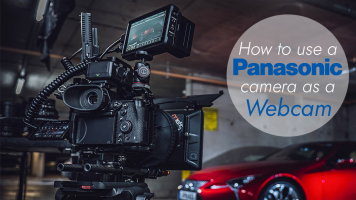
Whether you want a professional look for your livestreams or simply to look better on your next video chat, one of the best options is to use a dedicated camera with excellent video specs—such as your Panasonic mirrorless camera. To make this happen, Panasonic has introduced the Lumix Tether for Streaming (Beta) application for simpler connectivity. Since you likely already have

by John Harris · Posted
Zoom, Hangouts, BlueJeans, Slack, and Teams. These are words that have taken on a whole new significance over the past few weeks. With so many of us now relying on livestreaming, video chat, and video conferences, the quality of connection and the quality of your image is increasingly important. It may be time to upgrade from the camera in your computer or the basic webcam that has been dangling off the side of your monitor for all these years. Joking aside, appearing clear, in focus, and well-lit is crucial when impressions are being made,

by Mary Latvis · Posted
When I’d perform a camera package checkout as a camera assistant, if there was any chance that we’d be shooting outside during the day, guess which filters I would add to the order? Neutral Density filters (aka NDs)! Even if they were not part of the original order, any production office coordinator (P.O.C.) worth their salt would approve this addition by the A.C. Read on to discover why, next to a polarizer, these are the filters most essential to your video shoot.
Shallow depth of field, daylight
ND Basics
Neutral: meaning there’s no