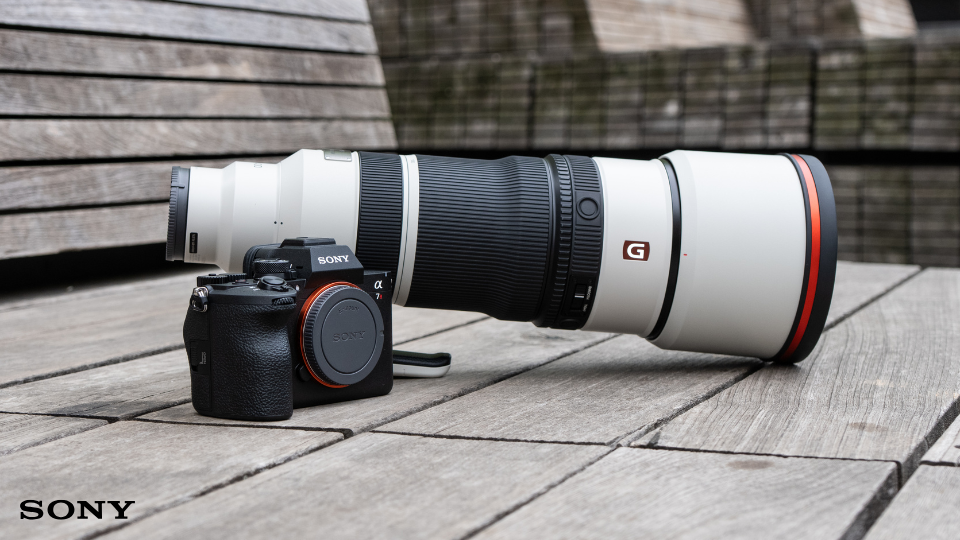
The wait is finally over, and Sony has unveiled not one, but two new game changing imaging tools to their arsenal. Introducing the a7R VI mirrorless camera and the FE 100-400mm f/4.5 G Master lens. The perfect marriage of speed and resolution.

I was lucky enough to spend a few hours with this new camera and lens before release. As a Sony shooter, I wanted to know how this camera and lens stack up in the current Sony Alpha Universe. Without any further ado, let’s take a closer look at the Sony a7R VI and the FE 100-400mm f/4.5 OSS GM.
Sony a7R VI
The a7R VI follows a well-established lineage of high-resolution powerhouses dating back to the early days of Sony’s full-frame mirrorless system. Aimed at the landscape and studio photographers, the R series came to fruition equipped with a 36-megapixel sensor and did away with the traditional optical low-pass filter for greater acuity. This started a trend that would see newer cameras with even more megapixels follow in the years to come.

At the heart of the a7R VI is the newly developed 66.8-megapixel fully stacked Exmor RS CMOS sensor. That’s not only more resolution to play with, but nearly 5.6x faster readout speeds to record an even greater variety of content. This comes a welcome surprise, as the R series has never been exceptional in the speed department. Sure, it could hold its own but never stood toe to toe with a camera like the A1 II or A9 III for continuous shooting speeds.

That’s changed with the new fully stacked imaging sensor and the addition of the BIONZ XR2 image processing engine. The a7R VI can record blackout-free full resolution 14-bit RAW images at 30 fps while maintaining AF/AE functionality. That’s a stark improvement over the 7 fps achieved by the a7R V. Both cameras deliver 10 fps when using the mechanical shutter, though the V was limited to 12-bit, whereas the VI offers 14-bit recording.
A stacked imaging sensor and powerful processing engine also allow for other features like Pre-Capture and Speed Boost. Pre-Capture gives users the ability to easily catch the decisive moment with timing settings from 0.03s to 1.0s before the shutter button is fully pressed. What’s even more practical is that Pre-Capture can be used at any framerate.

Speed Boost behaves differently, giving users the ability to essentially temporarily boost the continuous shooting speed to accommodate a sudden change in subject matter. Perhaps you’re on a safari, photographing a zebra when a bee-eater suddenly flies into view. You’ll likely not need 30 fps for a stationary zebra, but you may for birds in flight. Note that the camera doesn’t feature a dedicated front button like the A1 II and the A9 III.
What’s all that speed without an EVF to support it, and does this EVF perform. The 9.44 million-dot Quad XGA electronic viewfinder seems similar to that found in the a7R V at surface level. It’s the same resolution, offers 120-fps refresh speeds, and an approximate magnification of 0.90x. These features made the a7R V ahead of its time, so it’s nice to see this EVF back, but that’s not to say Sony didn’t make some minor tweaks. In practice, the EVF found in the VI is much brighter. In fact, Sony states that the EVF is 3x brighter than the one found in the V.
I was immediately reminded of my own A1 II camera when shooting at Bryant Park. The bright, fast EVF and blackout free shooting made it perfectly clear how adept this camera is for fast action. There came a point where the concern was no longer can the a7R VI do this, but rather, what can’t the a7R VI do?

To accommodate the greater power draw of the sensor and processor, Sony has implemented a new battery system. This is the first for their system since 2017. Where the a7R V saw an average battery life of 400 shots, the VI sees a 17% increase in capacity, meaning it can achieve 600 to 710 shots when using the EVF or rear LCD respectively. That also leads to a new charger, new DC coupler, and a new vertical grip as well.
The new charger can deliver an 80% charge in just under an hour for a single battery, and 100% power at approximately 85 minutes. Additionally, the camera and charger offer a new battery check that offers insight into the health of a battery and any issues that may arise. When using the vertical grip, you can check the condition of both batteries individually.

With that power comes room for even more features, with one stand out for low-light photographers—illuminated buttons. Essential controls on the rear and top of the camera can be illuminated when the new dedicated illumination trigger button, found between the video record button and mode dial, is pressed.
The Mode dial has seen a slight redesign, with the traditional memory recall selection, or “MR3” custom mode selector, being replaced with a single “*” icon. This allows fast, independent selection between up to 10 MRs unique to each shooting mode. That means you can program a total of 30 memory recalls between the still, video, and S&Q modes. Additionally, the Auto mode index has been raised allowing users to find and identify it by feel.

The a7R VI is certainly equipped with a slew of new tech, but what about the existing features we love? What was immediately familiar was the overall feel of the camera. Sony really hit their mark with the prior generation of a7 bodies, and this trend continues in the a7R VI. Even the interface and ports are largely the same.

The 4-axis multi-angle rear LCD returns as well, giving users the ability to shoot at all sorts of odd angles. This addition has been part of the Alpha series for some time, seeing its first iteration in this camera’s predecessor. What I like most about this is the ability to shoot low and high angles with the tilt function, as flipping out a screen can be a challenge when your arm is in the way.
If you’ve read our recent review of the Sony a7 V, you’ll know that the line between flagship and enthusiast camera continues to blur. This is good news. For the most part, the days of niche cameras and flagship models being the sports and wildlife photographers’ only choice are over. Now, most if not all full-frame cameras offer the continuous shooting speeds and autofocus accuracy to get the job done. Though models like a A9 III and A1 II still have the edge, the a7R VI is perfectly suited for many users.
For those coming from an existing R series camera, or for those who were already considering the V, let’s take a look at some of the most practical features and how they stack up between models:
|
Sony a7R V |
Sony a7R VI |
|
61 MP Exmor R BSI CMOS Sensor |
66.8 fully stacked Exmor RS CMOS Sensor |
|
BIONZ XR + AI Processing Unit |
BIONZ XR2 + AI Processing Unit |
|
8K 24p and 4K 60p (with 1.24x crop), FHD 120p |
8K 30p/24p, 4K 60p (no crop), 4K 120p (crop) |
|
10 fps shooting with AF/AE |
Blackout free 30 fps shooting with AF/AE (electronic shutter) |
|
ISO 100-32000 Native (50-102400 Extended) |
ISO 100-32000 Native (50-102400 Extended) |
|
Pre-Capture: No |
Pre-Capture: Yes, at 0.3s to 1.0s before full shutter press |
|
Wi-Fi 5 (802.11ac) |
Wif-Fi 6 (802.11ax) |
|
9.44M-dot OLED EVF |
9.44M-dot OLED EVF |
|
Dual CFexpress Type A/SD Card Slots |
Dual CFexpress Type A/SD Card Slots |
|
3.2” 4-Axis Multi-Angle Touchscreen LCD |
3.2” 4-Axis Multi-Angle Touchscreen LCD |
|
NP-FZ100 Rechargeable Battery |
New Battery System (Increased Capacity) |
|
5-axis in body image stabilization (8-stops) |
5-axis in body image stabilization (8.5-stop center, 7-stop peripheral) |
|
Battery Life: Approx. 440 shots |
Battery Life: Approx 600 shots EVF/ 710 LCD |
Sony FE 100-400mm f/4.5 GM OSS
The a7R VI may be an impressive marriage between speed and resolution, but with all that speed, we need the glass to keep up with it. For that reason, Sony has taken this opportunity to also unveil one of the most excited updates to their G Master line. That is the FE 100-400mm f/4.5 G Master lens, a newly developed bridge from enthusiast level zooms to pro level super-telephoto primes.

Longtime Sony users will have likely encountered the legendary FE 100-400mm f/4.5-5.6 GM at some point in their journey. It is after all, the lens that many sports and wildlife shooters first got their hands on when they adopted the Sony Alpha system. To this day, its stellar optics and borderline ridiculous minimum focusing distance have made it the long lens of choice for many enthusiasts and professionals alike. The lens was truly ahead of its time, and for that reason, it has remained a staple of Sony’s lens lineup for nearly a decade. That is, until a worthy successor comes to the table.

The term successor is used loosely here, as this lens does more than offer some updated features. The original 100-400 was compact, and very similar in form factor to similar lenses in that focal range and lenses like the FE 70-200mm f/.2.8. This update throws away preconceived notions of what a 100-400mm lens should be and opts to be unique in every way it counts for long lens users.
|
FE 100-400mm f/4.5-5.6 G Master |
FE 100-400mm f/4.5 G Master |
|
External Zoom Mechanism |
Internal Zoom Mechanism |
|
Maximum Aperture: f/4.5-5.6 |
Maximum Aperture: f/4.5 |
|
Image Stabilization: Yes |
Image Stabilization: Yes |
|
Filter Size: 77mm |
Filter Size: 95mm |
|
Diaphragm Blades: 9 |
Diaphragm Blades: 11 |
|
Size: 93.9mm x 205mm |
Size: 119.8mm x 328mm |
|
Weight: 1395 g (49.3 oz) |
Weight: 1840 g (65 oz) |
The most notable upgrade has to be the constant f/4.5 aperture. This means we get the same light-gathering capabilities at 100mm and 400mm, and the same background rendering as well! This is especially practical for sports users and the wildlife contingent out there who rely on low-light performance to get the shots they need.
As the proud owner of the FE 200-600mm G lens, I immediately noticed the silkier background rendering when photographing some of New York’s most famous wildlife, the ever-present pigeon. Considering that the lens is compatible with both 1.4x and 2x teleconverters, it may be a compelling option for those looking for a versatile zoom. At 100-400mm, it’s perfect for walks in the park and sport events, but at 140-560mm, it’s better optimized for smaller subject matter like birds.

The internal zoom mechanism is another trait that sets this lens apart from the original 100-400mm lens, providing greater weather sealing. Not that the original 100-400mm couldn’t handle a little rain, but the ability to shoot in adverse weather conditions without worrying about cleaning the extended barrel allows photographers to focus on the task at hand.

Yet another update of note is that the lens’s controls have been moved further down the barrel. Being able to quickly toggle switches with your thumb in the field is essential, so why move them back? It’s easy to toggle switches closer to where your hand rests on the lens, but it’s also easy to accidentally toggle switches when you don’t intend to do so. This migration keeps our controls reasonably close to thumbs reach while keeping them out of harm’s way so to speak.
Additionally, this new control position helps the gimbal head owners of the sports and wildlife contingent. Gimbal heads sit to one side of the lens, mounted via the lenses tripod foot. When mounted, the gimbal can often block access to our controls, depending on how we mount it of course. By moving them back, we retain access no matter what tripod head we use.
Resolution Meets Speed
The a7R IV is more than a landscape camera. With flagship worthy speeds, and resolution that would make even the most avid pixel peepers blush, this is a logical upgrade for a7R V owners, or those looking for the resolution to print large or to crop in post. Additionally, the R VI is perfect for photographers looking for the speed of the A1 II but don’t need the pro-level connectivity or weather sealing.

If you’re a sports or wildlife photographer, the FE 100-400mm f/4.5 G Master is an obvious choice. Its zoom range is advantageous for a myriad of uses, and compatibility with teleconverters makes it compelling for even bird photographers, who often want more reach. If you primarily shoot tiny songbirds in brighter daylight, you may be better off with he 400-800mm f/6.3-8 G, but any early morning outings, and you’ll be wanting for a little extra light.
If you’re interested in either the a7R VI and/or the FE 100-400mm f/4.5 G Master lens, check out the detailed product pages below.

