Search results for: photography buying guide best cameras for landscape photographers
About 24 filtered results
by Mathew Malwitz · Posted
As complementary as peanut butter is to jelly, the camera and tripod are an age-old pairing that still manages to maintain relevance and unmatched functionality in a world dominated by image stabilization and Photoshop tricks. While the form and function of a tripod is far simpler to understand than the scrolling menus of today’s feature-packed cameras, it can still be a chore to choose the right setup for your needs from among a sea of manufacturers and seemingly comparable models.
Now, what’s the big deal with tripods? Most photographers

by Mathew Malwitz · Posted
Landscapes and wildlife are among the most challenging subject matter to capture well with a camera. Wildlife is unpredictable and despite your best efforts, will not respond to posing instructions. Landscapes are stationary but at the mercy of available light and weather conditions. All that being said, it is the unpredictable nature of landscape and wildlife photography that has earned these genres a very large, very dedicated, and very passionate following. The dedication of these photographers can make finding the right gift all the more

by Todd Vorenkamp · Posted
The camera bag starts as an afterthought—something you get after you buy a camera and/or lenses, and for many, just about any camera bag will do the trick for them. But, when you get deeper into photography and expand your kit, the camera bag becomes an essential part of your everyday carry. There are many parallels between shopping for a camera bag and shopping for something like a pair of shoes—hundreds (maybe thousands?) of options,

by Shawn C. Steiner · Posted
Whether you just picked up your first mirrorless camera or you've been partying with your Canon DSLR for years, there are always a few toys you haven't managed to add to your collection and a couple you haven't even thought of yet. Here are a few I would recommend to anyone who is looking to fill out their wish list for the coming holidays, for nearly any type of photographer.
Protective Cloths/Lens Wraps
Okay, this is definitely my favorite item on the list and I can tell you that if you don't already have a

by Todd Vorenkamp · Posted
What is the best lens focal length for photographing the total solar eclipse? Well, there really isn’t a correct answer to that question. There are many factors involved, so let’s outline some options for different types of cameras and budgets.
Above: The Hinode satellite X-ray telescope mission captures the January 6, 2011 solar eclipse. © JAXA/NASA.
Expedition 43 Flight Engineer Samantha Cristoforetti took a series of photographs

by John Harris · Posted
There is still one basic truth about photographing sports—access is everything. If you are not near the action, you will not get a photograph. Does this mean you need a sideline pass at the Super Bowl or a family member in the NBA? No. Those are good to have, and media credentials for a Super Bowl is a professional feather in your cap, but “access” can be found in many places and many ways. A good sports photo does not even have to be on-field action, so do not let a lack of access intimidate you, but understand that to join the upper echelons

by Bjorn Petersen · Posted
Just as mirrorless is now the dominant camera type, full frame is now the dominant sensor size. It wasn’t too long ago when full-frame cameras were seen strictly as tools for professional and high-end photo applications due to their expense and the associated feature sets that were part of the complete full-frame camera system. Over the last few years, however, full-frame options have begun to trickle down to the middle tier of interchangeable-lens camera development, with some instances placing entry-level full-frame cameras right alongside

by Bjorn Petersen · Posted
A pioneer of full-frame mirrorless, Sony has expanded its system into a full-fledged lineup that caters to all varieties of image makers. No longer a niche market, Sony recognizes the value and versatility of a full-frame sensor: Its large form factor yields excellent image quality, it’s the same size as 35mm film for a sense of familiarity, and it’s still small enough so the overall camera size remains portable and compact.
Now that Sony has a grip on how to use full-frame sensors, and has released such a bevy of different cameras over the

by Jill Waterman · Posted
No matter how many lenses a photographer has, there are often added lenses we still wish for, and even more lenses after which we lust.
There are so many options that choosing your next lens can often involve a dizzying cavalcade of choices—manufacturers, focal lengths, prime or zoom functionality, auto or manual focusing, and price. Below, we offer up some thoughts on what your next lens might be based on your shooting preferences and needs.
To keep things simple, our suggestions are based on the use of a full-frame camera—those seeking a

by Cory Rice · Posted
Like vinyl records and your father’s wardrobe, instant cameras are back and as popular as ever. Alongside refurbished and reimagined analog cameras, many new hybrid models combine the benefits of digital capture with the immediacy of instant film. Polaroid and FUJIFILM continue to produce “true” instant film stock—the kind you expose and then wait to see develop. They share the market with a new thermal printing technology, ZINK, short for “Zero Ink,” a borderless printing process that has risen in popularity, particularly with hybrid cameras

by Jason T · Posted
If you’ve just ordered your first camera system, now you may be wondering what else you need to get started. Deciding which accessories to buy when you’re first beginning in photography can be a bit of a challenge to the uninitiated. Some accessories, like lens wipes for instance, are universal, but other types of accessories to consider may vary quite a bit depending on the kinds of photos you’re interested in making, and where you plan on shooting

by Cory Rice · Posted
One of the most daunting aspects of stepping up to an interchangeable-lens camera is the startup cost of purchasing a camera body and a lens. Fortunately, camera companies and retailers, well aware of this financial deterrent, often team up on a solution: the “kit” lens. While technically kit lenses come in a wide variety of shapes, sizes, and price points, for the purposes of this article I am thinking of a specific lens many photographers have encountered at one point or another when buying a new camera: the “all-purpose” zoom that provides

by Bjorn Petersen · Posted
Landscape photographers are a contradictory bunch. Always on the quest for gear that is simultaneously lightweight and substantial, landscape photographers, as well as travel and nature photographers, are always in search of equipment that can get them a new look, serve a distinct purpose, or be flexible enough to handle a variety of conditions. If there’s a landscape photographer in your life to whom you’re looking to give the perfect photography gift, or if you’re looking to reward yourself with a new piece of kit, here are some gift

by Jill Waterman · Posted
For photography enthusiasts seeking to expand their horizons from pictures made with a mobile phone or a point-and-shoot, the major benefit in of upgrading to a DSLR or mirrorless camera system is the ability to swap out different lenses to fit your specific needs. Prime lenses are available in all lengths and varieties and offer numerous advantages in performance when compared to their zoom-lens brethren. Also, the particular choices associated with sticking to a specific focal length can help improve your photographic technique, as well as
by Jason T · Posted
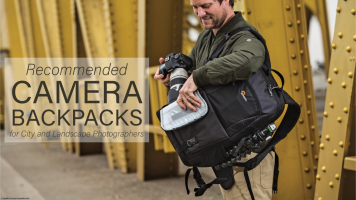
For we city and landscape photographers, carrying a lot of gear is par for the course. On an average day out it’s not unusual to carry a camera body, tripod, two or three lenses, filters, a filter holder, remote trigger, a laptop, and extra batteries, at a minimum. Now, that’s a lot of stuff, you’re going to be walking for a long time, and it’s going to be heavy—not to mention that what you’re carrying is worth a lot of your hard-earned money. However, the run-of-the mill backpack that you take to work or class is definitely not going to cut