
Third-party lenses—those made by a brand other than the camera manufacturer—present a wide variety of creative opportunities and fiscal benefits. Though there are certain sacrifices with some third-party options, such as mount availability and autofocus/electronic compatibility, more often than not, you’re rewarded with benefits you can’t achieve with in-system, first-party lenses—for example, a different take on the size and speed of a particular focal length or even just a better value for your particular budget.
With those benefits and creative opportunities in mind, we’ve put together a list of some of our favorite third-party lenses from the past year.


For FUJIFILM X
For FUJIFILM shooters, we’re sharing a few recent retro-inspired and classic-looking manual focus primes. Aesthetically, they’re perfect matches for the vintage looks of most FUJIFILM cameras. There’s also something so satisfying about a traditional manual focus lens to pair with the optimized haptics of FUJIFILM’s camera designs.
Thypoch Simera 28mm f/1.4 and 35mm f/1.4
With a design that pays homage to the legendary Alpa Kern Macro Switar, the Simera 28mm f/1.4 and Simera 35mm f/1.4 lenses, from Thypoch, are fast, elegant primes that straddle a vintage and modern aesthetic in a unique way. Most eye-catching is the “automatic” depth of field indicator scale that is extremely easy to understand—a V-shaped pattern of holes gradually become filled in as the focus position is changed, letting you set your hyperfocal distance easily or quickly recognize your depth of field range.

Other interesting details include a manual aperture ring that can be de-clicked and a manual focus ring that includes both a fully scalloped design and a focus tab, letting you choose either to have the fine-tuned precision of the ring or the repeatable and intuitive focus indexing of a tab.
Being bright f/1.4 designs and touting 14-blade apertures, both lenses invite shooters to use shallow depth of field and selective focus techniques and both lenses also have complex optical designs that produce high sharpness, accurate colors, and smooth rendering.
While perfect matches for FUJIFILM’s X system, Thypoch’s Simera lenses are also available for Canon RF, Nikon Z, and Sony E mirrorless mounts, as well as Leica M mount for those who want to use the lenses with a film or digital rangefinder (or adapt them to mirrorless).
Voigtlander Color-Skopar 18mm f/2.8 Aspherical, Nokton 50mm f/1.2, and Nokton 35mm f/0.9 Aspherical
Voigtlander is another perfect match for the aesthetics and style associated with FUJIFILM, and their latest X-mount release is the epitome of a lens for Fuji shooters: the Color-Skopar 18mm f/2.8 Aspherical. This pancake wide-angle lens measures just 0.9” long and weighs about 4 oz, helping to maintain the sleek size of FUJIFILM’s cameras. It has a slim focus tab for indexed control, a manual aperture ring, and pairs a close minimum focusing distance of 6.7” with a 10-blade diaphragm for smooth background blur when working with close-up subjects.

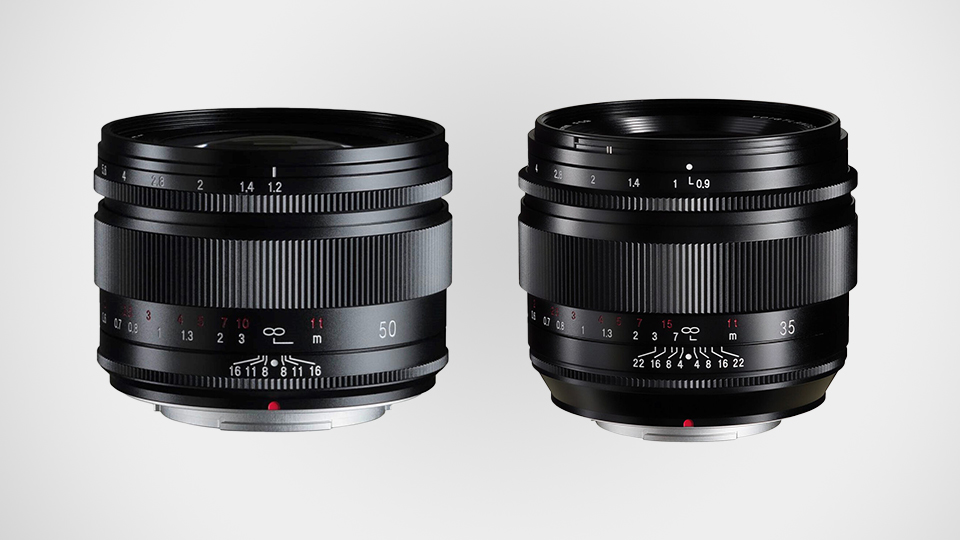
Two more Voigtlander lenses that need to be mentioned are a pair of fast Nokton primes—the Nokton 50mm f/1.2 and the Nokton 35mm f/0.9 Aspherical. Both of these were announced in late 2023 but, seeing them early in 2024, they still remain standout manual focus options for FUJFILM X shooters throughout the year. These lenses are interesting alternatives to some of FUJIFILM’s own lenses, they offer generally quicker speeds and a mechanical operation that many will prefer to the zippy autofocus and focus-by-wire designs of the electronics-imbued optics. The 35mm f/0.9, especially, is a unique option as it breaks that f/1 barrier and has the optical character to back up the immense speed.
For Canon RF
Third-party lenses for Canon RF mount are a relatively new and rare thing as of the end of 2024. It wasn’t until earlier this year that brands, besides Canon themselves, were able to make autofocus lenses for RF-mount mirrorless system, and even now, companies seem to be limited to making AF lenses that only cover an APS-C sensor. Still, it’s exciting to see some progress, and Sigma has been right at the forefront of the trend with a couple of their unique, fast, and compact zooms.
Sigma 10-18mm f/2.8 DC DN Contemporary
An ultra-wide fast zoom, the 10-18mm f/2.8 DC DN Contemporary is a great complement to the EOS R7, R10, R50, and R100, namely because it offers something Canon doesn’t themselves: a constant f/2.8 zoom specifically made for APS-C-format bodies. Moreover, the ultra-wide focal length range is also a relative rarity for APS-C cameras over the year, specifically because you can always mount the faster full-frame glass down to APS-C, but when you need a wide field of view, there aren’t many full-frame 10-18mm f/2.8 options out there, especially that come in weighing about half a pound and measuring less than 3” long.

Sigma 18-50mm f/2.8 DC DN Contemporary
Picking up where the 10-18mm left off, the 18-50mm f/2.8 DC DN Contemporary is another example of Sigma filling a gap in Canon’s own lineup by offering a compact f/2.8 zoom built just for APS-C. This is the fast standard zoom to get, especially for R7 shooters who are comfortable with the APS-C format and looking to maximize quality and versatility without needing to jump up to full-frame.

Both of these zooms have been around for a few years, first available for L-Mount and Sony E, and then later for FUJIFILM X, but it hasn’t been till 2024 that they’ve made their debut in a Canon RF mount. The lenses are solid, fast, and unique options for APS-C RF-mount shooters and are significant as they’re the first available third-party RF-mount lenses with autofocus.
For Nikon Z
Nikon shooters are in a good place with respect to third-party lens options—it also wasn’t until relatively recently that more autofocus options were being made available to Z-mount shooters, but as of late, many new zooms and primes have been flowing in from the likes of Viltrox, Venus, Tamron, and more. And one distinction between Canon and Nikon in this segment is that AF-enabled lenses are available for both full-frame and APS-C sensors, meaning every Nikon shooter from a Z9 user to a Z30 user has access to more lens options. With a bevy of options pouring in throughout 2024, we’ll quickly highlight some of the standout lenses from the past several months.
Viltrox AF 27mm f/1.2, AF 20mm f/2.8, And AF 16mm f/1.8
Despite all being a somewhat similar focal length, these three wide-angle autofocus lenses from Viltrox are individually interesting options and surprisingly distinct. The AF 27mm f/1.2 is the sole APS-C-specific lens called out here, chiefly because of its impressive f/1.2 maximum aperture, tough design, and well-implemented AF features—this is a great option for Z50 shooters looking for a faster alternative to Nikon’s own NIKKOR DX 24mm f/1.7.

The AF 20mm f/2.8 stands out because of how small it is—it’s a compact ultra-wide that manages to cover full-frame and pack an STM AF motor. It’s an apt performer for its modest price and doesn’t really have any competition on Nikon’s end unless you jump up in size, speed, and price for their 20mm f/1.8—this Viltrox option is great for those who are looking to save on weight or are ultra-wide curious but not quite ready to fully commit to bigger, heavier optics.

And contrary to the sleek 20mm, Viltrox also has the AF 16mm f/1.8, which is a beast of an ultra-wide, both in size and in angle of view. This is another one of those unrivaled lenses for the moment, mixing a huge field of view with a bright f/1.8 design that’s great for low-light landscape shooters or astrophotographers.

Venus Optics Laowa 10mm f/2.8 Zero-D FF
Another brand with a penchant for wide angles of view, Venus Optics’ 10mm f/2.8 Zero-D FF is the first autofocus-enabled lens from the lens maker and is among the widest options you can find for any mirrorless camera. This lens carries their Zero-D designation, too, meaning its distortion is well-controlled and is a suitable choice for architecture, interiors, and landscape shooting, as well as for astrophotography subjects.

Tamron 90mm f/2.8 Di III VXD Macro and 50-400mm f/4.5-6.3 Di III VC VXD
A solid and reliable macro option, Tamron recently released the 90mm f/2.8 Di III VXD Macro lens, which offers 1:1 magnification with a 9.1” minimum focusing distance. This is the type of telephoto prime many expect to use for tabletop and close-range macro shooting, and this lens gains all of the technological benefits Tamron has developed over the years, including VXD autofocus, refined coatings, and a weather-sealed design.

And, if you need more reach, Tamron also released the 50-400mm f/4.5-6.3 Di III VC VXD zoom, which is an interesting alternative to Nikon’s NIKKOR Z 28-400mm f/4-8 VR. The two lenses share a lot of core features, but the Tamron has the upper hand with a greater 1:2 maximum magnification ratio (compared to Nikon’s still-impressive 1:3 magnification) and a brighter design at the 400mm position. Regardless of the similarities, it’s good to see Tamron pushing into telephoto zoom territory for the Z system and offering appealing options that challenge some of Nikon’s most beloved zooms.

For Sony E
Kudos to Sony for welcoming the development of third-party lenses during the fledgling times of their own camera system—they are the camera brand with the greatest selection of alternative optics, and they see the greatest number of new third-party options popup throughout the year. Here are some of the more unique third-party lens options from 2024 that Sony users get to enjoy.
The Sigma Primes
Not afraid of the extremes, Sigma launched a trio of primes early in 2024 that all push the boundaries—the 500mm f/5.6 DG DN OS Sports lens is among the most compact super-telephoto primes around and includes an advanced optical design, image stabilization, quick AF, and a robust build. Even better, Sony lacks their own 500mm lens, so this lens hits a unique place in the E-mount lineup.


At the opposite end of the focal length spectrum, Sigma also released the 15mm f/1.4 Fisheye DG DN Art; another unique release that has virtually no competition. Beyond the extremes of being a 180° diagonal fisheye for full-frame, the lens’s amazing f/1.4 maximum aperture makes this a truly innovative lens for astrophotography use.
And in the middle of the focal length line, the 50mm f/1.2 DG DN Art is just a solid, impressively fast normal-length prime that excels for portraiture, landscapes, and more. It’s a simple, elegant lens and an interesting alternative to Sony’s G Master option.
The Sigma Zooms
On the zoom front, Sigma was equally as active with a trio of fast standard zooms that are all similar yet different enough to make you reconsider which is the best fit for your needs. The 24-70mm f/2.8 DG DN II Art is the second-gen of this quintessential standard zoom, featuring a lighter, smaller body and improved optical performance. There’s always going to be a Sony version of this lens to compete with, but Sigma makes it interesting with their take on what many would describe as the most versatile lens around.


Now for the most unique option, the 28-45mm f/1.8 DG DN Art makes up for its short zoom range with an impressive f/1.8 constant maximum aperture. In the realm where an f/2.8 zoom is still considered “fast,” an f/1.8 option is practically unheard of. This is a more specialized standard zoom and will be great for those looking to get a bit of focal length breathing room while keeping the depth of field shallow.
And for a lens that approaches a no-compromise all-in-one status, the 28-105mmm f/2.8 DG DN Art is another unheard-of lens that riffs on the 24-70mm f/2.8 by adding an appreciable amount of reach and keeping the bright f/2.8 design. This is a tempting option for shooters looking to reduce the need to swap lenses mid shoot and have a single fast option for wide establishing shots and tight, selective focus portraits.
What are your favorite third-party lenses from this past year? Did we miss an important or under-the-radar release? Let us know in the Comments.
