Search results for: photography lenses depth field explained
About 13 filtered results
by Stepan Andranikian · Posted
So, you've decided to dive into the captivating world of portrait photography, but now you may be wondering, "What kind of lens would be best for me?" Let's look at various focal lengths, examine the differences between lenses, and explain how they impact your work. We'll also discuss the pros and cons of prime lenses and zoom lenses for portrait photography.
Your choice of focal length plays a pivotal role in framing your subject and influencing the final look of your photographs. As we delve into this topic, you'll notice that mid-telephoto

Posted
As Deanne Fitzmaurice describes it, a photojournalist's job is part sociology and part archeology, but most important, it's being on the cutting edge of what's happening, telling stories about people. It's this combination of varied disciplines, connecting with subjects, and learning something new every day that has held her fascination from her very beginnings at the San Francisco Chronicle through to the rich tapestry she's woven as a visual storyteller today. We recently sat down with Fitzmaurice to gain insights into the many facets of her
Posted
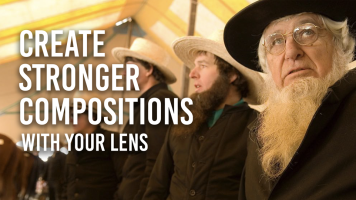
Sony Artisan of Imagery Bob Krist discusses his practical approach to creating strong compositions using the properties of your lens. Krist goes over wide-angle lenses, telephoto lenses, and perspective compression. Additionally, he explains how to utilize your lenses to craft stories with your images.
0:00 - Introduction
3:00 - Most Common Focal Range
4:10 - Wide-Angle Lens
10:11 - Foreground Frames
13:49 - Foreground Interest
18:19 - Getting People to Relate to Their Environment
26:30 - Capturing Wide Open Space When You Can’t Take a

by Jill Waterman · Posted
“How do you make pictures about a person who doesn't exist anymore?” This was the fundamental question facing Jessica Hines while sorting through a box of her brother Gary’s letters, photographs, and other objects from his military service in Vietnam some 35 years after his return—25 years after his life ended in a battle with post-traumatic stress.
Photographs © Jessica Hines

by Jill Waterman · Posted
No matter how many lenses a photographer has, there are often added lenses we still wish for, and even more lenses after which we lust.
There are so many options that choosing your next lens can often involve a dizzying cavalcade of choices—manufacturers, focal lengths, prime or zoom functionality, auto or manual focusing, and price. Below, we offer up some thoughts on what your next lens might be based on your shooting preferences and needs.
To keep things simple, our suggestions are based on the use of a full-frame camera—those seeking a

by Allan Weitz · Posted
If the longest telephoto lens you own never seems to get you in tight enough to your subject, you have three choices. The first is to get up and get physically closer to your subject. If you can’t, for whatever reason, do this, you can either take the picture as is and crop it to your liking post-capture, or you can use a teleconverter.
Photographs © Allan Weitz 2021
Either method will work, albeit at a cost. As for the price of cropping versus the price of

by Jill Waterman · Posted
Katrin Eismann’s fascination with the visual world started early. “When I was very young, my parents had a faceted crystal stopper on a bottle of cognac, and I would run around the house looking through it, taking pictures … in my mind,” she recalls.
She got her first real camera at 12, a little Instamatic that she earned from collecting the S&H Green Stamps her mother gave her from food shopping. “It was called a Lady Carefree Camera, and it had a lace cover and little flash cubes, she says. “But my father photographed with a Rolleiflex,

by Jill Waterman · Posted
Ami Vitale has a remarkable affinity for life-changing events. A native of South Florida, Vitale was a self-described shy, gawky child who, like many young girls, possessed little confidence. The assessment of a grade school teacher, who told her she was not very good at English, stuck with her for years. “I just thought that I had no ability as a writer, or as a creative person,” she says. “I remember thinking I was going to become an engineer because I had almost perfect math scores on my SAT.”
Photographs © Ami Vitale

by Bjorn Petersen · Posted
Macro photography is a specialized genre that has wide appeal. Despite its familiarity to most as just being “close-up shooting,” there are a variety of terms and tools that come up in the macro photography field that don’t seem to affect other broader, more general shooting methods. Let’s take a look at some of the specialized nomenclature and tools of the macro trade.
1. Macro
Starting with the obvious one first, macro photography is loosely defined as close-up photography done at scales of life-size or greater. We’ll get into this more in

by Shawn C. Steiner · Posted
There are many different macro lenses on the market today, with focal lengths from 15mm to 200mm. Most of them hit the same 1:1 magnification ratio that gives shooters the life-sized reproduction they want for superb close-ups. With so many options to choose from, how should you go about making your decision?
To begin, you should think about what and how you plan to photograph. If you are working with jewelry in a studio, you are going to have very different

by Allan Weitz · Posted
Sometimes, the phrases, acronyms and strings of numbers or number-letter combinations used to identify photographic hardware or techniques can be daunting to the uninitiated neophyte photographer.
We've prepared a list of the basic terms. Have we left any out that you think should be added? Please let us know!
0-9 | A | B | C | D | E | F | G | H | I |

by Bjorn Petersen · Posted
If you spend much time perusing the Lenses section of the B&H website, or follow along with the latest announcements of new glass, you're likely to run into a range of phrases that are not inherently known to those with less than a keen, honed understanding of photographic and optical geekery. Scientific-sounding words like aspherical elements, chromatic aberration, coma, low dispersion, and high refractive index to the layman often lead to imprecise thoughts

by Joseph Albanese · Posted
Take only pictures, leave only footprints.” Over time, the origins of that quote have become muddy. Some attribute it to the Baltimore Grotto, a caving club whose members feared their activities would mar the landscapes they so enjoyed. Whatever the origins, it has come to stand for an ethos encouraged by many outdoor organizations that promote responsible recreational uses of our outdoor spaces. One activity that does not alter the scenery is photography. All you are doing is capturing the essence of an area—the blues, greens, reds, and