Search results for: photography lenses understanding bokeh
About 15 filtered results
by John Harris · Posted
It would be foolish to claim that there is only one way to take a portrait, but there are some accepted norms and basic camera settings that you should understand if portraiture is to become your area of photographic interest. Remember though, as you walk down your creative path, that a portrait is more than a headshot, more than a beautiful photo of your subject; it is an opportunity to get to know someone, to have a visual conversation with a person, and to use your photographic skills to pass that understanding of the person on to the

by Mathew Malwitz · Posted
Today, we're going to learn about practical applications of other, less common lenses for street photography such as portrait lenses, ultra wide-angle landscape lenses, and special effect glass like mirror lenses and beyond. These are by no means the only unconventional lenses out there, but these should get your gears turning and inspire you to start experimenting.
Portrait Lenses
Portrait lenses are known for their unparalleled sharpness and eye-catching, subject isolating qualities. This is thanks to their simple design, top-of-the-line

by Todd Vorenkamp · Posted
There are many ingredients in the recipe that make a good photographic portrait—foreground, background, setting, pose, expression, color, lighting, and so on—but one element that can be as important to the result as the portrait sitter is the lens used to capture the portrait and help create the art.
Technically, any lens can be used to take a portrait with your camera, and there are traditional focal lengths for “portrait lenses” like 85mm and 105mm, but I asked my fellow B&H photographers, as well as our B&H Creative partners and
by Todd Vorenkamp · Posted
We all know that cameras make fantastic gifts for Mom on Mother's Day (or on birthdays and holidays as well!), but what if Mom is already a photographer? B&H Photo has you more than covered!
Is Mom a professional photojournalist? Is she the designated shutterbug for the local Scout troop? Maybe she is totally into floral macro photos, or is Mom responsible for the awesome family portraits that are framed on the mantle and hang on the wall?
Regardless of her photographic passions, there are always great gifts in all price ranges that can

by Rachel Leathe · Posted
There's nothing quite like the thrilling spontaneity of grabbing your camera and stepping out the door with no plan other than to point and shoot at whatever captivating scenes you encounter. In the realm of professional photography, where meticulous control over light, talent, and location is the norm, street photography throws all of that out the window, transforming the world into your unscripted canvas. The absence of predetermined variables and the sheer randomness of it all can be an incredibly liberating and enlightening experience for

by Todd Vorenkamp · Posted
Are optical designers designing (and re-designing) lenses today to create better bokeh at the expense of optical characteristics such as diffraction spikes (popularly known as star effects/sunstars/starbursts)? Is the trend toward creating “better” bokeh sending the lens-made diffraction spike the way of pay phones, SLR cameras, manual transmissions, and the internal combustion engine?
The photography world, especially on the Internet, is full of debates. Canon vs. Nikon.

by John Harris · Posted
What can you do with a high-end telephoto lens? Be a boss, is what you can do. I mean, c’mon! Strutting around the sidelines or cuttin’ through the bush with one of these beasts resting on your shoulder―not only do you look tough, but you’re also carrying a lens that you need to get the best photos in sports and wildlife photography. When I say best, let’s not underestimate the greatness of photographers who can create wonderful images with a wide-angle lens or even a telephoto of lesser quality, but to really excel in the disciplines of

by Todd Vorenkamp · Posted
Specular out-of-focus highlights have appeared in photographs since the first photos were taken through lenses. In 1997, Photo Techniques magazine introduced the word “bokeh” to the photography world’s vernacular and the out-of-focus areas of photographs have been scrutinized ever since. Before the term, there was certainly discussion about the aesthetics of the out-of-focus specular highlights of a photograph, but until 1997, there wasn’t a good word in the English language to describe the phenomenon. Credit goes to Mike Johnston, article

by John Harris · Posted
Bokeh is a word that carries a lot of weight in modern photography circles and can, surprisingly, breed heated conversations, but what does it really mean and how does it apply to portrait photography? As an introduction, consider the word—which is derived from the Japanese term for “blur” or “haze”—to mean the aesthetic quality of the out-of-focus parts of an image surrounding an in-focus subject. It is not simply something not in focus, it is a product of shallow depth of field and can be quite beautiful on its own, but also lends to

by Allan Weitz · Posted
The term “bokeh” was made popular in the late 1990s by Mike Johnston, the editor of Photo Techniques magazine, who produced a series of articles on the subject for his publication. Based on the Japanese term “boke-aji,” it was used to describe the quality of the blurry or hazy portions of a photograph. The term quickly weaseled its way into the lexicon of desirable lens attributes. The funny thing is, many photographers still aren’t quite clear as to what bokeh really is.
Resolution, contrast, color quality, and distortion are lens qualities
by Shawn C. Steiner · Posted
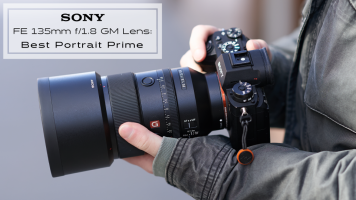
Portrait photographers have long clutched their precious 85mm f/1.4 lenses. They have had good reason. The 85mm is seemingly a Goldilocks length—not too long, not too short—and the f/1.4 provides that creamy bokeh we always want when photographing people. I think the 85mm can step aside to make room for the 135mm—specifically, Sony’s outstanding

by Allan Weitz · Posted
Sometimes, the phrases, acronyms and strings of numbers or number-letter combinations used to identify photographic hardware or techniques can be daunting to the uninitiated neophyte photographer.
We've prepared a list of the basic terms. Have we left any out that you think should be added? Please let us know!
0-9 | A | B | C | D | E | F | G | H | I |

by Todd Vorenkamp · Posted

by John Harris · Posted
So, you just bought your first DSLR camera and you are interested in joining the ranks of image-makers everywhere who find pleasure and creativity in documenting the world as they see it. What are you gonna do now? Do you know how to set your aperture? Or what ISO is? Did you know that DSLR stands for Digital Single Lens Reflex? It doesn’t matter: what you do know is that you’re ready to step up from your point-and-shoot camera and create images over which you have more control.
A digital SLR camera is a great machine that allows you to
by Jason Geller · Posted
The aperture of the lens controls the amount of light that passes through on its way to the camera's sensor or film plane. A camera's aperture is also commonly called its f-stop, though 'f-stop' technically refers to the diameter of the opening created by internal adjustable blades, rather than the entire mechanism. While a camera can function without the use of a shutter, all cameras must have an opening for light to enter and make an exposure. Early photographers