Search results for: photography tips solutions film photography basics
About 29 filtered results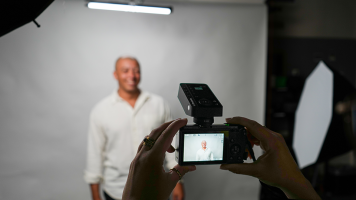
by Luke Rollins · Posted
At first glance, studio photography and the compact camera may seem strange bedfellows. The type of work associated with the studio—still life, product photography, portraiture, macro photography—usually wants cameras with larger sensors and interchangeable lenses, especially in professional applications. Compact, point-and-shoot cameras, for their part, have their natural home in everyday, travel, nightlife, and street applications, where their discretion and size become virtues.
It might seem almost cruel to introduce the compact to the

by Todd Vorenkamp · Posted
Taking a look at any modern mirrorless or DSLR camera, you’ll notice a slew of controls, buttons, and dials. Atop nearly all cameras sits a large dial labeled with many letters and icons. This is our mode dial. It is how we control the level of power we give to our camera or take for ourselves.
One of the wonderful things that modern electronic digital and film cameras give you is many high-tech options for your image making. One of the horrible things that modern electronic digital and film cameras give you is many high-tech options for your

by Mathew Malwitz · Posted
Photography is by definition, the capture of light on a light sensitive surface. That surface could be glass, tin, film, or a digital imaging sensor like those found in most modern cameras. The amount of light that reaches our light-sensitive surface is what we can define as exposure.
A good exposure will look accurate to life or the photographer's creative vision. It will maximize an images quality and

by Mathew Malwitz · Posted
As you begin to research cameras, you’ll likely hear some technical jargon about sensors. While it’s easy to ignore some elements of any devices, there’s no way to work around sensors. But what is a sensor and what does it do? In this guide, we’re diving into the often confusing world of imaging sensors. By time we’re done, you’ll have a better understanding of the most significant component in our digital camera.
About Sensors
What Is an Imaging Sensor?
At the heart of our digital cameras sits an imaging sensor, which serves as the digital

by Mary Latvis · Posted
Welcome to Filmmaking 101, where we offer some tips on how to go about creating your movie masterpiece. Read on to discover suggestions for your pre-production, production, and post-production phases.
Pre-Production
Scriptwriting
You have your idea for an arthouse masterpiece or an action-based blockbuster; now how do you translate that into a script―the backbone of your production? You can use MS Word, Google Docs, or another document program. But using dedicated screenwriting software provides the standard formatting, outline tools,

by Stepan Andranikian · Posted
So you just finished watching a great white shark feeding video and thought, “Wouldn’t it be awesome to be in the water with a camera to film this feast?” I'm right there with you, which is why today we’ll be diving into the world of underwater video creation, from the gear you’d need, to tips for getting the perfect action shot.
Before we get into it, I’d like to leave a little disclaimer: while venturing out into the vast and expansive deep blue is a riveting adventure, please practice caution and, if you’re not experienced in underwater

Posted
Photographer and cinematographer Jeff Berlin discusses how he learned to think like a filmmaker. Berlin breaks down the basics of creating cinematic content, goes over his techniques, and explains everything you need to know about cinematography.
0:00 - Introduction
1:43 - Jeff Berlin's work
7:25 - What Makes Film Cinematic?
13:32 - Breaking Down Director's Notes
15:55 - The Journey from Photo to Film
17:30 - The Best Camera for "The Mission"
23:09 - What is Dual-Base ISO?
26:14 - 180-Degree Shutter Rule: What is Shutter Angle?
28:40 - What

by Todd Vorenkamp · Posted
A lens’s hyperfocal distance—a mathematical combination of lens focal length, aperture or f-stop, and focus distance—is a tool that photographers can use to maximize their depth of field for capturing nearby foregrounds and distant backgrounds in acceptable sharpness.
While you can always dial up your lens’s sharpest aperture (sweet spot), many landscape photographers want as

by Todd Vorenkamp · Posted
Photography is all about capturing light. In fact, the etymology of the word “photograph” is basically “light drawing.” To make a photograph that we can see, we have to control both the amount of light that is exposed to a photosensitive surface, be it film or a digital sensor, and also control the sensitivity of that surface to the light. In this series, we will discuss a bit of the physics and characteristics of light and then how a camera and lens combine to control exposure by using what is commonly known as the “Exposure Triangle.”

by Todd Vorenkamp · Posted
Specular out-of-focus highlights have appeared in photographs since the first photos were taken through lenses. In 1997, Photo Techniques magazine introduced the word “bokeh” to the photography world’s vernacular and the out-of-focus areas of photographs have been scrutinized ever since. Before the term, there was certainly discussion about the aesthetics of the out-of-focus specular highlights of a photograph, but until 1997, there wasn’t a good word in the English language to describe the phenomenon. Credit goes to Mike Johnston, article

by Shawn C. Steiner · Posted
Time lapses feel a lot like photography during capture stages and a lot like video during the editing process. Creating them is a common progression for photographers looking to dip their toes into video and motion because you can start making high-quality time lapses with your current still photo equipment. If you are starting to tackle time-lapse projects, applying some video tricks can help smooth out your final product.
The Absolute Basics
I’m hoping that by the time you make it to this article you already have a basic understanding of how

by Todd Vorenkamp · Posted
A few things happen when you look through a pair of binoculars, a spotting scope, or a telescope. The first thing that happens when you see awesomeness is you think, sometimes out loud, "Wow!" The next thing that happens is that you want to share what you are seeing with others—this

by Jill Waterman · Posted
As described in our companion article that makes up Part 1 of this story, both teachers and students scrambled to face unique challenges and solve unforeseen problems with the sudden shift from face-to-face classes to remote learning in March 2020. Since a new school year is now upon us, we asked a diverse group of educators for updated tips, as well as insights about the online teaching/learning process.
In Remote

by Bjorn Petersen · Posted
Despite photography taking mainly a digital form nowadays, there is still immense value in the tactile side of photography, especially in regard to teaching photography. With education being based more in the home at the moment, it can be the perfect time to introduce someone to photography using the simplest and most basic tools. Pinholes are of the most primitive examples of photography but are also some of the most perfect tools with which to teach the basics of exposure without needing to complicate it using abstract modes, shutter speeds,

by John Harris · Posted
I love spending time with my kids, lots and lots of time. And while we are passing all of this time together, I thought I’d have a try at teaching them a little bit about photography. I don’t go into this endeavor with any illusions; they are probably going to end up teaching me.
My kids were both born well after the year 2000 and, I’d argue, that alone puts their visual acumen far ahead of what mine was at their age. Their understanding of photography as a language and their consideration of what can happen inside a frame is much more