Lighting Triggers & Remotes

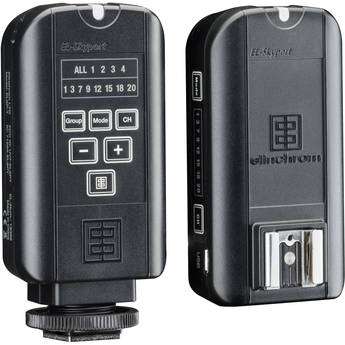
Elinchrom EL-Skyport Universal Plus Set
- 16 Channels, 4 Groups
- 656' Range
- Control Flash Power On/Off
- Runs on AA Batteries
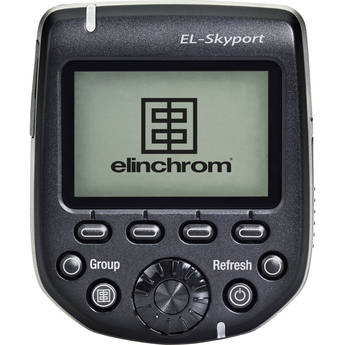
Elinchrom EL-Skyport Transmitter Pro for Canon
- 20 Channels in Normal Mode
- 20 Channels in Speed Mode
- 4 Groups
- Hi-Sync Mode Up to 1/8000 sec
RadioPopper Jr2 Sekonic Combo Studio Set for Nikon
- Transmitter and Receiver Set
- Sekonic Module for Light Meters
- Frequency: 902-928 MHz
- Range: 1500'
Broncolor RFS 2.1 Transceiver
- 40 Channels
- Indoor Range: 164' (50 m)
- Outdoor Range: 656' (200 m)
- Full Stop and 1/10 Stop Power Control
FUSION TLC Raven Flash Trigger for Nikon
- Supports Nikon
- Dual Flash Brand Control and Triggering
- Range: 1500' Manual, 500' TTL/HSS
- Controls TTL, Manual, PowerTrack Modes
Broncolor RFS 2.1 Receiver
- 40 Channels, 99 Groups
- 2.4 GHz Wireless Frequency Band
- Indoor Range: 164'
- Outdoor Range: 656'
Angler RC-16-R Receiver
- For Angler Q-400 Monolight
- Raise or Lower Flash Power Remotely
- 16 Channels, 16 Groups
- 433 MHz Frequency
Vello FreeWave Fusion Basic 433 MHz Wireless Receiver for Sony Multi Interface Shoe
- 16 Channels
- Up to 150' Wireless Range
- 433 MHz Frequency
- Dual Shutter Release Button
Impact ControlSync16 Receiver
- For Impact Astral Extreme AS-X-400
- Compatible w/ Interfit Strobies Flashes
- Raise or Lower Flash Power Remotely
- 16 Channels, 16 Groups
Jinbei TR-V6 Digital Flash Trigger USB Receiver
- For Use With TR-V6 Digital Flash Trigger
- For Select Jinbei Studio Strobe Systems
- Features Male USB Type-A Plug
- 2.4 GHz Wireless Range: 984.25'
TTArtisan J01 Wireless Flash Trigger (Black)
Impact PowerSlave Wireless Flash Receiver
- Compatible with Impact Quikbox
- 2.4 GHz Reduced Interference Frequency
- 16 Channels
- Operating Range up to 150'
Angler RC-16-T Transmitter
- For Angler Q-400 Monolight
- Raise or Lower Flash Power Remotely
- Controls Modeling Lamps and AF Assist
- 150' Range, Controls Audio Alerts
Scott Robert Tiny Transmitter V3
- For Strobie 230 Flash & Tiny Receiver V3
- Frequency: 2.4 GHz
- Range: 300'
- PC Sync Port
Godox CTR-04 Speedlite Trigger Receiver
- Compatible with CT-04 Speedlite Trigger
- Frequency: 433 MHz
- Range: 98'
- 4 Channels
RoboSHOOT RX-15 Receiver
- For Fujifilm X-Series Cameras
- Supports X-Series Speedlights
- Runs on AAA Batteries
- 60 to 120' Range
RoboSHOOT RX-20 Receiver
- For Fujifilm X-Series Cameras
- Off-Camera TTL Operation
- Supports X-Series Speedlights
- Nikon i-TTL Speedlight Compatible
Vello FreeWave Mini-Stand Receiver
- Use with Optional FreeWave Transmitter
- 1x Radio Receiver/Flash Mount
- Batteries Included
- 2.4GHZ Radio Signal
JJC JF-U1 Wireless Remote Control & Flash Trigger Kit with One Receiver
Impact Venture Wireless Controller with Sony Auto-lock Accessory Shoe
- Optional Remote TTL for Sony/Minolta
- 9 Channels, 3 Groups
- Wireless Power Control
- Remote Modeling Light Control
Vello FreeWave Fusion Basic 2.4 GHz Wireless Receiver for Sony Multi Interface Shoe
- 16 Channels
- Up to 328' Wireless Range
- 2.4 GHz Frequency
- Dual Shutter Release Button
Vello FreeWave Fusion Basic 2.4 GHz Wireless Receiver
- 16 Channels
- Up to 328' Wireless Range
- 2.4 GHz Frequency
- Dual Shutter Release Button
LightPix Labs FlashQ T2 Receiver (Black)
- Compatible with FlashQ Trigger
- 33' Operating Range
- Trigger any Shoe-Mount or PC Flash
- Cold Shoe Adapter w/ 1/4"-20 Threads
ALZO Wireless Flash Trigger Kit
- 16-Channel Transmitter
- 16-Channel Receiver
- 80' Wireless Range
- 10" PC Accessory to 2.5mm Sync Cord
Photogenic MRT-16 Wireless Transmitter
Exploring Flash Triggers and Radio Transmitters
Although many cameras, flash lights, and studio lights have wireless flash triggers and radio transmitters and receivers, these units have limited range, and are dependent on line-of-sight communication. In such instances, camera-mounted remote flash triggers offer increased flexibility, greater range, and an ability to trigger more than one set of lights simultaneously.
Understanding Infrared Transmitters
Low-cost infrared systems are effective for medium-range indoor and outdoor work. Transmitters slide into camera hot shoes and transmit signals to infrared receivers attached to flash or studio lights. Many lights have built-in infrared receivers, although separate infrared receivers may be more reliable. Most types support through-the-lens (TTL) light metering, while others have the ability to manually control flash output. If some lights aren't in direct line of sight, you can use optical slaves to trigger these lights.
Features of Wireless Flash Triggers
Wireless triggers operate on the same frequencies as other Wi-Fi systems and have multiple channels to ensure trouble-free communication. Each consists of a transmitter attached to the camera and one or more radio receivers attached to lights. Most use the 2.4 GHz radio frequency and have a TTL metering range of approximately 300 feet. Line of sight isn't important because wireless signals penetrate walls and structures, although signal attenuation does limit effective range. Transmitters using lower frequencies such as 900 MHz, 433 MHz, and 340 MHz have the potential for greater range.
Accessories for Wireless Radio Transmitters
In most instances, the camera's hot shoe controls the transmitters. However, you need to connect slave units to the remote flashes or strobe lights using appropriate radio slave cables. Additionally, if you're remotely triggering both the cameras and flash units, you may need camera cables. Other useful slave accessories include charging kits, hot shoe adapters, and flash zone controllers.
Measuring Incident Light with Light Meters
Managing the correct exposure is important. Although TTL metering works well with flash and strobe lighting, it's less effective as the distance between the cameras and sets increases, especially if you're working outdoors. In such instances, handheld light meters are more effective. While some read incident and reflected light, others also analyze flash intensity. Some models even control the power of strobe and flash lights to obtain the correct exposure.
Choose the best equipment for triggering and controlling your lighting at B&H Photo and Video.