Search results for: photography tips solutions how to use a uv filter for photography
About 19 filtered results
by Mathew Malwitz · Posted
Are you interested in the wide and wonderful world of photography? Well, you’ve certainly come to the right place! Check out this short checklist of a dozen items, designed to get you started in digital or film photography and headed in the right direction.
1. Inspiration
The first thing you need is a bit of inspiration. This may seem obvious, and odds are, if you’re reading this, you’ve already checked that box. Consider what exactly you’re interested in photographing, as this will help you make more informed decisions when purchasing gear

by Todd Vorenkamp · Posted
Close-up or macro photography is an incredible way to capture the tiny world around us on a super-detailed level. While the dedicated macro lens is still one of the best tools for exploring the world on a miniature scale, there are some very inexpensive ways to jump into macro photography with the lens or lenses you already own—no need for a specialized close-up macro lens. In this article, we will take a closer look (no pun intended) at close-up

by Shawn C. Steiner · Posted
Filters are common in landscape photography. They help photographers craft images that wouldn’t be possible otherwise. For example, filters can cut reflections that are impossible to remove, permit longer exposures or wider apertures, and even provide a boost to the contrast of an image. Aerial photographers using drones should understand what filters are available and which they can use to get the best possible photos and video.
Drone Filters Are

by Allan Weitz · Posted
If wanderlust is starting to get the best of you, consider upgrading your camera gear before heading out on your next outdoor adventure.
1. Clean Your Gear
Your first order of business should be to make sure your camera bodies and lenses are clean and in proper working order. To learn more about cleaning and optimizing the performance of your cameras, camera sensors, lenses, and other photo essentials, refer to the tips I offer in

by Todd Vorenkamp · Posted
When the moon passes directly between Earth and the sun, those on Earth are treated to one of nature’s greatest spectacles—a total solar eclipse. It is a phenomenon that almost every observer would like to capture in a photograph.
Due to the rarity of the event, the short duration in which to capture it, and the dynamic nature of the subject, it is one of those photographic opportunities that requires the proper gear, setup, planning, and practice.
Eclipse and solar

by Todd Vorenkamp · Posted
How unfortunate is it that some of the best photographic opportunities present themselves when it's miserably cold outside? It doesn't matter what kind of camera equipment you're using; proper preparation and knowledge of your gear and environment are essential to helping ensure success when you're out in the cold, making photographs.
Before we talk photography, let me say this: be smart. Cold causes hypothermia and frostbite. There is no potential
by Todd Vorenkamp · Posted
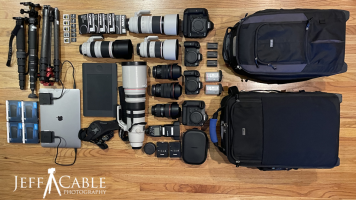
This post is all about the gear I am bringing with me to the Games in Tokyo. As always, my goal is to share with you all what it is like to be at the Games. In the past I focused mainly on the photography, but this time around I plan on giving you the photographic view, but also the behind-the-scenes view from these very different Games.
As I stated before, this is the first Games where I need to bring everything with me, since Canon is not allowed to lend products to photographers (due to COVID protocol) unless it is a dire emergency. And yes

by Allan Weitz · Posted
If you live in the northern hemisphere, it’s summertime, which means it’s time to give thought to taking pictures under bright, sunny skies. Aside from being toasty warm, summertime also packs more daylight into our waking hours than the dead of winter. The farther north you live, the longer the sun lingers in the sky, and if you go far enough north, it never sets at all!
This is all terrific but, like all terrific things, there’s a price to pay. In the case of photography, the price of all these additional hours of sunshine is that the sun

by Cory Rice · Posted
Before computers and digital cameras, lens filters were among the indispensable tools filling every serious photographer’s bag. Fast forward to the present and the first things that come to many minds when they hear the words “photo filter” are overused color profiles and distorted selfies on social media. Today, editing software can simulate the effect of many types of lens filters, reducing the need for photographers to invest in and carry around entire collections of additional glass. However, there are still a number of filters that cannot

by Jill Waterman · Posted
The prospect of an Antarctic journey is sure to conjure an inescapable sense of adventure in even the most seasoned traveler. Award-winning photographer and journalist Caryn B. Davis knows this feeling well, because her travel bug runs deep. A former producer, writer, and cameraperson for television documentaries, Davis shifted cameras and careers, in 2000, to specialize in architectural and travel photography.
“My dream has always been to travel the world and take pictures and write about it,” she says. “And that seems to be happening with

by Jill Waterman · Posted
The bright lights and lively bustle of the city at night is especially captivating to photographers, who have long sought to capture this rich spectrum of color, contrast, and motion in images. Yet there is more to consider in the world after dark than just a snapshot approach and automatic camera settings. With this in mind, consider these seven tips to help you get the most out of urban environments in low light.
Establishing time and place

by Todd Vorenkamp · Posted
What is the best and safest way to clean your camera’s lens? In this article we will discuss the best method to clean your lenses and optics and the gear you will need to keep your images looking their best.
Let's start with some facts:
Dirty optics can and will affect your image quality.
There are correct methods and tools to clean lens and filter optics.
There are incorrect methods and tools to clean

by tom kirkman · Posted
After posing for a few gigabytes of formals in a hall, you can sense the wedding party’s palpable relief when, weather permitting, it’s time to take it outside. If you’re lucky enough to have nicely landscaped grounds, it’s a great opportunity to stop fighting with the tungsten light sources inside and take advantage of that flash-friendly sunlight.
Whether you’re just starting out as a wedding photographer or a friend asked you to shoot his or her wedding or you’re a seasoned professional, you’ll need some kind of help to maximize your

by Todd Vorenkamp · Posted
Aiming your camera at the sun is inherently difficult due to the brightness of the sun—especially with long focal length telephoto lenses. The longer the focal length, the narrower the camera’s field of view and the more difficult it is to target the sun.
One of our Explora readers, Chris Haecker, came up with an easy homemade solution that he was generous enough to share with us. Haecker is a retired engineering manager who did stints at the Los Alamos and Hanford nuclear labs, as well as running management of several large industrial

by Todd Vorenkamp · Posted
The Sun, our source of light and warmth, is a notoriously poor photographic target, due to its extreme brightness and constant emissions of damaging ultraviolet and infrared radiation. However, with the right equipment, the sun can be a challenging and rewarding photographic subject.
The sun, like the moon, is above the horizon and in our skies half of the time. However, unlike the moon, when the sun is above the horizon, it is always visible (unless it is cloudy). The moon progresses through different phases as it orbits our planet, from new