Search results for: photography tips solutions understanding image noise
About 21 filtered results
by Mathew Malwitz · Posted
Exposure can be challenging to master. There are many moving parts, and knowing which settings affect what aspect of our image takes time and practice. The goal might be to take full control and use manual exposure mode, but first, we need to learn the ropes using auto exposure modes.
These modes let us use our camera with a little help. As covered in our introduction to exposure article, photography consists of

by John Harris · Posted
It would be foolish to claim that there is only one way to take a portrait, but there are some accepted norms and basic camera settings that you should understand if portraiture is to become your area of photographic interest. Remember though, as you walk down your creative path, that a portrait is more than a headshot, more than a beautiful photo of your subject; it is an opportunity to get to know someone, to have a visual conversation with a person, and to use your photographic skills to pass that understanding of the person on to the

by Todd Vorenkamp · Posted
Taking a look at any modern mirrorless or DSLR camera, you’ll notice a slew of controls, buttons, and dials. Atop nearly all cameras sits a large dial labeled with many letters and icons. This is our mode dial. It is how we control the level of power we give to our camera or take for ourselves.
One of the wonderful things that modern electronic digital and film cameras give you is many high-tech options for your image making. One of the horrible things that modern electronic digital and film cameras give you is many high-tech options for your

by Todd Vorenkamp · Posted
Every facet of photography is about controlling light, from the amount of light we allow to enter our camera via the aperture of a lens to the duration of our exposure set by the shutter speed. But how does the camera measure the brightness of the scene to set these settings automatically? How do you, the photographer, know how much to adjust your exposure settings to achieve a specific result for the final image? This is achieved with an in-camera light meter.
What Is Metering?
Metering is how a camera evaluates the available light to

by Mathew Malwitz · Posted
If you’ve been around photography for any length of time, you’ve probably heard of ISO. ISO is one of the three settings that determine our exposure in photography. These settings are collectively referred to as the exposure triangle. ISO is unique in this equation, and in this guide, we’re going to explore why.
ISO can be referred to in two ways. It’s most commonly spoken as an abbreviation, but it is also sometimes referred to as a word pronounced as eye-so. General consensus is that you call it whichever you like. After all, it’s not what

by Mathew Malwitz · Posted
Photography is by definition, the capture of light on a light sensitive surface. That surface could be glass, tin, film, or a digital imaging sensor like those found in most modern cameras. The amount of light that reaches our light-sensitive surface is what we can define as exposure.
A good exposure will look accurate to life or the photographer's creative vision. It will maximize an images quality and

by Mathew Malwitz · Posted
Getting great pictures of your newborn or infant is certainly no easy task. Indeed, the window of opportunity for coaxing a perfect expression and a picturesque pose from your little bundle of joy is fleeting, at best. For parents (and others) who aspire to capture such moments, user-friendly gear, highly functional accessories, and photogenic props can make all the difference. With this in mind, here are our best recommendations to help make photo sessions with your unpredictable little darlings a success.
Pick the Right Camera for the Job

by Rachel Leathe · Posted
What makes a camera good for landscape photography? In this article, we’ll dive into factors such as megapixel count, sensor size, usability, weather readiness, and design—helping you develop your own personal metric for finding the ideal camera. We’ll help you wade through all the technical mumbo jumbo to figure out what specs really matter, whether you want to capture stunning mountain ranges or shoot star-strewn night skies.
Megapixels
It doesn't get much more basic than megapixels. They're like the atoms of photography. But just how many

by Todd Vorenkamp · Posted
Photography is all about capturing light. In fact, the etymology of the word “photograph” is basically “light drawing.” To make a photograph that we can see, we have to control both the amount of light that is exposed to a photosensitive surface, be it film or a digital sensor, and also control the sensitivity of that surface to the light. In this series, we will discuss a bit of the physics and characteristics of light and then how a camera and lens combine to control exposure by using what is commonly known as the “Exposure Triangle.”

by Bjorn Petersen · Posted
Have you ever tried to take a photograph of a snowy scene and later realized that your shot was underexposed, maybe with an overwhelming orange or blue hue, or just lacking a certain "something?" Frustratingly, and surprisingly, snow can be one of the trickiest environments in which to make a correct exposure. But, with a few tricks and techniques in mind, hopefully you'll be able to make easy work of these trying conditions.
It All Begins with the Light Meter
The culprit behind these wrong exposures is likely your light meter; but this light
by Jason T · Posted
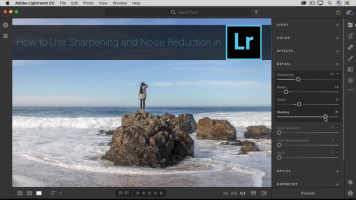
Photographers generally don’t agree on much. Sony, Nikon, or Canon? If you ask three different photographers, you’ll get three different answers. Color or black-and-white? Film or digital? The debates go on and on. But there’s one thing almost everyone can agree on, and that is that a good photo is a sharp photo. If there’s one immutable truth in the photography lexicon, that may be it. And, many of us will go through great lengths to get the sharpest photo, whether it was captured that way to begin with, or not.
The truth is, due to huge

by Jennifer Hahn · Posted
ISO can be a sticky subject when it comes to video. It is used in photography when you have a great amount of control over your aperture, shutter, and exposure, and when you understand the lighting of your environment. But when used in video, if used too often, it can be more of an enemy than a friend to your footage. The most controversial setting is auto ISO, causing you to lose control over your ISO setting—and it can have mixed results. However, there are times when auto ISO can be your friend.
What ISO Is and What It Is Not
Technically,

by Rachel Jones Ross · Posted
There are few natural phenomena that inspire the imagination as much as the Northern Lights. For most landscape photographers, capturing the aurora is a bucket-list shot. Because it’s such a rare opportunity, and can come and go very quickly, it helps to be armed with a few pointers before heading out to shoot.
What Causes the Aurora?
The aurora is directly related to activity on the sun. Solar storms on the sun send charged particles hurtling through space. When those charged particles reach Earth, they interact with atoms and molecules in

by Todd Vorenkamp · Posted
ISO, which stands for International Organization of Standards, is a measure of the sensitivity of film or a digital sensor to light.
This article is part of a multi-part series about photographic Exposure.
1. Introduction: The Exposure Triangle
2. Aperture
3.

by Cory Rice · Posted
Over the past few years, pixel-shift image capture has transformed from a luxury reserved for deep-pocketed specialists to an increasingly common feature on new, resolution-oriented cameras. Today, in addition to Hasselblad’s behemoth Hasselblad H6D-400c, Olympus, Pentax, Sony, and Panasonic offer versions of the technology at much more accessible prices.
While it is advertised under several names (High Resolution Mode,