Search results for: photography tips solutions how to hold a camera
About 91 filtered results
by Todd Vorenkamp · Posted
Taking a look at any modern mirrorless or DSLR camera, you’ll notice a slew of controls, buttons, and dials. Atop nearly all cameras sits a large dial labeled with many letters and icons. This is our mode dial. It is how we control the level of power we give to our camera or take for ourselves.
One of the wonderful things that modern electronic digital and film cameras give you is many high-tech options for your image making. One of the horrible things that modern electronic digital and film cameras give you is many high-tech options for your

by Todd Vorenkamp · Posted
Every facet of photography is about controlling light, from the amount of light we allow to enter our camera via the aperture of a lens to the duration of our exposure set by the shutter speed. But how does the camera measure the brightness of the scene to set these settings automatically? How do you, the photographer, know how much to adjust your exposure settings to achieve a specific result for the final image? This is achieved with an in-camera light meter.
What Is Metering?
Metering is how a camera evaluates the available light to

by Mathew Malwitz · Posted
Despite what you might have seen on the internet, you don’t need all the money and time in the world to photograph wildlife. Sure, an African safari would be nice, but it is by no means the only way to capture stunning images of wild animals. In fact, regardless of where you live, odds are there’s a vast ecosystem that likely goes unnoticed. If you have trees in your neighborhood, you’re off to a great start.
What You Need to Photograph Wildlife
While gear plays a crucial role in our ability to photograph wildlife, it isn’t everything. In this

by Steven Gladstone · Posted
Whether you’re a student or a seasoned veteran, selecting the right camera can make your head spin with questions. Does sensor size matter? What’s the difference between 4:2:0 and 4:2:2? Do I really need a camera that can record 8K? What about raw? We’ll explain the key components that help a camera produce cinematic images, and in doing so, hopefully help you make that all-important decision.
Evaluate Your Needs and Your Budget
Before considering certain cameras, you must know your needs and your budget. And be realistic. If you are a student

by Mathew Malwitz · Posted
As you begin to research cameras, you’ll likely hear some technical jargon about sensors. While it’s easy to ignore some elements of any devices, there’s no way to work around sensors. But what is a sensor and what does it do? In this guide, we’re diving into the often confusing world of imaging sensors. By time we’re done, you’ll have a better understanding of the most significant component in our digital camera.
About Sensors
What Is an Imaging Sensor?
At the heart of our digital cameras sits an imaging sensor, which serves as the digital

by Mathew Malwitz · Posted
One of the most effective ways to improve your portraiture is by controlling the light, and one of the most effective ways to control your light is to move it. Seems like a simple enough concept, but it can be daunting at first, especially if you're using a speedlight or an on-camera flash. Despite its misleading name, an on-camera flash can, very easily, be used off the camera. The "on-camera" part simply refers to its form factor

by Todd Vorenkamp · Posted
Do you want to preserve the memory of that awesome neighborhood fireworks show? Let's discuss the best ways to try to make a memorable photograph commemorating the event.
Before we get started, let me say that there are many ways to accomplish fireworks photography and no technique is usually worse or better than others. The only thing that really matters as you head home after the show is:
You enjoyed the photographic process.
You are left with a photograph or photographs that you personally enjoy.
You enjoyed the fireworks show!

by M. Brett Smith · Posted
Thanks to the continued development of drone technology, aerial imaging has become a much more viable and potentially lucrative option for wedding photographers and videographers. Modern drones can capture images like never before, whether it’s a breathtaking still from a new and previously unattainable perspective or a cinematic tracking shot of the entire ceremony. With the right drone, the

by Allan Weitz · Posted
For the longest time, comparing image quality between point-and-shoot cameras and full-frame cameras, or even APS-C format cameras, was a conversation you could have start to finish during the course of an elevator ride. Point-and-shoot cameras were convenient, but the detail and dynamic range of their smaller sensors never measured up to the detail and dynamic range you get from larger sensors. And then one day Sony introduced a new 1" format CMOS sensor, and BOOM! People started having second thoughts about slinging heavy camera bags over

by Todd Vorenkamp · Posted
Photographing holiday lights and candles is one of the most fun holiday adventures any photographer can have and a great way to explore and enjoy the festive lights in your neighborhood and home.
Here are some tips on how to make the most of your captures of holiday lights while you wait to receive gifts from your B&H wish list!
1. Use Low-Light / Night Photography Techniques
The best time to view holiday lights is when the lights go down (indoors and outside). Therefore, you will benefit from the tried-and-true practices of

by Shawn C. Steiner · Posted
You finally made it to your destination, and as you kick up your feet and sip from an ice-cold drink, the last thing you want to worry about is storage. It is a little insane that you must rely on a semi-mysterious device to hold the photographs from your most recent excursion safe, especially as you plan to do a bit more shooting as you go about your travels. Hopefully, this portable hard drive guide will help you pick out a

by Todd Vorenkamp · Posted
When the moon passes directly between Earth and the sun, those on Earth are treated to one of nature’s greatest spectacles—a total solar eclipse. It is a phenomenon that almost every observer would like to capture in a photograph.
Due to the rarity of the event, the short duration in which to capture it, and the dynamic nature of the subject, it is one of those photographic opportunities that requires the proper gear, setup, planning, and practice.
Eclipse and solar

by Theanos Nikitas · Posted
Let’s face it, fashion shows are intriguing, and even if you’re not a fashionista, shooting a runway show can provide a level of excitement akin to photographing that big annual football game or covering the red carpet at a gala event. Fashion shows have, in a sense, become more democratized, thanks to social media and live streaming. Events that used to be limited to the press and buyers can now be easily viewed by anyone with an Internet connection. Still, there’s something very special about attending—and photographing—a live runway show or
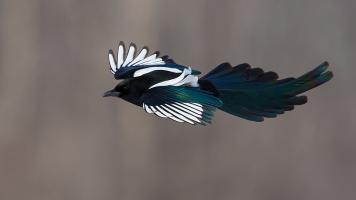
by Brian Zwiebel · Posted
The technological advancements in photography could hardly be imagined by photographers using slow film with manual focus, non-stabilized lenses just 20 years ago. Go back further and cameras did not even have built-in meters. Photographers had to use an incident meter to determine a proper exposure, then dial-in the settings manually. Everyone had to know how to use manual mode!
Above image: Black-billed Magpie; manual mode; 1/2000 second; f/8; ISO 800
The above image was the ultimate exposure challenge. A high-contrast bird was flying in

by Cory Rice · Posted
Chosen for their power and valued for their efficiency, monolights have long served as the light source of choice for portrait photographers. Whether working in studio or on location, these all-in-one strobes can play nearly any role in a lighting setup. Add the wide range of modifiers available to shape their output, and it becomes hard to think of a more valuable lighting tool in the portrait studio. This article introduces the equipment you will need to get up and running