Search results for: video tips solutions choosing shutter speed for video
About 12 filtered results
by Mathew Malwitz · Posted
Lighting is the key to all photography. While elaborate, multi-light setups may appear to be the standard, the creative photographer can produce a seemingly endless range of images using just one light source. This guide is designed to help those beginners out there build the perfect one-light kit for portrait photography.
Why One Light?
I completely understand why multi-light “studio in a box” kits are tempting to beginner and budget-conscience photographers. Why spend hundreds of dollars on one light when you can get three lights complete

by Allan Weitz · Posted
For the longest time, comparing image quality between point-and-shoot cameras and full-frame cameras, or even APS-C format cameras, was a conversation you could have start to finish during the course of an elevator ride. Point-and-shoot cameras were convenient, but the detail and dynamic range of their smaller sensors never measured up to the detail and dynamic range you get from larger sensors. And then one day Sony introduced a new 1" format CMOS sensor, and BOOM! People started having second thoughts about slinging heavy camera bags over

by Cory Rice · Posted
Mastering studio lighting can feel like a Herculean feat when you’re just getting started. Like any aspect of photography, it requires patience, practice, and plenty of mistakes before it comes naturally. In an effort to shorten your learning curve, we’ve rounded up 10 common issues that beginners encounter and how to fix them.
Technical Issues
Lighting setups can be as simple or complicated as your heart desires—or your shot requires. However, before you can begin to think about how to use your lights creatively, you need to understand how

by Mary Latvis · Posted
When I’d perform a camera package checkout as a camera assistant, if there was any chance that we’d be shooting outside during the day, guess which filters I would add to the order? Neutral Density filters (aka NDs)! Even if they were not part of the original order, any production office coordinator (P.O.C.) worth their salt would approve this addition by the A.C. Read on to discover why, next to a polarizer, these are the filters most essential to your video shoot.
Shallow depth of field, daylight
ND Basics
Neutral: meaning there’s no

by Jill Waterman · Posted
Ami Vitale has a remarkable affinity for life-changing events. A native of South Florida, Vitale was a self-described shy, gawky child who, like many young girls, possessed little confidence. The assessment of a grade school teacher, who told her she was not very good at English, stuck with her for years. “I just thought that I had no ability as a writer, or as a creative person,” she says. “I remember thinking I was going to become an engineer because I had almost perfect math scores on my SAT.”
Photographs © Ami Vitale
by Shawn C. Steiner · Posted
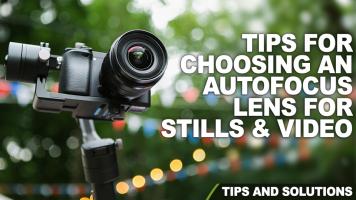
DSLRs and the video revolution resulted in a boom of people who previously shot photos exclusively to add video to their tool set and vice versa. Unfortunately, this meant that the previously split cinema lens and photo lens market didn't have the proper tools to appeal to both at once. What are you supposed to do if you want one lens that can work beautifully for stills and

2,888 Views· Posted
In this B&H video, National Parks at Night workshop leader Gabriel Biderman braves the elements to share valuable tips about setting up your camera for night photography. Starting with a photograph shot in program mode, Biderman explains how choosing manual mode at night allows you to explore the variables of ISO, aperture, and shutter speed for ultimate control.
Next, with his camera set to manual, Biderman demonstrates how adjusting your shutter speed can be used to emphasize moving elements in a long exposure image. Similarly, he

by Allan Weitz · Posted
As a working photographer, the center of the universe is your camera bag and its contents. Your cameras and lenses are the tools of your trade. As you may have noted, both are mentioned in plural because just as you wouldn’t jump out of an airplane without a backup parachute, you shouldn’t attempt to photograph an emotionally spiked, non-repeatable event armed with only one camera. The same applies to lenses, too. The many aspects that comprise shooting weddings—portraits, the ceremony, dimly lit environs, tight, crowded quarters and bright
by Shawn C. Steiner · Posted
We are now at the end of the series about learning video, and either you read it and would like to know what you should do now or you haven’t read it and are wondering why you should even bother learning video as a still photographer. To help you out, I have compiled a list of ideas and projects that can help explain how this video knowledge can perfectly complement your still image skills.
Interviews, Slideshows, Live Photos, and Cinemagraphs
I’ve made quite a few audio slideshows over the years but adding a video element, such as an

by Shawn C. Steiner · Posted
Love it or hate it, high-quality video is now a significant part of the latest DSLRs, mirrorless cameras, and point-and-shoots. This is, in part, because of a greater consumption of video content, thanks to faster Internet, impressively good mobile screens, and what I see as a natural evolution of visual media. So, with this higher demand of stellar video content, many dedicated still photographers are making the leap to video. This series is designed to help guide a photographer through the often confusing world of digital filmmaking.
A few

by Allan Weitz · Posted
Sometimes, the phrases, acronyms and strings of numbers or number-letter combinations used to identify photographic hardware or techniques can be daunting to the uninitiated neophyte photographer.
We've prepared a list of the basic terms. Have we left any out that you think should be added? Please let us know!
0-9 | A | B | C | D | E | F | G | H | I |

by Steven Gladstone · Posted
If you only shoot outside, using the sun and reflectors for light sources, it is highly unlikely that you will encounter flicker problems. However, for the rest of us, flickering light sources can become a daily headache when shooting video. What is important to remember is that most electrically generated light sources flicker in some manner, but what matters is how perceivable that flicker is when we are shooting. I can hear you thinking: “Wait, that’s not true—tungsten lights don’t flicker and neither do LED lights, because they are DC