Reflectors (Newtonians)

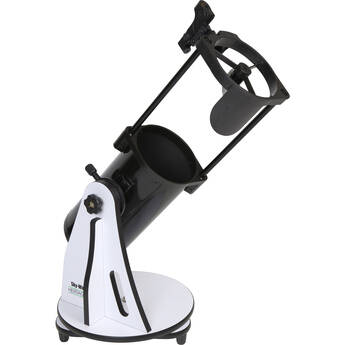
Sky-Watcher Heritage 150 150mm f/5 Tabletop Reflector AZ Telescope
- 150mm Dobsonian Reflector OTA
- 750mm Focal Length, f/5 Focal Ratio
- Collapsible Design: Just 16.75" Closed
- Aluminum-Coated Parabolic Mirrors

Sky-Watcher Virtuoso GTi 150P GoTo Tabletop Dobsonian Telescope
- 5.9" / 150mm Aperture
- f/5 Focal Ratio, 750mm Focal Length
- 25mm & 10mm Super Eyepieces
- SynScan GoTo App for iOS and Android
Celestron StarSense Explorer 150mm f/5 Tabletop Dobsonian Telescope
- Use Smartphone for Tour of Night Sky
- See Moon, Planets, Nebulae, Galaxies
- 150mm / 5.9" Parabolic Mirror
- 25mm & 10mm Eyepieces
Celestron StarSense Explorer LT 114AZ 114mm f/9 AZ Reflector Telescope
- Use Smartphone App for Star Navigation
- Follow Directions to Find Great Objects
- Advanced Precise Alignment Algorithm
- Powerful 114mm Reflector Optical Tube
Celestron StarSense Explorer DX 130AZ 130mm f/5 AZ Reflector Telescope
- Use Smartphone App for Star Navigation
- Follow Directions to Find Great Objects
- Advanced Precise Alignment Algorithm
- Oversized 130mm Reflector Optical Tube
Celestron StarSense Explorer 8" Smartphone App-Enabled Dobsonian Telescope
- Use Smartphone for Tour of Night Sky
- StarSense Sky Recognition Technology
- Dobsonian-Style Base
- 8" Newtonian Reflector Optical Tube
Celestron StarSense Explorer 114mm f/4 Tabletop Dobsonian Telescope
- Use Smartphone for Tour of Night Sky
- See Moon, Planets, Nebulae, Galaxies
- 114mm / 4.5" Parabolic Mirror
- 17mm & 10mm Eyepieces
Sky-Watcher 6" Traditional Dobsonian Telescope Kit
- Bright 152mm Aperture
- 1200mm Focal Length, f/7.9 Focal Ratio
- Highly Reflective Borosilicate Mirror
- 2" R&P Focuser with 1.25" Adapter
Celestron StarSense Explorer 10" Dobsonian Telescope
- 10" / 254mm Aperture, f/4.7 Focal Ratio
- 1200mm Focal Length
- 25mm Eyepiece, Red Dot Finderscope
- Variable-Tension Altitude Bearings
Sky-Watcher Flextube 300P SynScan 12" f/4.9 Dobsonian GoTo AZ Telescope
- Large 12" f/4.9 Aperture
- 1500mm Focal Length
- Highly Reflective Borosilicate Mirror
- Space-Saving Collapsible Tube Design
Sky-Watcher Heritage 130mm f/5 Tabletop Reflector Telescope
- International Year of Astronomy Edition
- 130mm Dobsonian Reflector OTA
- 650mm Focal Length, f/5 Focal Ratio
- Collapsible Design: Just 14.5" Closed
Celestron AstroMaster 114EQ 114mm f/8.8 Reflector Telescope
- 114mm Newtonian Reflector OTA
- 1000mm Focal Length, f/9 Focal Ratio
- CG-2 Manual German Equatorial Mount
- RA and Dec Slow Motion Cables
Sky-Watcher 10" Flextube 250P SynScan GoTo Collapsible Dobsonian Telescope
- 10" Dobsonian-Style Reflector
- 1200mm Focal Length, f/4.7 Focal Ratio
- SynScan Controller Finds 42,000 Objects
- Collapsible Design for Easy Travel
Celestron ExploraScope 114AZ 4.5" f/8.8 Alt-Az Reflector Telescope
- Aperture: 114mm / 4.5"
- Focal Length: 1000mm, f/8.8 Focal Ratio
- Anti-Reflection Fully Coated Optics
- 1.25" Rack-and-Pinion Focuser
Celestron StarSense Explorer LT 114AZ Reflector Telescope and EclipSmart Solar Filter Kit
- Use Smartphone App for Star Navigation
- Powerful 114mm Reflector Optical Tube
- Manual Alt-Azimuth Yoke Mount
- ISO-Certified Safe Solar Filter
Carson RedPlanet 45-100 x 114mm Newtonian Reflector Telescope
- 4.49" / 114mm Newtonian Reflector
- Focal Length: 900mm
- Two 1.25" Eyepieces
- Equatorial Mount
Celestron AstroMaster 130EQ 130mm f/5 Reflector Telescope
- 130mm Newtonian Reflector OTA
- 650mm Focal Length, f/5 Focal Ratio
- Spherical Mirror
- CG-3 Manual German Equatorial Mount
Celestron StarSense Explorer DX 130AZ f/5 AZ Reflector Telescope and EclipSmart Solar Filter Kit
- Use Smartphone App for Star Navigation
- Oversized 130mm Reflector Optical Tube
- Single Fork-Arm Manual Alt-Azimuth Mount
- ISO Compliant Safe Solar Filter
Celestron Astro Fi 130mm f/5 Reflector Telescope
- 130mm Newtonian Reflector OTA
- 650mm Focal Length, f/5 Focal Ratio
- Multi-Coated Parabolic Primary Mirror
- 1.25" Focuser, 10mm and 25mm Eyepieces
Explore Scientific 208mm Dobsonian Reflector Telescope (Black)
- Large 208mm/8" Aperture
- 1219mm Focal Length, f/5.9 Focal Ratio
- 2" Crayford Focuser with 1.25" Adapter
- 25mm 70° Eyepiece
Sky-Watcher Classic 200P Dobsonian Telescope Kit
- Bright 200mm Aperture
- 1200mm Focal Length, f/5.9 Focal Ratio
- 25mm & 10mm Eyepieces
- 2" Crayford Focuser with 1.25" Adapter
Sky-Watcher Classic 250P 10" Traditional Dobsonian Telescope
- Ideal Beginner Scope
- Bright 250mm Aperture
- 1200mm Focal Length
- Parabolic Primary Mirror
Sky-Watcher Flextube 8" f/6 Collapsible GoTo Dobsonian Telescope
- 8" Dobsonian-Style Reflector
- 1200mm Focal Length, f/6 Focal Ratio
- Space-Saving Collapsible Tube Design
- Motorized GoTo AZ Base Mount
Sky-Watcher Flextube 350P SynScan GoTo Collapsible Dobsonian Telescope
- Large 14" f/4.6 Aperture
- 1650mm Focal Length
- Space-Saving Collapsible Tube Design
- Wi-Fi or Wired SynScan Control
Sky-Watcher Flextube 400P SynScan 16" f/4.4 Dobsonian GoTo AZ Telescope
- Large 16" f/4.4 Aperture
- 1800mm Focal Length
- Highly Reflective Borosilicate Mirror
- Space-Saving Collapsible Tube Design
Celestron FirstScope 76mm f/4 Signature Series Moon Alt-Az Reflector Telescope
- Graphic of the Moon on Tube
- 76mm Aperture Newtonian Reflector
- 300mm Focal Length, f/4 Focal Ratio
- 1.25" Rack-and-Pinion Focuser
Celestron FirstScope 76mm f/4 Signature Series Moon Alt-Az Reflector Telescope with Map Kit
- Graphic of the Moon on Tube
- 76mm Aperture Newtonian Reflector
- 300mm Focal Length, f/4 Focal Ratio
- 1.25" Rack-and-Pinion Focuser
Explore Scientific National Geographic 76mm Compact Reflector Telescope
- Tabletop Dobsonian-Style Reflector
- Fully Assembled & Ready to Use
- 6mm and 20mm Eyepieces
- 2x Barlow Lens
Learning About Newtonian Reflectors
Newtonian reflectors are a popular choice in astronomical telescopes that use curved mirrors to reflect light onto smaller angled mirrors and into side-mounted eyepieces. Newton developed this telescope to overcome chromatic aberration problems with the lenses used in early refractor telescopes. You can use this simple, yet effective design with a large aperture that's ideal for looking at faint objects in the sky.
What Are Newtonian Reflectors?
Newton telescopes, such as Bushnell reflector telescopes, have a cylindrical shape that's open at the top. A large diameter parabolic primary mirror is at the bottom, and a small flat mirror sits at 45 degrees near the top of the tube. This second mirror reflects light onto an eyepiece mounted on the side of the telescope. Some reflector telescopes have coma corrector lenses to reduce aberrations at the edge of your viewing field. Because the eyepiece is on the side of the telescope, viewing is more comfortable than with comparable lens-based refractor telescopes.
The focal length of the primary mirror in a Newtonian telescope determines its overall length. Compound telescopes, also known as catadioptric (Cassegrain) telescopes, use a combination of two curved mirrors and an end-mounted eyepiece that reduces the overall length of the telescope, while permitting an increase in focal length.
Dobsonian Telescopes
Dobsonian telescopes, such as Tasco reflector telescopes, are Newtonian reflector telescopes mounted on an altazimuth mount. This type of mount has two degrees of movement, one vertical and the other horizontal, and is similar in concept to a photographic tripod. Although the original Dobsonian telescope concept was that it was lighter than comparative Newtonian telescopes, the main attribute of current Dobsonian telescope kits is a mount that's simple and easy to use.
Celestial Tracking Capabilities
While an altazimuth mount is easy to use, it doesn't follow the path taken by stars, so constant horizontal and vertical adjustments are necessary when tracking celestial bodies. An equatorial mount overcomes this problem by tilting the angle of rotation to match the earth's axis of rotation. This satisfies any astrophotographer's need for a long-time exposure. However, you can overcome the disadvantages of the altazimuth mount by using GoTo Dobsonians. These are Dobsonian telescopes with digital axis control that automatically tracks the movement of the stars.
Telescope Aperture and Magnification
A telescope's aperture is the diameter of its primary mirror. Larger mirrors collect more light and are brighter and sharper. The focal ratio is the focal length of the lens divided by its aperture, and as with camera lenses, smaller values are brighter. Determine magnification by dividing the focal length of the lens by the focal length of the telescope eyepiece. As a rule of thumb, it's best to avoid magnifications greater than 50 times per inch of aperture. If you're an amateur photographer, you may want to use a lower magnification, especially when using solar telescopes to view large objects like the sun or moon.
You can find the best Newtonian reflector telescope for your celestial viewing at B&H Photo and Video.