Search results for: photography tips solutions leading lines composition
About 18 filtered results
by Mathew Malwitz · Posted
Do you plan your images? Really think about that question. Do you have an idea of an image before you head out for a shoot, or do you let the moment inspire you as the pieces fall into place? There's no wrong answer here. Planning or "pre-visualization" is a key piece of the photography puzzle that some put a lot of thought and effort into while others effortlessly come up with ideas on the fly.
No matter how you go about taking a picture, there is some level of planning that goes into a shot. With that said, there's a big difference between

Posted
Now that you understand your camera from Part 1, the next step is understanding what makes a good photograph. Derek goes over some of the core elements of photo theory, composition, perfective, and storytelling.
0:00 - Intro
5:05 - Review of what makes an effective photograph
5:47 - Composition
12:54 - Rule of thirds
18:37 - Golden/Fibonacci spiral
23:47 - Leading lines
32:59 - Negative space
38:29 - Asymmetry
41:52 - Frame within a frame
43:10 - Patterns/Repetition
44:34 - Perspective
55:01 - Storytelling - Photo breakdown
1:15:29 - Photo

by Mathew Malwitz · Posted
If there’s one area of wildlife photography that challenges even some of the most consummate artists, it’s birds in flight. A dynamic flight shot shows action, and a bit of technical prowess. As you can imagine, capturing birds in flight is no easy feat.
To consistently capture these shots, one must be proficient with their gear and have a knowledge of animal behavior. We’d go as far as to say you need a bit of luck too, but what is luck if not preparedness meeting opportunity. In order to make the most of the opportunities that present

by Rachel Leathe · Posted
Did you know that the first photograph ever taken was of a landscape?
“View from the Window at Le Gras” was captured by Nicéphore Niépce, in 1827. It features a very abstract view from Niépce’s window. Then, in 1839, Louis-Jacques-Mandé Daguerre made history with his image of

Posted
In Part 3 of this four-part Introduction to Photography series, Sony Artisan of Imagery Tony Gale breaks down the principles of composition.
0:00 - Introduction
3:12 - Composition: Why and How to Frame a Photo
7:24 - What Are You Trying to Say in Your Photos?
9:06 - What's in the Frame?
15:41 - Composing In-Camera
19:24 - Balance, Symmetry, Reflection, and Repetition
20:21 - Edges of the Frame/The Form of Elements in the Frame
27:35 - Lens Choice
31:24 - Finding the Angle
27:26 - Rule of Thirds, Leading Lines, and Framing
41:15 - Camera Tools
by Caleb Quanbeck · Posted
Getting close enough to wild animals is one of the greatest challenges a wildlife photographer faces. So how do you solve this problem? The way most wildlife photographers do is to buy a telephoto lens with as much reach as their wallet allows. Today, a fairly economical way to enter the realm of the super-telephoto lens has been via the family of very nice 150-600mm lenses from brands like Sigma and

by Todd Vorenkamp · Posted
Raise your hand if you, like me, have arrived at a scenic vista and, standing next to the brown sign with a camera on it, have stood exactly where we were supposed to, raised our cameras to eye height, looked though the viewfinder, and taken the perfect postcard shot. While there is nothing wrong with that approach to landscape photography, there are a few techniques that you can employ to give your photographs a bit more visual appeal and, more importantly, make them stand apart from the image(s) you might have remembered when I asked you to

by Todd Vorenkamp · Posted
For many photographers, the lure of a machine is an addictive draw to the camera and lens. Airplanes, cars, trucks, tractors, wristwatches, cameras, super colliders, and factory machinery are the subject of many photographs around the world. And, for a small group of passionate photographers, the appeal of photographing railroads is forever intoxicating. Locomotives, commuter trains, subways, and railway landscapes come together to create visual poetry that blends nature and man-made landscapes, as well as the human love for complex machinery.

by Staff Writer · Posted
What a beautiful world we live in! Aren’t we lucky to now live in a world where we can photograph and share the wondrous vistas of the nature that surrounds us? Landscape photography is an aspect of many photographers’ portfolios and a huge part of what we generally think about doing whenever we pick up a camera, or travel to beautiful places.
Here are some tips (beginning and advanced) to make you a better landscape photographer.
Beginner Tips
Location, Location, Location—Find the best spot. Landscape photography is all about location, so get
by Shawn C. Steiner · Posted
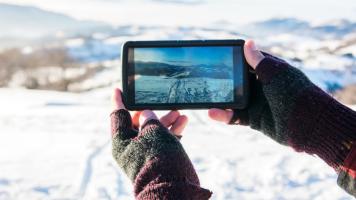
Even among the most serious professional photographers, there is recognition that the smartphone is an extraordinarily capable and convenient tool. They have it easy, though, with years of experience that make taking a photo with their mobile devices intuitive, and then follow it up with stellar editing that really makes the subject pop. If you have always wanted to make your smartphone photos shine like the pros, you have come to the right place, because this

by BH Event Space… · Posted
Sponsored by Canon, this B&H Event Space video features Canon Explorer of Light Jack Reznicki showing you how to leverage the functions of your camera, and discussing the richness of post processing to give your travel photos more impact. Using his own images for visual reference, Reznicki discusses essential technical details, such as camera and lens choices, automatic settings, camera metering and focus modes; practical design principles such as the rule of thirds, leading lines, repeating patterns, perspective and point of view; and

by John Harris · Posted
Conversations about the rules of composition tend to annoy me. Perhaps it’s just my disposition about rules in general, but try talking to your favorite photographer about composition rules and the technical details of their greatest photo and you may be ignored, or worse. Let’s face it—nobody ever liked a photograph because it adhered to a rule. Perhaps the best you can say about any rule of composition is that it’s good to know so you’ll know how to break it, and while I feel that good composition is important and often underlies the emotion

by Cory Rice · Posted
“I hope we will never see the day when photo shops sell little schema grills to clamp onto our viewfinders; and that the Golden Rule will never be found etched on our ground glass.” —Henri Cartier-Bresson
Above: Apneet Kaur, Rockaways; Photographs © Cory Rice
If the Internet provides any indication of how photography is imagined by its practitioners today, one could be forgiven for thinking a robot capable of churning out flawless pictures. Two characters share the brunt of the blame for the above conclusion: the gear fetishist and

by Todd Vorenkamp · Posted
In a sense, every act of creating a photograph is an act of framing. We frame a scene with our camera and capture it with a photograph. The camera and lens determine the field of view and, through aiming, zooming, and positioning, we decide what to include or exclude from that field of view.
There are several places where the word “framing” appears in photography, from the act of framing an image in the viewfinder of a camera, to the act of putting your favorite print in a frame for display.
This article is about framing in composition.

by Sarita Ashkenazy · Posted
When it comes to composition, paying attention to the function of your foreground and background can be crucial to creating a great image. The human eye can distinguish between different elements and determine depth in a scene. Your camera, however, flattens the background and foreground; a photograph is a 2D version of the 3D reality you see. This flattening of space is one reason foreground and background elements can become distracting in a photograph. For exactly this reason, it’s essential to work the foreground and background so they