Search results for: photography tips solutions understanding wide angle lenses
About 21 filtered results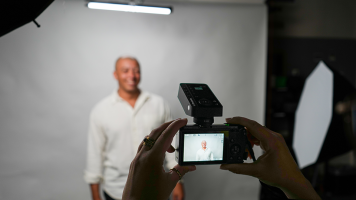
by Luke Rollins · Posted
At first glance, studio photography and the compact camera may seem strange bedfellows. The type of work associated with the studio—still life, product photography, portraiture, macro photography—usually wants cameras with larger sensors and interchangeable lenses, especially in professional applications. Compact, point-and-shoot cameras, for their part, have their natural home in everyday, travel, nightlife, and street applications, where their discretion and size become virtues.
It might seem almost cruel to introduce the compact to the

by John Harris · Posted
It would be foolish to claim that there is only one way to take a portrait, but there are some accepted norms and basic camera settings that you should understand if portraiture is to become your area of photographic interest. Remember though, as you walk down your creative path, that a portrait is more than a headshot, more than a beautiful photo of your subject; it is an opportunity to get to know someone, to have a visual conversation with a person, and to use your photographic skills to pass that understanding of the person on to the

by Mathew Malwitz · Posted
Aperture is one of the most significant settings in photography and also one of the first we should learn. It’s also one of the three settings collectively referred to as the exposure triangle that help to determine an image’s exposure.
Much like the iris of the human eye, a lens’s aperture opens and closes to control the amount of light reaching a light-sensitive imaging area. For this reason, the setting is

by Mathew Malwitz · Posted
What better place to spend a Saturday morning than the zoo. You can enjoy some time outside, all while seeing a variety of both local and exotic animals you'd otherwise never dream of encountering. Zoos also are great place to try your hand at photographing wildlife! In this guide, we're talking about taking our camera to the zoo to capture natural looking images of animals in their element! We'll be covering what you need as well as tips and tricks that'll help you capture stunning, natural looking images of animals.
Above photograph © Mathew

by Mathew Malwitz · Posted
Portraiture: It’s one of the most popular and prevalent forms of photography. Although it may seem simple on paper, it comes with its own unique obstacles. Of course, you’ll want to be familiar with your gear. This is essential to all working photographers, but it allows you to focus your efforts on the genre-specific challenges you’ll face.
When photographing people, you’ll find that some folks are photogenic, while others are not. Your job as a photographer is to break down the barriers set by your clients and to put them in the most

by Tim Ireland · Posted
Macro photography allows photographers to explore the intricate details of subjects at a 1:1 or greater magnification ratio. However, capturing sharp, stable, and well-lit macro shots can be challenging, due to factors like camera shake, focusing difficulties, and lighting issues. This comprehensive guide will delve into the support systems and related tools that can enhance your macro photography experience, addressing specific challenges that may arise.
Stabilization Tools
Studio Stands: Studio stands are large, stable support systems

by John Harris · Posted
What can you do with a high-end telephoto lens? Be a boss, is what you can do. I mean, c’mon! Strutting around the sidelines or cuttin’ through the bush with one of these beasts resting on your shoulder―not only do you look tough, but you’re also carrying a lens that you need to get the best photos in sports and wildlife photography. When I say best, let’s not underestimate the greatness of photographers who can create wonderful images with a wide-angle lens or even a telephoto of lesser quality, but to really excel in the disciplines of

by Todd Vorenkamp · Posted
Specular out-of-focus highlights have appeared in photographs since the first photos were taken through lenses. In 1997, Photo Techniques magazine introduced the word “bokeh” to the photography world’s vernacular and the out-of-focus areas of photographs have been scrutinized ever since. Before the term, there was certainly discussion about the aesthetics of the out-of-focus specular highlights of a photograph, but until 1997, there wasn’t a good word in the English language to describe the phenomenon. Credit goes to Mike Johnston, article

by Todd Vorenkamp · Posted
So, you just bought a shiny, new, and maybe expensive, lens for your camera, and being the savvy consumer, you did your homework. You pored over customer reviews on the B&H Photo website, read online reviews splattered all over the Internet, grabbed a copy of every photo magazine that reviewed the lens, bookmarked dozens of websites, and now have the lens’s MTF curve charts burned into your retinas.
Now, your lens is here and it is time to go out shooting.

by John Harris · Posted
Landscape photography is often considered the realm of the wide-angle lens, but as my editor made clear in the pitch for this article—“It isn’t all about wide-angle.” And she is right: As photographers, we tend to grab the 35mm (or wider) lens when we are inspired by our vistas. Could it be the sheer scale—the vastness of the oceans and mountains—that enchants us? And is it human folly to try to encapsulate what cannot be confined? Do we want to replicate what our natural angle of view perceives, or, perhaps, is it the distortion created by

by John Harris · Posted
Bokeh is a word that carries a lot of weight in modern photography circles and can, surprisingly, breed heated conversations, but what does it really mean and how does it apply to portrait photography? As an introduction, consider the word—which is derived from the Japanese term for “blur” or “haze”—to mean the aesthetic quality of the out-of-focus parts of an image surrounding an in-focus subject. It is not simply something not in focus, it is a product of shallow depth of field and can be quite beautiful on its own, but also lends to

by Cory Rice · Posted
When many people think of special effects, they think of dimly lit rooms, expensive computers, and complicated software. While this may be an accurate picture if you are editing a blockbuster action movie, digital still photographers can do a lot to their images even before transferring files off their camera. The following guide covers some of the more popular in-camera effects on the market to consider when purchasing a new camera or for better understanding the camera you already own.
Film Simulation and Color Profiles
In recent years,

by Elizabeth Groeschen · Posted
Talking to wedding photographers about second shooters was, honestly speaking, much more interesting than I anticipated it to be. Wedding photographer, I am not. I cringe at images of bridesmaids holding up the groom. I roll my eyes at wide-angle shots of gigantic bridal parties taken from such a distance that you can barely make out the smiles of the bride and groom. Why does every wedding photographer insist on including a close-up of the rings? Doesn’t the bride see her ring every single day? Have I mentioned I’m not a wedding photographer?

by Allan Weitz · Posted
Sometimes, the phrases, acronyms and strings of numbers or number-letter combinations used to identify photographic hardware or techniques can be daunting to the uninitiated neophyte photographer.
We've prepared a list of the basic terms. Have we left any out that you think should be added? Please let us know!
0-9 | A | B | C | D | E | F | G | H | I |

by Todd Vorenkamp · Posted
The job of a photographic lens is to capture light and bend it toward the film or digital sensor. The refraction of light exerts a variety of side effects on the image projected onto the film or digital sensor. Your understanding of how this bending can affect the image may factor into how you compose your images.
Anomalies and Lens Distortion
Glass, crystal, liquid, or plastic lenses made for photography are never “perfect”—just like the lenses in our own eyes. Photographic lenses often comprise multiple lens elements. Because of the way