Search results for: photography tips solutions why i love prime lenses
About 11 filtered results
by Mathew Malwitz · Posted
Despite what you might have seen on the internet, you don’t need all the money and time in the world to photograph wildlife. Sure, an African safari would be nice, but it is by no means the only way to capture stunning images of wild animals. In fact, regardless of where you live, odds are there’s a vast ecosystem that likely goes unnoticed. If you have trees in your neighborhood, you’re off to a great start.
What You Need to Photograph Wildlife
While gear plays a crucial role in our ability to photograph wildlife, it isn’t everything. In this

by Todd Vorenkamp · Posted
1. Shoot every day Like any skill, the more you do it, the better you can get. The best camera you have is the one in your hand, so if you aren’t out with your full DSLR kit, don’t be afraid to take great photos with your cell phone camera or a point-and-shoot. Photography is photography, make pictures with a camera. Any camera.
2. Always have your camera near Pull up a chair and I can describe two amazing scenes that have been indelibly embedded in my mind. Unfortunately, for the first, my camera was broken (I was at sea, far from

by Cory Rice · Posted
Every portrait photographer who started with a kit zoom remembers the first time they swapped it out for a prime lens. The “Wow” factor of a bright, sharp prime is hard to match, even with the best zooms. Optical benefits aside, working from a fixed focal length encourages more natural photographer-sitter interactions and better spatial awareness. Read on to learn why so many portrait photographers love their prime lenses.

by Jill Waterman · Posted
Jean Fruth is a diehard baseball fan. “Growing up in New York, with two great hometown teams, how could you not connect with the sport?” she asks. As a teen, she worked in a restaurant owned by serious Mets fans who had season tickets, “And they would take me to games,” she reminisces. “And my grandfather was a Mets fan, listening to games on the radio.”
Such formative influences foreshadow her ultimate path to becoming one of baseball’s preeminent photographers, yet it took many years of exploration for Fruth to put a plan into action. “My

by Todd Vorenkamp · Posted
When it comes to capturing the world’s scenic vistas, there is nothing quite like photographing natural or urban beauty with a premium high-end landscape lens. The traditional “landscape lens” for generations of photographers has been the wide-angle prime lens. While the modern prime lens cannot be beat for its optical quality and performance,
by Allan Weitz · Posted
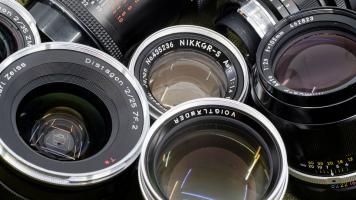
How “good” are vintage lenses when used on modern digital cameras? In a word, vintage lenses are “fine,” though I would have to immediately follow that statement by adding, “It depends,” because there are always exceptions to the rules, though even in these cases, the lens in question often works fine albeit with a technical or optical shortcoming of sorts.
Original photographs © Allan Weitz 2020
When adapting older-generation film camera lenses to DSLRs and mirrorless cameras, most perform well in terms of sharpness, color fidelity, color

by Allan Weitz · Posted
In this week’s edition of FAQ, the topic is a wide-angle lenses. When describing the focal lengths of lenses, there are three main groups: normal, wide-angle, and telephoto.
What is a wide-angle lens?
By way of comparison, normal lenses approximate the perspective and special relationships between elements within the viewing area the way our eyes do. In other words, normal lenses represent the world much like the way we see it.
Wide-angle lenses capture a wider view of the scene before the camera, but because they squeeze more of the scene

by Todd Vorenkamp · Posted
Many of us have been there. We get into photography and then we start getting more serious about the art, craft, hobby, or profession. Eventually, the “kit lenses” don’t seem to cut it any longer. Regardless of your path through the world of photography, it is likely that you set your gaze on the camera bag of a professional photographer and saved your hard-earned nickels to buy a set of “pro” lenses. Those lenses usually include the triad of f/2.8 aperture zooms covering wide (14-24mm), mid-range (24-70mm), and telephoto (70-200mm) needs.

by Todd Vorenkamp · Posted
Before we talk gadgets, know that it is possible to do epic panoramic photographs handheld. Thanks to awesome modern post-processing software, the combination of digital camera and computer can crank out good panoramic results for many photographers. However, if you remember the early days of photo stitching, have gotten some wonky stitching results, or you simply want to make the cleanest, best panoramic photographs possible, there are some unique tools to help you. Here, we will start with the simplest tools and work our way through the more
by Shawn C. Steiner · Posted
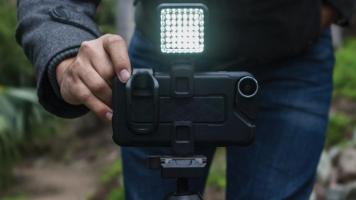
You can’t beat the camera you always have with you. It is now most likely that the images you see on a Facebook feed, Snapchat, or texts were taken with a smartphone. Nowadays, it isn’t uncommon to see news stories relying on smartphone video to make their case. One issue with the smartphone is its lack of ergonomics or features when it comes to making images, so here are some tips and tools to help take your mobile photography to new frontiers.
Vertical or horizontal
One thing that always bothers me is seeing a vertical video on a horizontal

by John Harris · Posted
And I’m not a pioneer of any style: I am just taking the kind of photos I like to take, using the principles of composition embraced by Cartier-Bresson and the street photography style forwarded by Klein and Winogrand, and applying them to a wedding.”
Some may beg to differ—after all, the “Ascough style” is a phrase often thrown around, referring to his black-and-white documentary wedding photography, and he is often mentioned as being one of the best wedding photographers in world. He is one of the