Search results for: bokeh techniques
About 30 filtered results
by Mathew Malwitz · Posted
If there’s one question fledgling photographers often ask, it’s “How did you get such a nice background?” Backgrounds are an essential element of a photograph that are often neglected. In fact, it’s safe to say that a background is as important to a composition as the subject itself. After all, a distracting one will detract from an image.
In this guide, we’re going to cover the many methods used to capture clean, smooth backgrounds in our images. This will encompass the settings and gear involved as well as the in-the-field techniques you can

by Mathew Malwitz · Posted
Today, we're going to learn about practical applications of other, less common lenses for street photography such as portrait lenses, ultra wide-angle landscape lenses, and special effect glass like mirror lenses and beyond. These are by no means the only unconventional lenses out there, but these should get your gears turning and inspire you to start experimenting.
Portrait Lenses
Portrait lenses are known for their unparalleled sharpness and eye-catching, subject isolating qualities. This is thanks to their simple design, top-of-the-line

by Mathew Malwitz · Posted
These days, everyone has a camera right in their pocket. Smartphones have long been the go-to camera for quick photos of our friends, family, pets, and of course, ourselves. With features like portrait mode, users can simulate blurry backgrounds and isolate their subject for more eye-catching images. What else could you ever need? What if I told you that with the

by Bjorn Petersen · Posted
With medium format shedding many of its niche associations and becoming a more viable and mainstream format, now might just be the time to begin incorporating this larger format into your working repertoire. When film was still king among working photographers, medium format cameras, particularly 645, was seen as an ideal balance between image quality, weight, speed, and number of frames per roll. Once the shift to digital occurred, weight and speed became the primary differentiators in which cameras and systems were being considered for the

by Luke Rollins · Posted
Leica’s newest M-mount lens, the silver chrome Summilux-M 50mm f/1.4, resurrects the look and feel of its film-era origins with modern optics to match the brand’s stable of high-resolution mirrorless cameras. The fifth member of the Leica Classic Line, the lens’s wide maximum aperture and naked-eye focal length yield outstanding results in both sharpness and bokeh, making it ideal

by Todd Vorenkamp · Posted
Photographing holiday lights and candles is one of the most fun holiday adventures any photographer can have and a great way to explore and enjoy the festive lights in your neighborhood and home.
Here are some tips on how to make the most of your captures of holiday lights while you wait to receive gifts from your B&H wish list!
1. Use Low-Light / Night Photography Techniques
The best time to view holiday lights is when the lights go down (indoors and outside). Therefore, you will benefit from the tried-and-true practices of
by Todd Vorenkamp · Posted
We all know that cameras make fantastic gifts for Mom on Mother's Day (or on birthdays and holidays as well!), but what if Mom is already a photographer? B&H Photo has you more than covered!
Is Mom a professional photojournalist? Is she the designated shutterbug for the local Scout troop? Maybe she is totally into floral macro photos, or is Mom responsible for the awesome family portraits that are framed on the mantle and hang on the wall?
Regardless of her photographic passions, there are always great gifts in all price ranges that can

by Shawn C. Steiner · Posted
If you want to cover all your bases, you only need three lenses: a wide-angle zoom, a standard zoom, and a telephoto zoom. This set is so practical that every major manufacturer has its own holy trinity of zooms. Sony happens to have two—one G Master set with f/2.8 apertures and a G series with f/4 apertures. You can’t go wrong with either, or mixing and matching for that matter, but let’s take a closer look at these two lens trinities and see which one is best for you.
What Lenses are in the Trinity?
Even though many photographers know
by Shawn C. Steiner · Posted
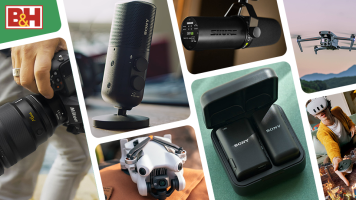
With several new products to discuss, the last few days leading up to B&H's holiday break have been pretty exciting. Nikon dropped an optic with a new name, the ultra-high-performance NIKKOR Z 135mm f/1.8 S Plena Lens. Meanwhile, DJI shared yet another announcement this year: the Mini 4 Pro, which
by Rebecca Melville · Posted
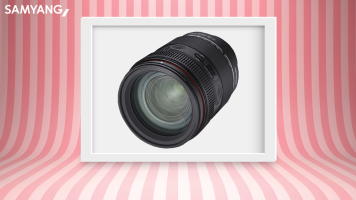
Samyang has announced a new AF 35-150mm f/2-2.8 FE Lens for Sony full-frame mirrorless systems. This all-in-one lens is designed to toggle the five main focal lengths (35/50/85/135/150) quickly, making it a great option for photographers looking to swap lenses less often.

by Todd Vorenkamp · Posted
Photographers and filmmakers of the past used to break out homemade tricks—some innovative and fun—when trying to achieve special effects to make their images stand out from the crowd. Many of us have heard of the technique of smearing petroleum jelly on a lens filter for soft-focus effects. Today, one company—Lensbaby—has brought professional-grade optical tools to the world of creative photography and videography, allowing users to create

by John Harris · Posted
What can you do with a high-end telephoto lens? Be a boss, is what you can do. I mean, c’mon! Strutting around the sidelines or cuttin’ through the bush with one of these beasts resting on your shoulder―not only do you look tough, but you’re also carrying a lens that you need to get the best photos in sports and wildlife photography. When I say best, let’s not underestimate the greatness of photographers who can create wonderful images with a wide-angle lens or even a telephoto of lesser quality, but to really excel in the disciplines of

by M. Brett Smith · Posted
Portrait photography, or portraiture, remains one of the most popular genres of photography today—and for good reason. Portraits are compelling; they are evocative. Portraits tell a story; they elicit an emotion. Shot correctly, a portrait can reveal the true essence of a person, who they are and what they feel. According to Godard, portraiture is tantamount to capturing the soul. About what other medium or form of expression could you say such a thing?
As with most genres of photography, portraiture is not beholden to any one specific

by Todd Vorenkamp · Posted
Specular out-of-focus highlights have appeared in photographs since the first photos were taken through lenses. In 1997, Photo Techniques magazine introduced the word “bokeh” to the photography world’s vernacular and the out-of-focus areas of photographs have been scrutinized ever since. Before the term, there was certainly discussion about the aesthetics of the out-of-focus specular highlights of a photograph, but until 1997, there wasn’t a good word in the English language to describe the phenomenon. Credit goes to Mike Johnston, article

by John Harris · Posted
Bokeh is a word that carries a lot of weight in modern photography circles and can, surprisingly, breed heated conversations, but what does it really mean and how does it apply to portrait photography? As an introduction, consider the word—which is derived from the Japanese term for “blur” or “haze”—to mean the aesthetic quality of the out-of-focus parts of an image surrounding an in-focus subject. It is not simply something not in focus, it is a product of shallow depth of field and can be quite beautiful on its own, but also lends to