Search results for: photography tips solutions understanding metering modes your camera
About 12 filtered results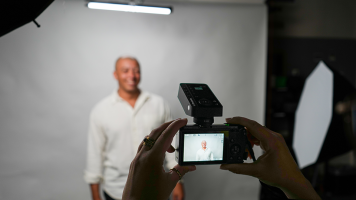
by Luke Rollins · Posted
At first glance, studio photography and the compact camera may seem strange bedfellows. The type of work associated with the studio—still life, product photography, portraiture, macro photography—usually wants cameras with larger sensors and interchangeable lenses, especially in professional applications. Compact, point-and-shoot cameras, for their part, have their natural home in everyday, travel, nightlife, and street applications, where their discretion and size become virtues.
It might seem almost cruel to introduce the compact to the

by Mathew Malwitz · Posted
Exposure can be challenging to master. There are many moving parts, and knowing which settings affect what aspect of our image takes time and practice. The goal might be to take full control and use manual exposure mode, but first, we need to learn the ropes using auto exposure modes.
These modes let us use our camera with a little help. As covered in our introduction to exposure article, photography consists of

by John Harris · Posted
It would be foolish to claim that there is only one way to take a portrait, but there are some accepted norms and basic camera settings that you should understand if portraiture is to become your area of photographic interest. Remember though, as you walk down your creative path, that a portrait is more than a headshot, more than a beautiful photo of your subject; it is an opportunity to get to know someone, to have a visual conversation with a person, and to use your photographic skills to pass that understanding of the person on to the

by Todd Vorenkamp · Posted
Taking a look at any modern mirrorless or DSLR camera, you’ll notice a slew of controls, buttons, and dials. Atop nearly all cameras sits a large dial labeled with many letters and icons. This is our mode dial. It is how we control the level of power we give to our camera or take for ourselves.
One of the wonderful things that modern electronic digital and film cameras give you is many high-tech options for your image making. One of the horrible things that modern electronic digital and film cameras give you is many high-tech options for your

by Todd Vorenkamp · Posted
Every facet of photography is about controlling light, from the amount of light we allow to enter our camera via the aperture of a lens to the duration of our exposure set by the shutter speed. But how does the camera measure the brightness of the scene to set these settings automatically? How do you, the photographer, know how much to adjust your exposure settings to achieve a specific result for the final image? This is achieved with an in-camera light meter.
What Is Metering?
Metering is how a camera evaluates the available light to

by Mathew Malwitz · Posted
If there’s one area of wildlife photography that challenges even some of the most consummate artists, it’s birds in flight. A dynamic flight shot shows action, and a bit of technical prowess. As you can imagine, capturing birds in flight is no easy feat.
To consistently capture these shots, one must be proficient with their gear and have a knowledge of animal behavior. We’d go as far as to say you need a bit of luck too, but what is luck if not preparedness meeting opportunity. In order to make the most of the opportunities that present

by Mathew Malwitz · Posted
Photographing pets is something you likely do daily, whether it be with a phone or a dedicated camera. I don’t know about you, but I have thousands of pics of my pup filling up my photos app. After all, pets are part of the family, and we want to capture them in the best possible light. In this quick guide, we’re going to look at 10 ways you can improve your pet photography with practical creative tips and techniques as well as gear.
1. Get to your pet’s level. If there’s one trick to make your images more engaging, it’s to physically shoot

by Todd Vorenkamp · Posted
A lens’s hyperfocal distance—a mathematical combination of lens focal length, aperture or f-stop, and focus distance—is a tool that photographers can use to maximize their depth of field for capturing nearby foregrounds and distant backgrounds in acceptable sharpness.
While you can always dial up your lens’s sharpest aperture (sweet spot), many landscape photographers want as

by Jason T · Posted
Metering for optimal exposure is crucial in all forms of photography, but especially so for landscape and cityscape applications. When you’re shooting outside during the day, you’ve got to deal with the sun and the sky, which of course can be extremely bright, and you may also have very dark shadows relative to the sky within the same frame. This can create an extremely wide dynamic range that can be tricky to expose for, especially when shooting backlit scenes facing the sun.
Photographs © Jason Tables 2021
Before I go on, I’d just like to

by Bjorn Petersen · Posted
Using flash is one of the technical aspects of photography that’s difficult to understand, mainly because it’s something you cannot really see with your own eyes. Working with natural light, you can usually envision how your shot will turn out, and then when you become a bit more skilled, you can even envision how the effects of aperture and shutter speed will affect your images. Working with flash further complicates our visual relationship to what we’re photographing, since it’s an additional level of abstraction we’re adding to the mix

by Allan Weitz · Posted
Sometimes, the phrases, acronyms and strings of numbers or number-letter combinations used to identify photographic hardware or techniques can be daunting to the uninitiated neophyte photographer.
We've prepared a list of the basic terms. Have we left any out that you think should be added? Please let us know!
0-9 | A | B | C | D | E | F | G | H | I |

by Todd Vorenkamp · Posted
Welcome to the wonderful world of photography and the Learn Photography Portal on B&H Explora. If you just picked up your first camera, or are thinking about getting a camera, or, even if you are a seasoned pro, we hope that you enjoy your educational journey through this course while you enjoy the experience of a photographic journey through life.
photography noun pho·tog·ra·phy \fə-ˈtä-grə-fē\: the art, process, or job of taking pictures with a