Search results for: photography tips techniques depth in composition
About 17 filtered results
by Todd Vorenkamp · Posted
Do you want to preserve the memory of that awesome neighborhood fireworks show? Let's discuss the best ways to try to make a memorable photograph commemorating the event.
Before we get started, let me say that there are many ways to accomplish fireworks photography and no technique is usually worse or better than others. The only thing that really matters as you head home after the show is:
You enjoyed the photographic process.
You are left with a photograph or photographs that you personally enjoy.
You enjoyed the fireworks show!

by Mathew Malwitz · Posted
Despite what you might have seen on the internet, you don’t need all the money and time in the world to photograph wildlife. Sure, an African safari would be nice, but it is by no means the only way to capture stunning images of wild animals. In fact, regardless of where you live, odds are there’s a vast ecosystem that likely goes unnoticed. If you have trees in your neighborhood, you’re off to a great start.
What You Need to Photograph Wildlife
While gear plays a crucial role in our ability to photograph wildlife, it isn’t everything. In this

by Mathew Malwitz · Posted
These days, everyone has a camera right in their pocket. Smartphones have long been the go-to camera for quick photos of our friends, family, pets, and of course, ourselves. With features like portrait mode, users can simulate blurry backgrounds and isolate their subject for more eye-catching images. What else could you ever need? What if I told you that with the

by Todd Vorenkamp · Posted
If you are selling a used car online, one great way to make your car stand out from the rest and attract more attention is to up your photo game. You don’t need to be a professional photographer to capture compelling images of the car or truck you are ready to sell—a few simple tips can help your photos grab the attention of possible buyers.
Photographs © Todd Vorenkamp
You’ve seen the standard used-car photo—the boring shot taken outside a dealership, in a driveway or crowded parking lot, midday, from standing eye level, of a sterile-looking

by Allan Weitz · Posted
I’ll never forget the first time I looked through the viewfinder of a camera fitted with a 20mm ultra-wide-angle lens. Everything looked amazing and I blew several rolls of film shooting everything I saw along the way. Prior to using this “exotic” lens, I had never shot with anything wider than the 50mm normal that came with my first 35mm camera.
The sobering part came when I developed the film and started eyeballing the results of my first outing. In a word, they were underwhelming, but I kept at it until I figured out how to use ultra-wide

by Todd Vorenkamp · Posted
Tunnel View in Yosemite National Park is one of the most scenic overlooks on the entire planet. Because of its sheer beauty, it is difficult to walk away from it with a bad photograph. (I have always said that it is easier to make a beautiful photograph of something that is already beautiful than it is to make a beautiful photograph of something that is not beautiful.) And, almost every camera-armed tourist who drives out the end of the Wawona Tunnel on State Highway 41 comes away with a very similar photograph—similar to the one that Ansel

by Todd Vorenkamp · Posted
Raise your hand if you, like me, have arrived at a scenic vista and, standing next to the brown sign with a camera on it, have stood exactly where we were supposed to, raised our cameras to eye height, looked though the viewfinder, and taken the perfect postcard shot. While there is nothing wrong with that approach to landscape photography, there are a few techniques that you can employ to give your photographs a bit more visual appeal and, more importantly, make them stand apart from the image(s) you might have remembered when I asked you to

by John Harris · Posted
Bokeh is a word that carries a lot of weight in modern photography circles and can, surprisingly, breed heated conversations, but what does it really mean and how does it apply to portrait photography? As an introduction, consider the word—which is derived from the Japanese term for “blur” or “haze”—to mean the aesthetic quality of the out-of-focus parts of an image surrounding an in-focus subject. It is not simply something not in focus, it is a product of shallow depth of field and can be quite beautiful on its own, but also lends to

by Jill Waterman · Posted
With 215 episodes in the bank and dedicated listeners in countries that span the globe, over the past five years the B&H Photography Podcast has garnered more than three million downloads from B&H Photo’s Explora blog. Our intrepid team of John Harris, Allan Weitz, and Jason Tables spins up weekly episodes featuring a wide variety of insightful and entertaining guests. From gear and technique to history, science, and art, the

by Jill Waterman · Posted
The bright lights and lively bustle of the city at night is especially captivating to photographers, who have long sought to capture this rich spectrum of color, contrast, and motion in images. Yet there is more to consider in the world after dark than just a snapshot approach and automatic camera settings. With this in mind, consider these seven tips to help you get the most out of urban environments in low light.
Establishing time and place

by Jess Santos · Posted
Imagine yourself in the middle of nowhere, before sunrise, there’s a quiet around you, the stars start to fade and the light of the sun begins to bring everything to life in blue hues. There’s a magical moment that happens in between day and night. Light gets softer and the glow of the sun still affects the landscape in a beautiful way. Most people underestimate this time of day, forever chasing golden hour and the colors against the clouds as the sun sets, but this has easily become my favorite time of day to photograph. I’ve become obsessed

by Jill Waterman · Posted
Here’s a hot tip: In addition to photo, video, and audio gear, as well as other tech products, B&H carries thousands of books and tutorials covering the fields of photography, video, audio and computers, plus inspirational titles to get your creative juices flowing. For all you bibliophiles out there, we’ve compiled this shortlist of must-have publications spanning photography basics, photo careers, marketing and promotion, business practices, teaching photography, lighting technique, specialty photo subjects, creative inspiration,
by Shawn C. Steiner · Posted
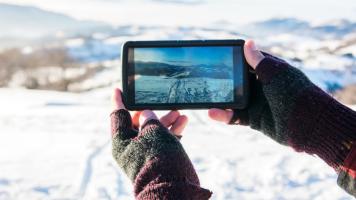
Even among the most serious professional photographers, there is recognition that the smartphone is an extraordinarily capable and convenient tool. They have it easy, though, with years of experience that make taking a photo with their mobile devices intuitive, and then follow it up with stellar editing that really makes the subject pop. If you have always wanted to make your smartphone photos shine like the pros, you have come to the right place, because this

by Bjorn Petersen · Posted
If you spend much time perusing the Lenses section of the B&H website, or follow along with the latest announcements of new glass, you're likely to run into a range of phrases that are not inherently known to those with less than a keen, honed understanding of photographic and optical geekery. Scientific-sounding words like aspherical elements, chromatic aberration, coma, low dispersion, and high refractive index to the layman often lead to imprecise thoughts

by John Harris · Posted
So, you just bought your first DSLR camera and you are interested in joining the ranks of image-makers everywhere who find pleasure and creativity in documenting the world as they see it. What are you gonna do now? Do you know how to set your aperture? Or what ISO is? Did you know that DSLR stands for Digital Single Lens Reflex? It doesn’t matter: what you do know is that you’re ready to step up from your point-and-shoot camera and create images over which you have more control.
A digital SLR camera is a great machine that allows you to