Search results for: photography tips understanding camera sensitivity
About 20 filtered results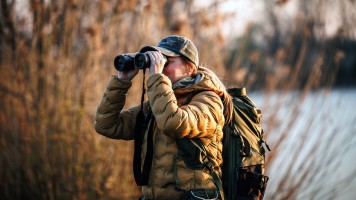
by Mathew Malwitz · Posted
Birds, they’re all around us. If you haven’t paid much attention to them, you’re not alone. But, once you do, you’ll have a hard time stopping. If you haven’t yet dabbled in bird watching, known colloquially as birding, we have just one question. Why not? Birding is the perfect way of partially disconnecting from the digital world we find ourselves in and connecting with nature through observation, and one of the most relaxing pastimes imaginable.
If you’re fascinated by our feathery friends but don’t know where to start, we’ve got you covered

by John Harris · Posted
It would be foolish to claim that there is only one way to take a portrait, but there are some accepted norms and basic camera settings that you should understand if portraiture is to become your area of photographic interest. Remember though, as you walk down your creative path, that a portrait is more than a headshot, more than a beautiful photo of your subject; it is an opportunity to get to know someone, to have a visual conversation with a person, and to use your photographic skills to pass that understanding of the person on to the

by Mathew Malwitz · Posted
Imagine, if you will, a photo shoot. Your subject is a striped, orange cat bouncing off of the walls. You have your camera raised to your brow, finger on the trigger, waiting for the perfect pose. He turns his gaze toward you, but his head is constantly moving. No matter, you quickly fire a few frames, figuring that you finally nailed the shot. You check your shots, only to see a series of blurry portraits.
If this sounds like a situation you’ve been in before, we know the feeling. That’s why, today, we’re taking a look at settings for pet

by Mathew Malwitz · Posted
As photographers, we are faced with a wide array of lighting conditions, ranging from bright sunlight to dimly lit interiors. Using ambient light as your main source is often preferable; however, in a situation such as an event or portrait where time is of the essence, you will need to know how to properly expose all these varying scenes using both natural and artificial light sources.
Being resourceful with your lighting setups lends greater efficiency, and having a lighting system you can easily move from one situation to the next quickly is

by Mathew Malwitz · Posted
If you’ve been around photography for any length of time, you’ve probably heard of ISO. ISO is one of the three settings that determine our exposure in photography. These settings are collectively referred to as the exposure triangle. ISO is unique in this equation, and in this guide, we’re going to explore why.
ISO can be referred to in two ways. It’s most commonly spoken as an abbreviation, but it is also sometimes referred to as a word pronounced as eye-so. General consensus is that you call it whichever you like. After all, it’s not what

by Mathew Malwitz · Posted
Aperture is one of the most significant settings in photography and also one of the first we should learn. It’s also one of the three settings collectively referred to as the exposure triangle that help to determine an image’s exposure.
Much like the iris of the human eye, a lens’s aperture opens and closes to control the amount of light reaching a light-sensitive imaging area. For this reason, the setting is

by Mathew Malwitz · Posted
Photography is by definition, the capture of light on a light sensitive surface. That surface could be glass, tin, film, or a digital imaging sensor like those found in most modern cameras. The amount of light that reaches our light-sensitive surface is what we can define as exposure.
A good exposure will look accurate to life or the photographer's creative vision. It will maximize an images quality and

by Mathew Malwitz · Posted
Anyone who has dabbled in pet photography knows that it can be a rewarding yet challenging experience. While pets are considered to be part of the family, they’re still animals who walk to the beat of their own drum and do things at their own pace. Even the best listeners can be easily distracted or have trouble sitting still for more than two seconds. If you’re considering trying your hand at photographing our fuzzy friends, we’ve put together this helpful guide for you. In this guide, we’re going to cover the essentials for those with a

by Mathew Malwitz · Posted
For macro photographers, having the right gear is essential. Magnification and lighting are key, but you don’t necessarily need the biggest, priciest macro lenses out there to get close-up shots. If you’re a macro photographer yourself or buying a gift for one, we have some excellent recommendations for every budget.
Gifts Under $50
1. Close-up macro filters (like this Macro Lens

Posted
“The eye should learn to listen before it looks.” – Robert Frank
Australian photographer Wayne Quilliam used to consider his camera as a tool, but today it’s become his “companion.” This is just one of the inspiring takeaways from our chat for the new monthly podcast series, “Picturing World Cultures.”
Above photograph © Wayne Quilliam
Listen in as Quilliam describes his journey—from growing up on the island state of Tasmania knowing little about his indigenous roots, to gaining a fascination with culture while traveling with the Royal

by Todd Vorenkamp · Posted
Photography is all about capturing light. In fact, the etymology of the word “photograph” is basically “light drawing.” To make a photograph that we can see, we have to control both the amount of light that is exposed to a photosensitive surface, be it film or a digital sensor, and also control the sensitivity of that surface to the light. In this series, we will discuss a bit of the physics and characteristics of light and then how a camera and lens combine to control exposure by using what is commonly known as the “Exposure Triangle.”

by John Harris · Posted
After our introductory lesson to creating narrative and telling personal stories with smartphone cameras, I asked my kids to advance their skill set by telling visual stories using a more advanced, more versatile camera. In this case, they’re using my Sony Alpha a6500 mirrorless

by Rachel Jones Ross · Posted
There are few natural phenomena that inspire the imagination as much as the Northern Lights. For most landscape photographers, capturing the aurora is a bucket-list shot. Because it’s such a rare opportunity, and can come and go very quickly, it helps to be armed with a few pointers before heading out to shoot.
What Causes the Aurora?
The aurora is directly related to activity on the sun. Solar storms on the sun send charged particles hurtling through space. When those charged particles reach Earth, they interact with atoms and molecules in

by Shawn C. Steiner · Posted
Welcome to sunny Vermont? The sun was shining during our adventure north, though it did little to warm us up, with temperatures consistently hovering in the single digits. Hopefully, you are reading this along with a cup of hot tea or coffee so you can stay warm yourself as you enjoy some tips on action sports photography and working in snowy conditions.
Our destination was Killington Mountain, in Rutland,


by Todd Vorenkamp · Posted
ISO, which stands for International Organization of Standards, is a measure of the sensitivity of film or a digital sensor to light.
This article is part of a multi-part series about photographic Exposure.
1. Introduction: The Exposure Triangle
2. Aperture
3.