Search results for: photography tips solutions how to use natural light in photography
About 88 filtered results
by John Harris · Posted
It would be foolish to claim that there is only one way to take a portrait, but there are some accepted norms and basic camera settings that you should understand if portraiture is to become your area of photographic interest. Remember though, as you walk down your creative path, that a portrait is more than a headshot, more than a beautiful photo of your subject; it is an opportunity to get to know someone, to have a visual conversation with a person, and to use your photographic skills to pass that understanding of the person on to the

by Mathew Malwitz · Posted
First, a disclaimer: Like composition, lighting portraits is a subjective exercise. A setup that works for one situation may not work for the next, and lighting that one photographer adores might repulse another. Cultivating a personal lighting style involves an awareness of conventional approaches and willingness to go beyond what everyone else is doing. Study portraits

by Mathew Malwitz · Posted
As photographers, we are faced with a wide array of lighting conditions, ranging from bright sunlight to dimly lit interiors. Using ambient light as your main source is often preferable; however, in a situation such as an event or portrait where time is of the essence, you will need to know how to properly expose all these varying scenes using both natural and artificial light sources.
Being resourceful with your lighting setups lends greater efficiency, and having a lighting system you can easily move from one situation to the next quickly is

by Mathew Malwitz · Posted
Despite what you might have seen on the internet, you don’t need all the money and time in the world to photograph wildlife. Sure, an African safari would be nice, but it is by no means the only way to capture stunning images of wild animals. In fact, regardless of where you live, odds are there’s a vast ecosystem that likely goes unnoticed. If you have trees in your neighborhood, you’re off to a great start.
What You Need to Photograph Wildlife
While gear plays a crucial role in our ability to photograph wildlife, it isn’t everything. In this

by Steven Gladstone · Posted
Whether you’re a student or a seasoned veteran, selecting the right camera can make your head spin with questions. Does sensor size matter? What’s the difference between 4:2:0 and 4:2:2? Do I really need a camera that can record 8K? What about raw? We’ll explain the key components that help a camera produce cinematic images, and in doing so, hopefully help you make that all-important decision.
Evaluate Your Needs and Your Budget
Before considering certain cameras, you must know your needs and your budget. And be realistic. If you are a student

by Cory Rice · Posted
The trick with any home studio is in creating a space that can be used to create images that do not betray the fact that you shot them in your living room, in your pajamas, using your pet dog as an assistant. Luckily, creating a home studio can be done fairly easily without breaking the bank. This article will help get you up and running.
Planning Your Studio
Before making any purchases, it is important to sit down first and answer some basic questions about what you want your studio to accomplish. First, what type of photographs do you plan

by Mathew Malwitz · Posted
One of the most effective ways to improve your portraiture is by controlling the light, and one of the most effective ways to control your light is to move it. Seems like a simple enough concept, but it can be daunting at first, especially if you're using a speedlight or an on-camera flash. Despite its misleading name, an on-camera flash can, very easily, be used off the camera. The "on-camera" part simply refers to its form factor

by Luke Rollins · Posted
Color negative and color transparency films have distinctive ways of rendering specific colors, and may have a warm (reddish), cool (bluish), or neutral color balance, as well as different color contrast characteristics. Thanks to the resurgence in film’s popularity in recent years, analog shooters have an astonishing number of choices, from major manufacturers like Kodak, Ilford, and Fujifilm, to smaller suppliers like Foma, Rollei, Agfa, Lomography, Kentmere, and Arista.
Obviously, we can’t include comprehensive info and hands-on impressions

by Rachel Leathe · Posted
I can’t count the number of times a stranger has approached me while I’ve been setting up my drone to ask if they can watch the launch. I imagine this is how the world’s first television owners must have felt as the neighborhood kids crowded around the only television on their block to witness such groundbreaking technology.

by Allan Weitz · Posted
For the longest time, comparing image quality between point-and-shoot cameras and full-frame cameras, or even APS-C format cameras, was a conversation you could have start to finish during the course of an elevator ride. Point-and-shoot cameras were convenient, but the detail and dynamic range of their smaller sensors never measured up to the detail and dynamic range you get from larger sensors. And then one day Sony introduced a new 1" format CMOS sensor, and BOOM! People started having second thoughts about slinging heavy camera bags over

by John Harris · Posted
Many photographers, attempting to postpone a major decision or save money, will buy a lens they believe will give them the results they desire, only to find that the lens does not perform as expected. When budget is a factor (and when isn’t it?), it’s important to select a telephoto lens that best serves your specific purposes. When it comes to sports and wildlife photography, the purposes are often similar—magnify distant subjects, separate the subject from background—but it’s worth understanding a few basic distinguishing features and how

by Shawn C. Steiner · Posted
Filters are common in landscape photography. They help photographers craft images that wouldn’t be possible otherwise. For example, filters can cut reflections that are impossible to remove, permit longer exposures or wider apertures, and even provide a boost to the contrast of an image. Aerial photographers using drones should understand what filters are available and which they can use to get the best possible photos and video.
Drone Filters Are

by Todd Vorenkamp · Posted
One of the first words I learned how to say was, “Moon.” All of my life, I have been fascinated by our natural satellite and I have been photographing it for as long as I have had a camera. My photos have gotten better over the years, but I still search for the perfect photo of the moon. Here are some tips and thoughts for your own lunar photography.
Above photograph: A waxing gibbous moon the day before the full moon. FUJIFILM X-T1; Leica APO-Televid 77 spotting scope @ 1000mm (1500mm, 35mm equivalent); f/13, 1/500-second, ISO 200

by Todd Vorenkamp · Posted
Photography is all about capturing light. In fact, the etymology of the word “photograph” is basically “light drawing.” To make a photograph that we can see, we have to control both the amount of light that is exposed to a photosensitive surface, be it film or a digital sensor, and also control the sensitivity of that surface to the light. In this series, we will discuss a bit of the physics and characteristics of light and then how a camera and lens combine to control exposure by using what is commonly known as the “Exposure Triangle.”
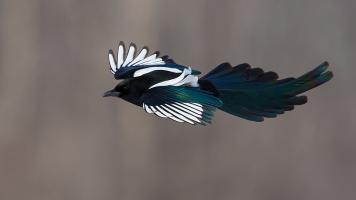
by Brian Zwiebel · Posted
The technological advancements in photography could hardly be imagined by photographers using slow film with manual focus, non-stabilized lenses just 20 years ago. Go back further and cameras did not even have built-in meters. Photographers had to use an incident meter to determine a proper exposure, then dial-in the settings manually. Everyone had to know how to use manual mode!
Above image: Black-billed Magpie; manual mode; 1/2000 second; f/8; ISO 800
The above image was the ultimate exposure challenge. A high-contrast bird was flying in